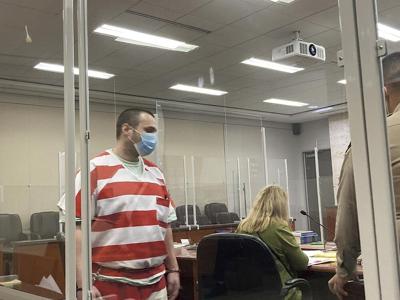
WITH SHERIFF’S DEPUTIES IN PURSUIT, JOSEPH SAMPOGNARO JR., ZIPPED ALONG THE TIGHT CURVES OF CARMEL VALLEY ROAD, the roar of his father’s black convertible Corvette competing with the pulsating wails of the approaching sirens. In one way, the younger Sampognaro had accomplished what he set out for that morning of Sept. 12, 2020. The question of taking one of his father’s cars was what triggered the argument in the converted barn where they lived, near the top of Laureles Grade. Weaving in and out of oncoming traffic, he pressed the gas and took the roadster past 100 mph.
He reached just south of Carmel on Highway 1 before law enforcement bumped his tail and ran the Corvette off the road. Covered in an amount of blood that belied the minor injuries from the crash, Sampognaro was taken into custody and charged with murder. Patricide by handgun.
He was charged with first-degree murder, evading a peace officer, evading a peace officer against traffic, and possession of a firearm by a felon. A preliminary hearing began in February 2021. Sampognaro’s taxpayer-funded legal team was led by Thomas O’Keefe, a 15-year veteran of the Public Defender’s Office with more than 50 murder cases under his belt. O’Keefe was accompanied by the younger and greener Rachel Miller, tasked with her first murder case since she was admitted to the bar in 2017. On the other side, Deputy District Attorney Matthew Johnson’s team would try to prove that in the moments before the high-speed chase began, Sampognaro shot his father in the head and ended his life.
With evidence submitted and the witness list approved, the court selected 12 jurors and their alternates on April 12, 2021. The prosecution and defense each argued their case before the jurors and Monterey County Superior Court Judge Mark Hood for eight days, wrapping up their closing arguments on April 23. On April 26, the jury read out its unanimous verdict: guilty on all counts.
As is customary after securing a conviction in a high-profile criminal case, District Attorney Jeannine Pacioni announced the conviction later that afternoon in a press release and said the 32-year-old Sampognaro faced up to 53 years in prison.
Yet today, more than one year later, Sampognaro has still not been sentenced. Over the last year, the perfect picture of due process has come crashing into reality – realities that have less to do with the workings of the criminal justice system and more to do with the messiness of human inner life – things like our appetites, carnal desires, blood-sugar levels, passions, sleep schedules.
Sampognaro filed a motion for a retrial on Dec. 28, 2021. On Thursday, May 19, Judge Hood is scheduled to issue a decision on Sampognaro’s request, a decision which will offer a metric of public tolerance for the justice system’s inherent inner messiness. The question before the court is: despite a sexual affair between two courtroom officials, despite allegations of sleeping jurors, and despite a defense team claiming the discovery of new evidence, did the due process do enough to justify sending Sampognaro to prison for most of the rest of his life?
ON MAY 7, 2021, LESS THAN TWO WEEKS AFTER SHE MADE THE CLOSING ARGUMENT ON BEHALF OF SAMPOGNARO, Miller approached her colleague, fellow deputy public defender Michelle Wouden, with a confession. During the Sampognaro trial, Miller said, she had met courtroom bailiff, Deputy Donovan Gonzales, at hotel rooms to have sex.
As laid out in court papers and affirmed in questioning in the same courtroom where Sampognaro’s trial happened nearly a year earlier, Miller and Gonzales described their relationship in a hearing on Feb. 24. (The Weekly’s reporting of this story relies mostly on court documents and testimony; most people contacted for this story were unwilling to do interviews.)
They had developed a friendly relationship as courtroom colleagues that evolved into Miller and her husband twice inviting Gonzales, his wife and kids over for dinner. Then, less than a week ahead of jury selection, Miller and Gonzales met for lunch, where the idea of a sexual affair was first proposed. They disagreed in their public testimony over who introduced the idea, but they would go on to meet three times at a nearby hotel – April 12, after jury selection; again midway through the trial; and once more, the day after the jury read its verdict.
Miller and Gonzales said that despite the timing, they never discussed the case during their time together, and the affair was confined to times outside of business hours only.
“For Miller, [the affair] was a business decision in that she would use the relationship with Gonzales as a stress reliever during the trial,” Sampognaro’s new attorney, Tara Higgins, wrote in her motion for a new trial. “Miller says that the case has taken something out of her in that the defendant’s relationship with his father was similarly challenging as was Miller’s relationship with her mother.”
According to the motion, Wouden said that Miller felt guilty about the affair’s implications in her marriage, “but did not understand that potential conflicts created by the sexual relationship with the bailiff.”
But Wouden was concerned, and reported the relationship to the higher-ups. O’Keefe declared a conflict of interest with the court in the Sampognaro case on May 17, 2021. The following day, the Public Defender’s Office was taken off the case and Higgins took over as a representative from the Alternate Public Defender’s Office, an arm of the public defender that comes in for relief when there is a conflict of interest.
O’Keefe, who was seated next to Miller through much of the trial, testified that at one point he noticed Miller acting too casual and friendly given the seriousness of the case, and that he told her to tone it down. (She told the court he criticized her for discussing her Friday night “steak night” custom in the courtroom.) O’Keefe said he did not suspect the affair.
However, two other people who attended each day of the trial had a different view. Cathy and Maryanne Sampognaro – sisters to the elder, deceased Sampognaro and aunts to the younger, convicted Sampognaro – testified that from their perspective in the gallery, they noticed Miller openly flirting with Gonzales. They said it created a double-sided distraction: Miller from her work defending their nephew, and Gonzales from keeping an eye on the jurors to ensure they were engaged and not dozing off. Maryanne said she even raised the issue with O’Keefe.
“[Miller] wasn’t focused on Sampognaro. She was focused on whatever was happening [with Gonzales],” Maryanne said. “I walked out and I waited for Mr. O’Keefe to come out. I said ‘What was that? What was that? If she wants to date she needs to do that outside of the courtroom… This is my nephew’s life. I just lost my brother. This is a tragedy and she’s making a joke of it.”
The prosecution opposes a new trial on all grounds, including on the basis of the affair. In court papers, Johnson argues a romantic relationship between the public defender and a bailiff did not stir opposing interests in the case, such as between a prosecutor and a defense attorney.
Citing case law from 2013, Johnson argues that not only did the relationship have to impact Miller’s performance, but it has to be “reasonably probable” that, absent the relationship, the trial would have gone differently. Yet, Higgins argues that Miller’s failure to disclose the relationship violated Sampognaro’s Sixth Amendment right to effective and conflict-free assistance of counsel.
WITNESSES DURING THE TRIAL PLACED THE MURDER WEAPON, A HANDGUN, IN SAMPOGNARO’S HANDS and said they watched him shoot his father that September morning near the top of Laureles Grade. Yet, despite Sampognaro being convicted on a charge of possession of a firearm by a felon, the murder weapon was never recovered.
Part of Miller’s closing argument during the initial trial focused on the mystery of the murder weapon and proposed that another person allegedly present during the murder, Joseph “Tank” Bustamante, could have been the one to pull the trigger. In court papers, Higgins outlines Miller’s argument, and alleges that Bustamante was present at the shooting and had time to leave before the cops arrived.
“Did Tank take the gun with him?” Miller asked the jury. “Tank also wasn’t here to testify, which is very strange, because Tank was there. He was there for the shooting. He was a percipient witness.”
Months after the trial, on Nov. 3, 2021, police arrested Bustamante on a separate incident and charged him with possession of guns and drugs. He was sentenced to three years in prison on April 20, 2022. Higgins says Bustamante’s gun was a “silver cowboy revolver,” similar to the description one witness gave of the murder weapon in the Sampognaro case.
“It was impossible that this evidence incriminating Bustamante could have been produced at the trial,” Higgins wrote in her argument for the retrial. She emphasized that precedent says new evidence does not have to rise to prove a strong probability that another person committed the crime, but only needs to raise a reasonable doubt over the defendant’s guilt: “This evidence can raise a reasonable doubt and lead the jury to a different result.”
The DA’s team believes the new evidence claims are “vague declarations” and are not enough for a new trial.
“Multiple witnesses placed the gun in the defendant’s hand prior to and at the time of the shooting,” the prosecution wrote in its closing argument against a new trial. “The defendant was observed shooting the victim. The defendant fled the scene of the murder covered in the victim’s blood. Even if defense contentions are found to be true, the fact that another person living in the barn where the murder took place also possessed firearms is irrelevant.”
THE RIGHT TO A TRIAL BY JURY IS GUARANTEED IN THE U.S. CONSTITUTION AND THE CALIFORNIA STATE CONSTITUTION. Jury service is treated by many as an inconvenience, but in the process of jury selection, judges emphasize the privilege and power of jury service.
Jury trials are always up against the sleep schedules and personal habits of civilian jurors. Part of the challenge in an attorney’s performance on the courtroom stage is to not only convince jurors of guilt or innocence, but to hold their attention and keep them engaged. Still, sleeping or dozing jurors are not rare and the court has a process of letting jurors take breaks and stand up and stretch to help keep them attentive.
All 12 active jurors were unanimous in reaching Sampognaro’s guilty verdict. However, one alternate juror – who observed the entire trial, in case she was needed to deliberate – was so unconvinced that when she received a call from the courtroom clerk notifying her of the guilty verdict, she said she “experienced a little bit of a breakdown.”
After collecting herself, Annamaria Martinez Velazquez reported to the clerk that she did not feel justice was served. She also claimed to have seen two male jurors sleeping during the proceedings. Although she was in the back of the courtroom and unable to nail down the exact moment they were asleep, she said it was during an important part of Sampognaro’s argument – possibly blood spatter analysis, or when experts presented on DNA or gunshot residue.
After learning of this issue, the Sampognaro sisters also claimed to have seen jurors sleeping, and argued that the bailiff was too distracted by his affair with Miller to keep the jurors attentive.
Miller said she noticed a sleepy juror early in the trial but immediately brought it to the court’s attention. The judge followed it up by privately emphasizing how important it was for the juror to remain focused. Gonzales also caught two people sleeping during the trial. He recommended one woman watch the trial while standing up in the corner; the other male juror was talked to privately by Judge Hood.
However, Martinez Velazquez and the Sampognaro sisters testified that they watched jurors with closed eyes appear to drift off during other moments that went unnoticed by the judge, attorneys and bailiff.
During the hearing on the motion for a new trial, Hood seemed unpersuaded that Martinez Velazquez could clearly see whether a juror was sleeping, administering something of a vision test. He asked her to look at people seated in the back row – behind a plexiglass wall, 42 feet away. “Can you tell me what colors their eyes are?” he asked. She responded: “No.”
In court papers, Johnson is similarly skeptical of the claims of sleeping jurors.
“No mention of juror inattention was raised by anyone until an alternate juror had ‘a little bit of a breakdown’ when she heard that a verdict had been reached that she disagreed with,” he wrote.
Johnson also cited 1994 case law that contends closed eyes does not always indicate being asleep or inattentive. “Although implicitly recognizing that juror inattentiveness may constitute misconduct, courts have exhibited an understandable reluctance to overturn jury verdicts on the ground of inattentiveness during a trial,” the citation reads. “In fact not a single case has been brought to our attention which granted a new trial on that ground.”
Higgins disagrees, and maintains that jurors sleeping through critical points in the trial, if proven, is misconduct that violates due process.
BOTH DISTRICT ATTORNEY JEANNINE PACIONI AND PUBLIC DEFENDER SUSAN CHAPMAN DECLINED TO COMMENT FOR THIS STORY, BECAUSE THE CASE IS PENDING.
aThe bailiff and defense attorney involved declined to comment. The Sheriff’s Office says Gonzales didn’t violate any policies and employees may date whomever they wish on their own time; however, he has since transferred to working the county jail. Miller now works at the Placer County Public Defender’s Office.
It’s now up to Hood to decide whether or not to grant a new trial to Sampognaro. If he doesn’t, the case will proceed to sentencing, and Sampognaro still has a right to appeal. If he does order a new trial, both the prosecution and the defense will prepare their cases again, and start from scratch – something the criminal justice system generally tries to avoid, as witness memories fade and evidence can deteriorate over time.
Whether the affair, the gun or the sleeping jurors are enough to trigger a retrial is a separate question. Higgins says that question is bigger than whether Sampognaro is guilty.
“The system’s only going to work – especially when you are putting away people for 25 years to life – when we have faith that the process was fair, transparent and free of any kind of taint of misconduct,” she says.


(0) comments
Welcome to the discussion.
Log In
Keep it Clean. Please avoid obscene, vulgar, lewd, racist or sexually-oriented language.
PLEASE TURN OFF YOUR CAPS LOCK.
Don't Threaten. Threats of harming another person will not be tolerated.
Be Truthful. Don't knowingly lie about anyone or anything.
Be Nice. No racism, sexism or any sort of -ism that is degrading to another person.
Be Proactive. Use the 'Report' link on each comment to let us know of abusive posts.
Share with Us. We'd love to hear eyewitness accounts, the history behind an article.