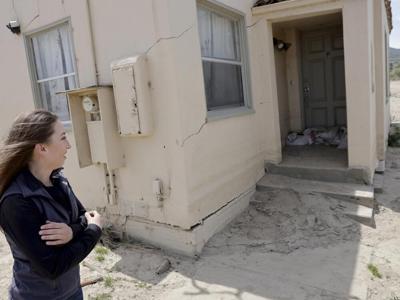

In the wake of flood damage from this past winter’s storms, the Monterey County Farm Bureau is looking to leverage a new pathway to mitigate that damage going forward. That involves a streamlining of state and federal permits to conduct river channel maintenance projects on the Salinas River. The details of the plan aren’t clear, nor is it clear how that will play out with regulatory agencies, though it could certainly be the case that local elected officials lean on those agencies to carve out exceptions to the laws they are charged with enforcing.
That seemed to be the intent behind a press conference the Farm Bureau held on April 19 on an approximately 200-acre Rincon Farms property in Chualar, just east of the river. On that property is a home that has been red-tagged because floodwaters undermined its foundation; Rincon’s Jynel Gularte, whose family has long owned the farmland, says they’ve been renting the house out to families for 80 years. “This affordable home will never house a family again,” Gularte said.
Norm Groot, the Farm Bureau’s executive director, said that the estimated damage to farmland from this past winter amounted to about $1 billion on 20,000 acres.
And it’s not just the Farm Bureau asking for changes, it’s a coalition of growers in the Salinas Valley as well, and what was made clear was they’re a “unified voice.” Whatever the cost or river channel maintenance and clearance, they say they’ll pay for it, and they’ll do it themselves.
There are a host of permitting agencies involved, including the state Department of Fish & Wildlife, NOAA Fisheries, the State Water Resources Control Board, among others.
Representatives from those agencies, and those from local elected officials at the state and federal level, may or may not show up to a meeting May 5 at the Farm Bureau’s office in Salinas to discuss the concerns Groot, Gularte and others raised on April 19. Their argument is that, in 1995, the river reached around 90,000 cubic-feet-per-second of flow versus around 30,000 this past March, but the amount of damage is the same.
“Something must have changed drastically for it to have caused the same amount of damage,” Gularte said at the press conference.
What changed, Gularte and others said, is that farmers have been constrained by the onerous and expensive permitting process that has both reduced the quality of habitat for fish and the carrying capacity of the river due to overgrowth of vegetation. Currently, permits expire every five years; the Farm Bureau is looking for a more seamless, “continuation of work plans” without interruption. Groot said, in terms of the state of the riverbed, “We want to get back to where we were in 1995.”
County Supervisor Chris Lopez, whose District 3 includes much of the Salinas Valley, added, “The farmer is losing, fish are losing, the general public is losing – nobody is winning.”
The general public will not be able to attend the private May 5 meeting. Whether or not representatives from public agencies choose to attend remains to be seen.


(0) comments
Welcome to the discussion.
Log In
Keep it Clean. Please avoid obscene, vulgar, lewd, racist or sexually-oriented language.
PLEASE TURN OFF YOUR CAPS LOCK.
Don't Threaten. Threats of harming another person will not be tolerated.
Be Truthful. Don't knowingly lie about anyone or anything.
Be Nice. No racism, sexism or any sort of -ism that is degrading to another person.
Be Proactive. Use the 'Report' link on each comment to let us know of abusive posts.
Share with Us. We'd love to hear eyewitness accounts, the history behind an article.