
Just a week into the new year, fires tore through Los Angeles, burning nearly 38,000 acres through Pacific Palisades, Altadena and surrounding areas. Tens of thousands of public service personnel were deployed alongside aircraft, Highway Patrol officers, nearly 1,500 fire engines and National Guard members. Winds reaching 70 mph delayed aircraft deployment, while water pressure issues impacted firefighting efforts.
Today, these fires – which claimed the lives of at least 27 people along with thousands of homes according to news reports – remain only partially contained. The fires were fueled by the perfect convergence of dry brush and heavy vegetation, a lack of rain and, of course, a connection to a changing climate that makes such “unprecedented” events occur with increasing regularity.
Concerned Monterey County residents, fearing similar disasters, have inundated local officials with questions about regional preparedness.
“There needs to be those interruptions so that fire can’t go from the forest into the community,” says Richard Bates, president of the Fire Safe Council for Monterey County. “Once it’s in the community, the structures themselves become the fuel, and as you saw in Altadena and Pacific Palisades the fires jump from one to the next.”
Compounding these concerns, roughly nine days after the fires in LA began, the Vistra battery storage plant in Moss Landing caught fire, prompting evacuations and emergency response plans, involving the deployment of officials from the Department of Emergency Management, firefighters and more (see story, p. 8).
While the nature of these fires differs, the events highlight overlapping challenges of resilience and preparedness in Monterey County.
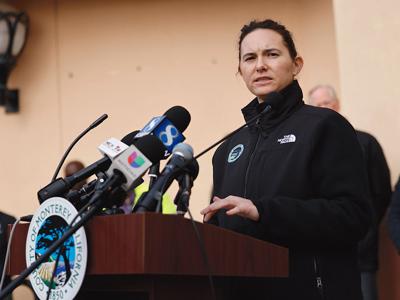
“One of the things our office has taken on is a keen eye toward community resilience, which isn’t just focused on the individual, but also at the community level,” says Kelsey Scanlon, director of the County Department of Emergency Management.
Amid disaster fatigue, Scanlon adds that their goal is to be specific and particular about the asks to the community about what to invest in with emergency management. First and foremost, she says, “register for emergency alerts, stay informed, build a kit, make a plan.
“On top of that, [we have to ask ourselves] how we can shift our cultural paradigm for how we respond to emergencies. It really is a team effort.”
According to the U.S. Department of Agriculture, homes in Monterey County are, on average, at greater risk from wildfires than 99 percent of counties in the U.S.
Monterey County’s risk stems from available fuel, or vegetation, proximity of homes to wildlands, and decades of prioritizing wildfire suppression over prevention.
Bates adds that risk to Monterey County is likely due to a significant portion of its land in wilderness areas like Big Sur. “There are [fire] challenges everywhere,” he says. “The only thing that changes a bit is the scale.”
Not all areas in the county are equally at risk, and ability to respond depends on the groundwork done beforehand, particularly in facilitating wildfire fuel reduction – before disaster strikes.
Numerous grants have been awarded recently locally to address this issue: $1.6 million to the Monterey County Regional Fire District for a community hazardous fuels reduction project; $3.26 million to the Resource Conservation District of Monterey County from Cal Fire; and over $500,000 secured by the Monterey Peninsula Regional Park District. These initiatives, which aim to do things like thin vegetation in vulnerable areas and create escape corridors, will take time to implement.
On an individual level, residents should prepare “Go Bags” with essential items (see below), download fire-watch apps like Watch Duty, look to the Department of Forestry and Fire Protection’s recommendations on creating defensible space, and ensure medications, pet crates and other essentials are ready.
“It’s imperative that our residents sign up for our alert warning system via AlertMontereyCounty.org. That’s a tool that our Department of Emergency Management has, and our Sheriff’s Office has, to notify people timely and accurately,” says Nicholas Pasculli, communications director for the County of Monterey.
Sign up for alerts, stay up to date with the latest information, and find available resources after an emergency at ReadyMontereyCounty.org.



(1) comment
Change roofs to non-flammable material when time to re-roof. Keep a clear zone around the house with dry-scape such as cactus and agave. Have long, large diameter garden hoses. Remove tall trees that burn easily such as pine. If you live in a pine forest, as some of us do, have a chain-saw handy to quickly cut down the pine if a fire is approaching.
Welcome to the discussion.
Log In
Keep it Clean. Please avoid obscene, vulgar, lewd, racist or sexually-oriented language.
PLEASE TURN OFF YOUR CAPS LOCK.
Don't Threaten. Threats of harming another person will not be tolerated.
Be Truthful. Don't knowingly lie about anyone or anything.
Be Nice. No racism, sexism or any sort of -ism that is degrading to another person.
Be Proactive. Use the 'Report' link on each comment to let us know of abusive posts.
Share with Us. We'd love to hear eyewitness accounts, the history behind an article.