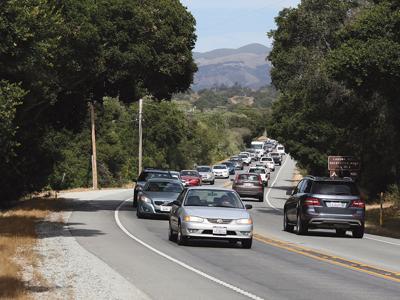

For years, the conventional wisdom has been that to reduce rush hour travel times on Highway 68 between Salinas and Monterey, there were two options: replace the nine signaled intersections with roundabouts, or add more turn lanes to them. Both are estimated to cost upward of $200 million.
Over the past two years, thanks in large part to the advocacy of Corral de Tierra resident Dwight Stump, both of those costly options have been potentially shelved indefinitely in favor of something far cheaper: Installing adaptive AI technology to all nine traffic signals, which will theoretically reduce travel times as the signals optimize the flow of traffic as they take in real-time information.
Last year, the board of the Transportation Agency for Monterey County – which plans traffic projects on the corridor, while Caltrans builds them – approved spending up to $500,000 to install adaptive AI to the signals to see how well they worked. Since then, TAMC’s board approved up to $700,000 to reimburse Caltrans for any other costs it may incur to make the project operational.
It’s the first project of its kind locally, and one that Caltrans considers a pilot, which will bring added costs like training.
The details of the reimbursement agreement are now awaiting final approval from Caltrans headquarters in Sacramento. Once approved, Caltrans can start ordering the equipment. It’s expected to come in within six weeks; installation is expected to go quickly, a matter of weeks.
Adaptive AI signals will be installed at all nine intersections by 2026. And if they are effective, the millions that would have been spent on roundabouts can instead go toward other projects.
--
Clarification 7/18/25 3:30pm: This article has been changed slightly from its original form to add "potentially" before "shelved indefinitely." Pending the installation and fine-tuning of the nine adaptive AI signals, traffic flow data will be collected and analyzed within the framework of a cost-benefit analysis comparing the AI signals to projected flow with roundabouts, a process that could take two years. Caltrans will decide whether to move forward with roundabouts pending the results of that analysis.


(1) comment
I've been supportive of the adaptive AI methodology for Hwy 68 for the past year, and I look forward to its implementation. I trust it will be successful. I look at is as a stop-gap to allow more funding for the end-goal of a Hwy 68 that is 4-lanes from Salinas to Monterey.
Welcome to the discussion.
Log In
Keep it Clean. Please avoid obscene, vulgar, lewd, racist or sexually-oriented language.
PLEASE TURN OFF YOUR CAPS LOCK.
Don't Threaten. Threats of harming another person will not be tolerated.
Be Truthful. Don't knowingly lie about anyone or anything.
Be Nice. No racism, sexism or any sort of -ism that is degrading to another person.
Be Proactive. Use the 'Report' link on each comment to let us know of abusive posts.
Share with Us. We'd love to hear eyewitness accounts, the history behind an article.