
When California American Water changed its rate structure in March, residential water bills for most customers shot up by more than 60 percent. Those were the lucky ones.
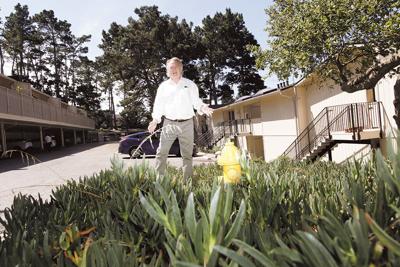
Residents in the Tanglewood community, a 75-unit community of condominiums in the Skyline Forest in Monterey, were not among the lucky. According to Curt Chaffee, board president of Tanglewood’s homeowners association, the community’s water bills jumped from $2,300 per month to $7,300. The increase had nothing to do with water use—it came almost entirely from an 8-inch water meter connected to two fire hydrants, which is used only if the hydrants are used.
“Cal Am is essentially extorting money for meters dedicated to fire prevention,” Chaffee says, adding that the condos have no grass, yards or even patios. “It’s like we’re all being punished just for being responsible, and it has nothing to do with water.”
Cal Am changed its rate structure after the company said it under-collected revenue since 2010, and that the new rates are meant to account for the overhead costs of running the water system.
“In Monterey, 95 percent of all costs are fixed,” Cal Am spokeswoman Catherine Stedman says. She adds that the previous rate structure came about after the cease-and-desist order the state issued Cal Am in 2009, ordering the company to curtail its illegal pumping of the Carmel River.
Cal Am changed its structure at that time to decrease the amount of fixed costs in its water bills from 30 percent to 15 percent, meaning that the remaining 85 percent was intended to come from billing customers based on water usage, incentivizing conservation.
“It gave us more ability to influence consumption, and it worked,” she says. “The problem is we were not collecting our revenue, and the cost to run the system was not covered in water bills.”
Cal Am has since flipped back to a structure where 30 percent of its revenue comes from fixed costs, like meter charges. But the burden of covering those fixed costs depends greatly on the size of a customer’s water meter.
For residents with a five-eighths-inch water meter—about 75 percent of Cal ratepayers, according to Stedman—monthly meter charges went from $10 to $17. For 8-inch meters, the charge went from $805 to $3,525, an increase of more than 300 percent.
Stedman says Tanglewood is among only five residential customers that have an 8-inch meter, and that the outsized increase was to put more of the fixed costs on the larger customers in order to keep rates more affordable for most of Cal Am’s customers.
Chaffee is in discussions with Cal Am about replacing it with a 6-inch meter, which would lower the charge to just over $2,200 per month.
While a recent study by nonprofit Food & Water Watch showed Cal Am has what might be the nation’s most expensive water—among the 500 largest water suppliers—Stedman takes issue with that assertion.
“Our average bill is about $76 a month,” she says. “That’s really in line with what you see in other areas of Northern California.”
She also notes that there are environmental mitigation costs, among others, built into Cal Am bills that other regions don’t have to pay.


(1) comment
Cal Am's Stedman ignores the fact that this 8 inch meter is not being used as the primary source of water and is specifically dedicated to two fire hydrants.
Welcome to the discussion.
Log In
Keep it Clean. Please avoid obscene, vulgar, lewd, racist or sexually-oriented language.
PLEASE TURN OFF YOUR CAPS LOCK.
Don't Threaten. Threats of harming another person will not be tolerated.
Be Truthful. Don't knowingly lie about anyone or anything.
Be Nice. No racism, sexism or any sort of -ism that is degrading to another person.
Be Proactive. Use the 'Report' link on each comment to let us know of abusive posts.
Share with Us. We'd love to hear eyewitness accounts, the history behind an article.