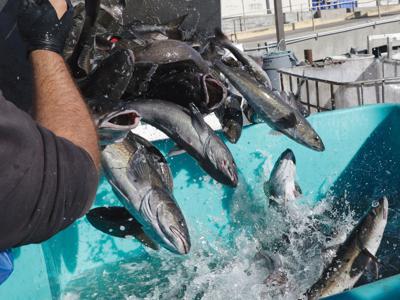

A new report by the Monterey Bay Fisheries Trust takes a look at the state of Monterey Bay’s commercial fisheries over four decades, finding that while the region’s commercial fishing industry has fundamentally shrunk, it has become more diversified over time.
The Monterey Bay Commercial Fisheries: Status and Trends report, released Sept. 2, comes at a time when the local seafood economy faces increasingly unpredictable environmental, economic and regulatory challenges – factors that have pushed fishers to adapt.
“I do really feel like it’s a critical moment,” MBFT Executive Director Melissa Mahoney says. “Our ocean is changing, our economy is changing. As a coastal community, if we lose our bridge to our fisheries, that’s huge in terms of our food security going forward.”
Seven fisheries central to the region were examined from 1981 to 2024 across Santa Cruz, Moss Landing and Monterey: market squid, coastal pelagic finfish, groundfish, Chinook salmon, Dungeness crab, California halibut and spot prawn. Roughly 1,100 commercial fishing vessels landed at Monterey Bay ports in 1981, compared with an annual average of 313 from 2010–2024. But although there are far fewer boats on the water than there were four decades ago, the volume and value of those landings have fluctuated over the years rather than following a consistent decline.
The organization also distinguished between fisheries that provide value (high participation and public interest) versus volume (fisheries dominated by exported fish that drive harbor activity.)
Chinook salmon, for example, is a high value fishery that was once a pillar of the local fishing community. The fishery has notoriously faced substantial challenges from intermittent closures related to droughts, especially after 2008. Dungeness crab grew as a high value fishery in the early 2000s before running into issues with domoic-acid related closures, compounded by regulatory changes put in place to mitigate whale entanglements.
Market squid has been the main revenue driver for the region’s harbors – when it shows up. It’s a high-volume fishery, and when landings are strong, the resulting wharfage fees help support harbor budgets and its ability to maintain infrastructure.
Many fishers have diversified their operations in response to changing conditions. For example, the sablefish, California halibut and certain groundfish fisheries have expanded over the last decade. Bluefin tuna has also re-emerged in the region’s fishery network, associated with warming ocean conditions.
Mahoney says environmental disruptions – heat waves, El Niño, La Niña and warming ocean temperatures – were among the toughest factors to analyze, but integral to understanding the future of the industry.
“I hope this report is seen by the community itself as well as our electeds, as this is where we are right now. Where do we want to go?” Mahoney says. “That is a conversation I hope we will have in the next couple of months.”

(0) comments
Welcome to the discussion.
Log In
Keep it Clean. Please avoid obscene, vulgar, lewd, racist or sexually-oriented language.
PLEASE TURN OFF YOUR CAPS LOCK.
Don't Threaten. Threats of harming another person will not be tolerated.
Be Truthful. Don't knowingly lie about anyone or anything.
Be Nice. No racism, sexism or any sort of -ism that is degrading to another person.
Be Proactive. Use the 'Report' link on each comment to let us know of abusive posts.
Share with Us. We'd love to hear eyewitness accounts, the history behind an article.