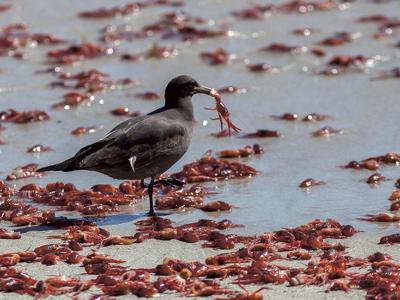

Seemingly every few years, thousands of tiny red crabs, called pelagic red crabs or tuna crabs, wash up along Monterey County shores. The crabs, mostly alive, pile onto the sand for a few days, providing a feast for birds and a unique experience for passersby before washing back into the ocean to live out their short lifespan.
The sight often spurs questions about what brings these red crabs, native to the warmer waters of Southern California and Mexico, up to the cooler waters of the Central Coast. The long-held hypothesis was that the presence of red crabs was correlated with rising sea temperatures; however, it’s more complex according to new research from a team out of UC Santa Cruz and the National Atmospheric and Oceanic Administration.
In a study published July 1 in the scientific journal Limnology and Oceanography, the research team, led by biological oceanographer Megan Cimino, figured out that the mechanics sweeping these red crabs north are abnormal ocean currents. However, what causes these abnormal ocean currents is still undetermined and researchers say their study can be a launch point to answer that question.
The study was triggered by a commute to work. Cimino, a recent Monterey Peninsula transplant, was cycling along the Rec Trail on her way to the NOAA lab in Heritage Harbor in November 2018 when she noticed thousands of red crabs stranded at Lovers Point. She remembered seeing this same species of crab during her years in Southern California and did not understand how the same species could have made it to the Central Coast.
A massive data scrape followed, using sources from oceanographic surveys to citizen science, remotely occupied vehicle footage and posts from Twitter accounts about seeing the stranded crabs. The team then used oceanographic models to trace how much and how often water was flowing from the southern California-Mexico border up north.
Cimino says it had long been hypothesized that El Niño caused this periodic northward expansion of the red crabs, by way of the abnormal currents created by El Niño.
“We found that, yes, in some years, El Niño is related to changes in currents, but in some years it’s not. We saw red crabs off of Monterey in both El Niño and La Niña years,” Cimino says. “Our study was the first to find that it’s anomalous currents that transport [red crabs] north and that’s unrelated to El Niño and kind of unrelated to warmer waters.”
The earliest reported sighting of these red crabs piled on the Monterey Bay shore was 1958.
Steven Bograd, a member of the research team, says the study answers the initial question of how these crabs end up in Monterey Bay while also opening the door to other questions.
“It will be interesting to know the extent to which predators of the red crab are also impacted by this northward expansion,” Bograd says. “That would tell us a lot about the impact on the larger ecosystem.”





(0) comments
Welcome to the discussion.
Log In
Keep it Clean. Please avoid obscene, vulgar, lewd, racist or sexually-oriented language.
PLEASE TURN OFF YOUR CAPS LOCK.
Don't Threaten. Threats of harming another person will not be tolerated.
Be Truthful. Don't knowingly lie about anyone or anything.
Be Nice. No racism, sexism or any sort of -ism that is degrading to another person.
Be Proactive. Use the 'Report' link on each comment to let us know of abusive posts.
Share with Us. We'd love to hear eyewitness accounts, the history behind an article.