
Imagine the kind of sleep you’d get if a construction crew set up shop near your house every night. You’d likely be grumpy, maybe stressed, especially if you were expected to perform your best at work.
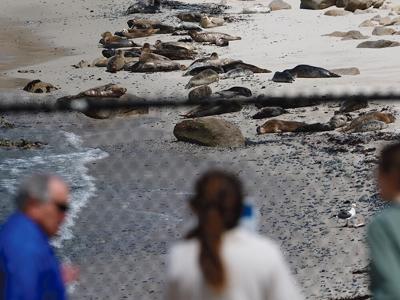
It’s not so different – but with higher stakes – for harbor seals at West Beach in Pacific Grove near Hopkins Marine Station, where researchers have been studying how noise impacts a declining population. During the 2022 pupping season, they found that nearby roadwork likely caused a sharp drop in births, significantly impacting a mother seal’s reproductive success.
Researchers partnered closely with local community scientists from Bay Net, a naturalist program under the Monterey Bay National Marine Sanctuary. Bay Net volunteers have tracked local harbor seal populations since around 2003, serving as the sanctuary’s eyes and ears along the Monterey Peninsula Recreational Trail.
“We saw a lot of miscarriages and stillbirths during the [2022 pupping season],” says Ryan O’Conner, who led the study. He notes a sixfold increase in failed births. “High stress levels in any mammal can cause reproductive failures. The more time pregnant seals are awake and disturbed, the less healthy they are.”
The study comes a year after the California Coastal Commission approved revised plans for a hotel at the American Tin Cannery, a few blocks from West Beach.
The 222-room resort must incorporate input from local harbor seal groups, resource agencies and scientific experts. Mitigation measures include avoiding tree removal, pruning or chipping from Nov. 1 to July 31 to alleviate disruption during pupping season.
Nocturnal animals, harbor seals feed at night and “haul out,” or sleep on the beach during the day, avoiding predators to rest and nurse in warmer environments that help them conserve energy. In the first weeks of nursing, mother seals can lose 25 to 30 percent of their body mass.
Energy conservation is crucial, and local groups warn that every disruption adds up. “It’s death by a thousand cuts,” says Kim Akeman, a long-time Bay Net volunteer. Hopkins researchers remain hopeful that with strong science and community support, construction can be guided to better protect wildlife.
“I’m hopeful for our harbor seal population,” says Giulio De Leo, a faculty member at Hopkins. “We have good data, great science, a municipality that’s listening, citizen scientists. Altogether, we’re well positioned to understand what’s needed to monitor this population moving forward.”


(0) comments
Welcome to the discussion.
Log In
Keep it Clean. Please avoid obscene, vulgar, lewd, racist or sexually-oriented language.
PLEASE TURN OFF YOUR CAPS LOCK.
Don't Threaten. Threats of harming another person will not be tolerated.
Be Truthful. Don't knowingly lie about anyone or anything.
Be Nice. No racism, sexism or any sort of -ism that is degrading to another person.
Be Proactive. Use the 'Report' link on each comment to let us know of abusive posts.
Share with Us. We'd love to hear eyewitness accounts, the history behind an article.