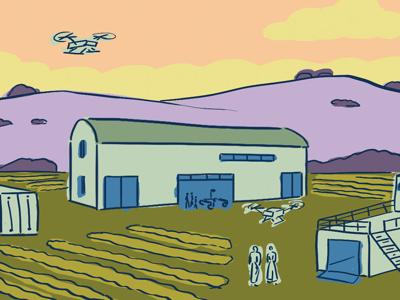

As an industry, ag tech is an amorphous and rapidly evolving space. It encompasses a wide array of technologies that include AI, drones, robots, autonomous tractors and even laser weeders. The potential of these innovations to transform our food systems is huge, with potential benefits that include enhanced farming efficiency, improved water conservation and reduced food waste.
However, a lot of this technology is developed elsewhere, sometimes adapted for crops and landscapes that are unique to a particular region and often expensive to try. This is where a new research and development facility in Salinas fits in. The facility will not only serve as the first local on-farm incubator dedicated to testing robotics and climate-smart solutions on crops, but partner with schools and other groups to build the ag tech workforce right here in Monterey County.
On Feb. 4, a $500,000 grant was awarded to support this project involving Hartnell College, Reservoir Farms, Mujeres en Acción and La Cultiva, through the Governor’s Office of Business and Economic Development (GO-Biz), the California Jobs First initiative and Uplift Central Coast.
“It’s really about social and economic mobility and community vibrancy,” Hartnell Superintendent Michael Gutierrez says. “When you have these ag tech startups, they’re either going to hire people from the outside or they’re going to hire people from within.”
Monterey Bay DART, a nonprofit focused on air mobility jobs, the Western Growers Association and UC Agriculture and Natural Resources are also partners. WGA’s 4,000 members will connect with farmers, UC ANR will provide research, and Hartnell – along with Mujeres en Acción, La Cultiva and DART – will train the workforce.
“It’s like a big community puzzle,” says Danny Bernstein, CEO of The Reservoir, which includes the farm. “Everyone brings their own differentiated piece.”
Reservoir Farms is currently building a facility that will include a robotics space and a lab, located adjacent to a 40-acre farm. Five acres of the farm will be dedicated to research and development, while the remaining 35 acres will focus on specialty crops like leafy greens, berries, carrots and onions.
“When we’re talking about aligning with industry, we’re reactionary. We wait until there’s labor market data that shows that there’s enough jobs available, and then we build a program,” Gutierrez says. “This puts us in a more proactive situation.”


(0) comments
Welcome to the discussion.
Log In
Keep it Clean. Please avoid obscene, vulgar, lewd, racist or sexually-oriented language.
PLEASE TURN OFF YOUR CAPS LOCK.
Don't Threaten. Threats of harming another person will not be tolerated.
Be Truthful. Don't knowingly lie about anyone or anything.
Be Nice. No racism, sexism or any sort of -ism that is degrading to another person.
Be Proactive. Use the 'Report' link on each comment to let us know of abusive posts.
Share with Us. We'd love to hear eyewitness accounts, the history behind an article.