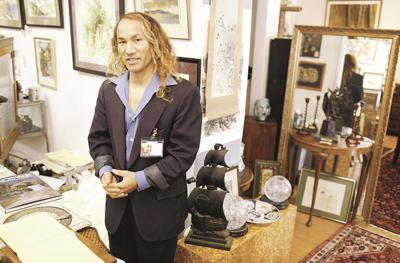

Bailochan Maharjan has regularly called his family in Kathmandu, Nepal, since he moved to the Monterey area in the late 1990s. But since the 7.8-magnitude earthquake struck their home April 25, the phone conversations with his older sisters are surreal.
“They just can’t talk normal. They’re crying because they lost everything,” he says. “They don’t have houses, and they’re sleeping on the street.”
None of Maharjan’s family members were injured in the quake that has reportedly killed more than 8,000 people and injured many more. But Maharjan, who owns Bay Consignment antique shop in Monterey, is doing what he can to help his sisters and other families struggling to put their lives back together.
Maharjan is collecting donations, both cash and collectibles, at his store, and contributing all his own profits through the end of May. He says he’s routing all the donations to the Nepalese bank account of his younger brother, who plans to send back a detailed record of how they’re spent.
Another local family has launched its own grassroots effort to help victims of the earthquake. Carmel Valley resident Christine Kolisch says she, her husband and son – plus a worldwide network of volunteers, and a crew on the ground in Nepal – have collected over $200,000 in donations since launching www.wehelpnepal.orgthe day after the quake.
“We have the Gurkhas [Nepalese soldiers] helping us, and they have a lot of respect,” she says. “We’re working with Nepalis in Nepal. Everybody is known to somebody in our group.”
She says her team was the first to respond in some areas accessible only by foot. They’re also providing water, food, solar-powered lights and medical supplies to people in tent camps.
Asked how her team moves its donated money, Kolisch offers only that couriers are putting it into the private bank accounts of people they trust. “I’m not going to tell you a whole lot about that, because I don’t want the Nepalese government to find out,” she says.
Her concern is shared by Maharjan, who says large international disaster relief organizations send their money through the Nepalese federal government, where it gets tied up.
“The government in Nepal is absolutely corrupted,” Maharjan says. “They take control of this aid, but they are not distributing it, because there are two parties fighting over who gets the money.”
Several prominent aid groups defend themselves from that perception.
Pooja Trivedi, regional marketing program manager for American Red Cross, says the nonprofit leverages each donated dollar into $0.91 of direct humanitarian services. Gary Shaye, senior director of humanitarian operations for Save the Children, says his organization’s worldwide average is $0.89 to the dollar.
“We’re able to distribute donations to the areas that need it,” Shaye says. “Right now the situation in Nepal needs both small and large organizations. It’s not either/or. I would not be critical of somebody who helped one person.”


(0) comments
Welcome to the discussion.
Log In
Keep it Clean. Please avoid obscene, vulgar, lewd, racist or sexually-oriented language.
PLEASE TURN OFF YOUR CAPS LOCK.
Don't Threaten. Threats of harming another person will not be tolerated.
Be Truthful. Don't knowingly lie about anyone or anything.
Be Nice. No racism, sexism or any sort of -ism that is degrading to another person.
Be Proactive. Use the 'Report' link on each comment to let us know of abusive posts.
Share with Us. We'd love to hear eyewitness accounts, the history behind an article.