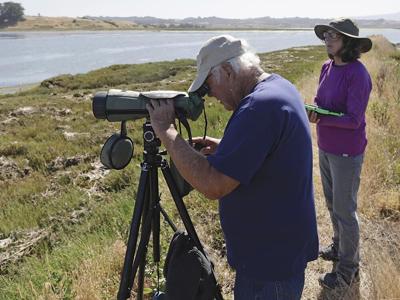

In 2007, at a meeting of volunteers organized by the Monterey Bay National Marine Sanctuary, Robert Scoles, a retired Santa Cruz County sheriff’s deputy, stood up and asked if anyone wanted to kayak on the Elkhorn Slough with him before dawn to look for otters.
Scoles first discovered evidence of them in 2006, and wanted to look deeper into the slough. Ron Eby, a retired naval officer, raised his hand. Not only have the two remained close friends ever since, they started – and continue – to collect valuable observational data for scientists trying to understand sea otter behavior and the ebbs and flows of the slough’s otter population.
About five years later, they began to recruit others to volunteer with them – the more locations that can be observed at the same time, the more valuable the data. They’ve since recruited nearly 30 others and now have an official title: the Elkhorn Slough Reserve Otter Monitoring Program, aka ROMP.
In August 2022, the scientific journal Ecosphere published a paper with nine authors that included Eby and Scoles, another volunteer named Susan Rosso, and Kerstin Wasson, the research coordinator at Elkhorn Slough National Estuarine Research Reserve. Its aim was to demonstrate the importance of the data that volunteer monitors can provide to career scientists, and evaluate the “rigor and value” of that data.
The paper’s abstract states that data is similar to that collected by professional scientists, both in long-term trends and variability. It has an added value: “The much higher frequency of volunteer observations allowed for seasonal and tidal dynamics to be detected that could not be revealed by less frequent professional monitoring.” The abstract concludes, “Volunteer data can thus provide critical information about coastal habitat use and behavior that can improve conservation strategies for threatened wildlife species.”
The ROMP team conducts counts of otters and seals twice a month, and splits up to collect data at over 20 locations.
And it’s not just the ROMP team providing volunteer data – it’s sightings made during the Elkhorn Slough Safari, where since 2017 the boat’s captain, Yohn Gideon (also a co-author of the paper), has been counting otters. “Because hundreds of excursions were taken each year, these counts represent the highest-frequency monitoring of sea otter abundance in the estuary,” the paper states.
“It is totally remarkable,” Wasson says of the ROMP team. “When Ron and Robert started this, it was just the two of them. I don’t know of another community science group better managed… It’s a pretty miraculous team.”
Among the newer recruits is Rosso, who had recently retired from a career doing corporate trainings in the tech industry. She now runs the team and onboards new volunteers and figures out which location in the slough to deploy them in.
“There definitely are some sites where people get an ownership, and we try to honor that,” she says. As for the whole venture, she adds, “It’s great. There’s so much to experience.”



(0) comments
Welcome to the discussion.
Log In
Keep it Clean. Please avoid obscene, vulgar, lewd, racist or sexually-oriented language.
PLEASE TURN OFF YOUR CAPS LOCK.
Don't Threaten. Threats of harming another person will not be tolerated.
Be Truthful. Don't knowingly lie about anyone or anything.
Be Nice. No racism, sexism or any sort of -ism that is degrading to another person.
Be Proactive. Use the 'Report' link on each comment to let us know of abusive posts.
Share with Us. We'd love to hear eyewitness accounts, the history behind an article.