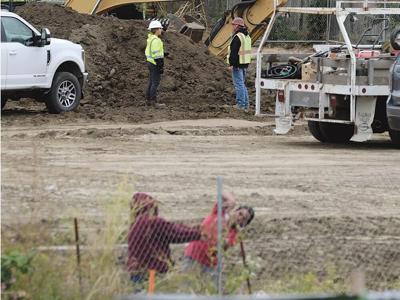

Around 5:30pm on Monday, June 19, Jeff Nohr, Avila Construction’s project manager for a planned farmworker housing project in Pajaro, sent an email to Louise Ramirez, tribal chair for the Ohlone/Costanoan-Esselen Nation (OCEN), informing her that the company’s contract with OCEN to provide tribal monitoring for the construction site had been canceled, effective immediately.
Nohr asked that Ramirez send a report of OCEN’s tribal monitors’ observations from the start of construction work, June 7, to that day, June 19. Though the letter did not state this, Avila Construction had already hired the Esselen Tribe to take over tribal monitoring of the site; having a tribal monitor present during construction is a requirement stipulated in the conditions of the project’s approval. This practice is intended to protect indigenous cultural artifacts.
For Ramirez, who lives in San Jose and was not onsite during the construction, the whole thing came as a surprise. In the course of the preceding week, Ramirez and Nohr had exchanged several emails, including about hiring additional monitors due to the fact that there were five earthmoving machines active on the site, which Ramirez says is far too many for one person to monitor.
Nohr initially resisted the idea, but later agreed to authorize OCEN to bring one more tribal monitor to the site. Ramirez insisted there be one monitor per earthmoving machine, which Nohr argued was not stipulated in the contract. Per the contract: “If more than one piece earthmoving equipment is deployed… at the same time, more than one tribal member shall be present during those periods.” Ramirez takes that to mean one tribal monitor for each piece of earthmoving equipment; Nohr’s interpretation differed.
In a June 12 email, Ramirez asked Nohr to compensate a second monitor and added, “I see your lack honor (sic) by your interpretation of our agreement.”
Mike Avila, who owns Avila Construction, says it became a struggle to agree on how to move forward in accordance with state law. “It got to be a personality conflict,” he says.
He adds that OCEN’s monitors called the Monterey County Sheriff/Coroner’s Office six times in two weeks to review for what the project’s offsite archaeologist – viewing pictures of the remains digitally from the Bay Area – confidently concluded were animal bones, not human remains.
Ramirez worries that even some of the animal bones might have cultural significance, including two small pieces that, to her eye, looked like they’d been carved by humans into tools. The presence of abalone shells, miles from the sea, also struck her as significant. She adds that, because there wasn’t a qualified archaeologist onsite, OCEN monitors are trained to call the coroner’s office when bones are uncovered.
Colin Busby, principal of Basin Research Associates, which is providing archaeological services to the project, rejects the notion that anything of significance has been found on the site thus far, and at least three archaeologists have reviewed the site since the 1980s, all with negative results.
When asked whether some of the bones may have been carved, he says, “Bullshit, no way in hell. We have looked at them physically.”



(2) comments
I am a resident on the Pajaro River I am What us Natives call Chiefa's I always find different bones after the city of Watsonville and county of Monterey due incompetent Sweeps they bring in bulldozers to take down construction of people shelters they never have anyone with them while they use the bulldozers and I have ask about this for years now and this is going unnoticed as well so now that I see formyself that it is illegally being done ibhope that some one can see this and have more say we on the Pajaro River do are best to keep it clean and we have dumpsters to put are trash in but no portable restrooms to use I don't get it but it's facts but yest I have found old bones even vertebrae no animal has a vertebrae like a human and I did take pictures of this so I can have it in my files but nothing was ever done and I know that are Native family has alot of berries family out here as well as on Lee road Indian burials are along most riversides
Since when did the state or the county not require that a qualified Archaeologist be on-site during construction or earth moving activity? A remote appearance by an archaeologist is totally unacceptable. Having been active in Archaeology in California for a number of years, I know that this is not acceptable and clearly unprofessional. Also the ability for the contractor in this case to shop for a Native American representative is entirely problematic. The State Native American heritage commission is supposed to identify the most likely descendants affiliated with the archaeological site in question.
Welcome to the discussion.
Log In
Keep it Clean. Please avoid obscene, vulgar, lewd, racist or sexually-oriented language.
PLEASE TURN OFF YOUR CAPS LOCK.
Don't Threaten. Threats of harming another person will not be tolerated.
Be Truthful. Don't knowingly lie about anyone or anything.
Be Nice. No racism, sexism or any sort of -ism that is degrading to another person.
Be Proactive. Use the 'Report' link on each comment to let us know of abusive posts.
Share with Us. We'd love to hear eyewitness accounts, the history behind an article.