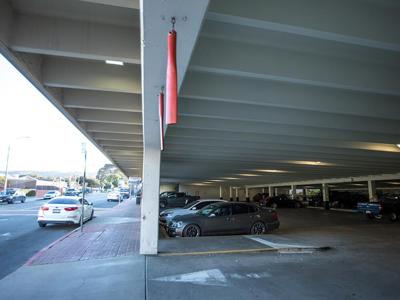

California’s Surplus Land Act, passed by the legislature in 2019, was supposed to help cities like Monterey transform parcels they have on hand into affordable housing. Instead, the complicated law with new rules that took effect Jan. 1, 2021, is catching cities off guard and throwing a wrench into development plans. Soon after the Monterey City Council approved moving forward with two nonprofit affordable housing developers to create housing downtown, planning officials learned they would have to start the search all over again.
“It was quite surprising,” says Grant Leonard, Monterey housing analyst. The Community Development Department was about to begin negotiations on contracts with MidPen Housing to develop three downtown parcels and First Community Housing to develop one, at 442 Adams St., for a total estimated 150 rental units.
“It’s just a matter of a few technical issues where we’re out of compliance,” says Leonard, adding that the spirit of the original request for proposals issued last July was “in the same vein” as the Surplus Land Act.
City staff discovered the problem as they were completing an annual housing report to the California Department of Housing and Community Development. A new checklist in the state’s report made them realize that the city did not comply with the law in two main ways: It did not advertise an RFP to a full list of developers identified by the state; and the City Council did not declare the four parcels as either surplus land or exempt surplus land.
If the city wants 100 percent of the parcels to be affordable – which was the council’s intent when it approved the plan in 2019 – under the law, they must be declared as exempt surplus land, and 75 percent of the units must be set aside for low-income tenants, meaning they earn no more than 80 percent of the median area income. (For an individual that’s $54,250 a year, and for a family of four it’s $77,500.) The remaining 25 percent of units could be targeted at median – or moderate-income tenants.
“This act caught a lot of people off guard,” says Geoffrey Morgan, president and CEO of San Jose-based First Community Housing. “It’s a very complex bill and it’s not the first time I’ve seen this happen.” It’s created issues for cities that are trying to do the right thing by providing affordable housing but have to start over to follow the new rules. Morgan says First Community will apply when a new RFP is issued, “and hopefully they’ll pick us again.”
It will take from three to six months to check all the state’s boxes, reissue the RFP and select developers, Leonard says. The delay coincides with the city’s efforts to bring more water to each of the sites necessary for building to begin. Monterey has signed on in support of a request to the State Water Resources Control Board to amend a cease-and-desist order limiting water pumped from the Carmel River. If successful, it would bring an additional 75 acre-feet of water – about 24.4 million gallons – for affordable housing projects on the Peninsula.



(0) comments
Welcome to the discussion.
Log In
Keep it Clean. Please avoid obscene, vulgar, lewd, racist or sexually-oriented language.
PLEASE TURN OFF YOUR CAPS LOCK.
Don't Threaten. Threats of harming another person will not be tolerated.
Be Truthful. Don't knowingly lie about anyone or anything.
Be Nice. No racism, sexism or any sort of -ism that is degrading to another person.
Be Proactive. Use the 'Report' link on each comment to let us know of abusive posts.
Share with Us. We'd love to hear eyewitness accounts, the history behind an article.