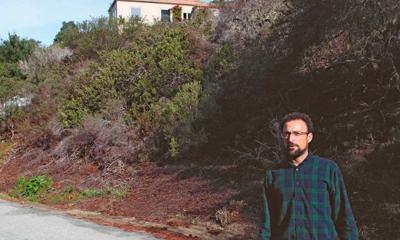
One of the lessons of the Pfeiffer Fire, and Basin Complex Fire before that, is suppression doesn’t prevent fires – it just makes them hotter, faster and more destructive.
Next month, the County Board of Supervisors will be presented with an opportunity to learn from that lesson and approve the creation of a county fuel mitigation officer (FMO) to oversee efforts to reduce the county’s ever-growing buildup of the brush and trees that help fuel these major fires.
The creation of a county FMO, and of a small task force that will advise the officer, isn’t the brainchild of one person or agency. It’s the culmination of years of work by a large group of locals that saw a dire need for change. It’s also being viewed as an unprecedented example of private citizens and public agencies all coming into agreement, and might become the blueprint for fire management throughout the state.
The process began with the Monterey Fire Safe Council (MFSC), a nonprofit founded in 1997 to help protect communities and properties from wildfires, and which has united various public agencies to fulfill that goal locally. “[We’re] trying to ensure that work is hitting the ground,” says MFSC Executive Director Seth Parker. “So many places have great needs.”
One of the responsibilities of the FMO, Parker says, will be to help streamline the permitting process for residents to do fuel mitigation on their properties, and to direct grant money to help them do it.
The Resource Conservation District of Monterey County is doing some of that now in collaboration with the council; district Project Manager Rami Shihadeh says the need is still great.
“Someone who lives out in the woods can’t get [fire]coverage, because the insurance companies say there are trees all around the house,” Shihadeh says. “But a homeowner can’t cut those trees, because they can’t get a permit.”
And while Big Sur gets a lot of attention because of recent fires, experts say several other areas are just as at-risk – places where more people live and which are of immense ecological and monetary value. Joe Rawitzer, a retired fire professional who has long been involved with MFSC, lists Cachagua, Carmel Highlands and Palo Colorado among those areas.
“Santa Lucia Highlands grapes are worth as much, if not more, than Pebble Beach,” Rawitzer says. “The last time that range burned was in 1941, and it’s just a matter of time before [it] burns off with extreme conditions.”
By extreme conditions, Rawitzer is referring to the heat of the fire, a distinction experts say determines whether or not a fire is “good” or “bad.” With massive amounts of fuel buildup, a fire burns so hot the soil beneath it is scorched, killing the native seeds buried within.
Identifying the specific areas of greatest need in a region as large as Monterey County is a monumental task, which is why the MFSC is creating a multi-agency task force to direct the fuel mitigation officer.
“Everybody is moving this project forward, it’s pretty historic,” Parker says. “If this gets through the Board of Supervisors, it will probably be the model for every city in the state.”


(0) comments
Welcome to the discussion.
Log In
Keep it Clean. Please avoid obscene, vulgar, lewd, racist or sexually-oriented language.
PLEASE TURN OFF YOUR CAPS LOCK.
Don't Threaten. Threats of harming another person will not be tolerated.
Be Truthful. Don't knowingly lie about anyone or anything.
Be Nice. No racism, sexism or any sort of -ism that is degrading to another person.
Be Proactive. Use the 'Report' link on each comment to let us know of abusive posts.
Share with Us. We'd love to hear eyewitness accounts, the history behind an article.