
Welcome to California State University, Monterey Bay in the year 2030.
It’s 36 years after a 1,350-acre tract of land littered with toxic sites and decrepit asbestos-filled buildings of the former Fort Ord Army base was given to the California State University system. The university now stands as an environmental and academic leader in the state as well as an economic incubator and stimulus for the region.

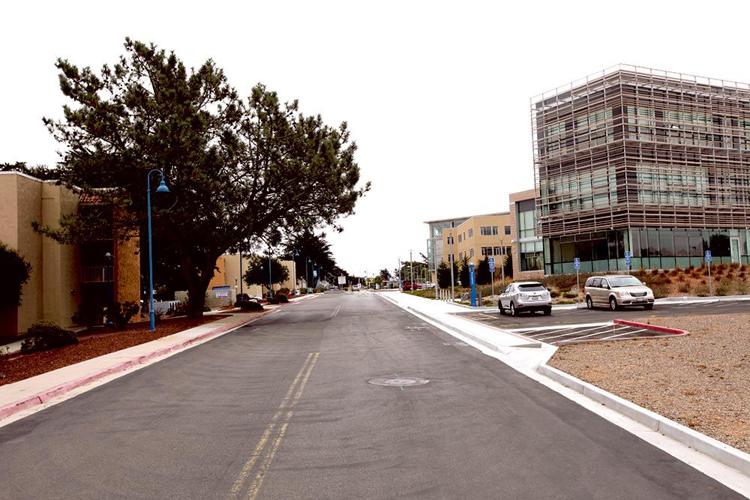
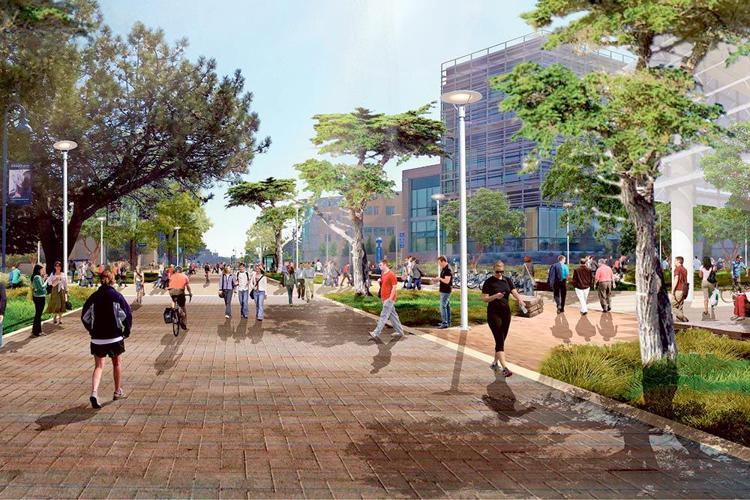
CSUMB 2030. The plan envisions a pedestrian mall on Divarty Street with new academic buildings.
With a net-zero footprint for carbon output and energy use, CSUMB has positioned itself as a pioneer in energy efficient development. Underground thermal energy storage captures heat in the warm months to use in colder months.
Ample affordable housing options on a walkable campus – with conveniently located bike shares, and easy access to public transit that connects to Salinas and the Monterey Peninsula cities – make cars a non-necessity. To ease the demands on the limited regional housing stock, 50 percent of faculty and staff and 70 percent of students live on campus.
Way back in 2016, 78 percent of students, faculty and staff commuted to campus by car; 14 years later, that number has dropped to 30 percent.
CSUMB’s technology park, adjacent to Marina’s The Dunes shopping center and housing development, and regional educational programs have helped diversify Monterey County’s workforce: It has gone from being based on low-wage and seasonal agricultural and hospitality jobs to cutting-edge agricultural technology and marine science venture startups.
With a 12,000-plus student body representing the diversity of the region and more than 1,000 faculty and staff, CSUMB is a regional economic driver spurring numerous businesses. These enterprises have set up shop on 2nd Avenue, General Jim Moore Boulevard and elsewhere to serve student needs as well as to take advantage of the area’s intellectual capital.
The run-down military infrastructure and blighted buildings that once stood in the way of creating a unique 21st-century identity are a distant memory. Now, LEED-certified academic, residential and administrative buildings lie within an expanse of open space home to native plants and animals.
It’s an optimistic portrait of CSUMB that the administration and other stakeholders are eager to imagine.
But it’s a vision that represents a departure from the realities of 2016, and for it to happen, state dollars won’t be enough. The ambitious goals outlined in the CSUMB master plan – currently under development – will require the public-private partnerships and possibly privatization of university housing. That will lead to new challenges.
: • : • :
There’s a discreet charm to a university growing from the ruins of a formerly major military base. Today, glass and steel structures arise with the striking lines of 21st-century architecture as old barracks rot and unused parking lots crumble into the soil only blocks away.
The university attracts students from across the Monterey Bay region, the state and the globe for its unique curriculum with service learning – volunteering in the community – at the core of education. Yet, hardly anyone would call the campus pretty.
CSUMB administrators are currently developing the master plan for the 21-year-old and roughly 7,200-student university. Their goal is to increase the number of students to 12,700 and double the built infrastructure to 2.4 million square feet while beautifying the campus by 2030. Yet prior plans for growth have fallen short, leaving a track record of unrealized expectations.
CSUMB President Eduardo Ochoa concedes it’s an ambitious approach.
“We have worked out a growth planning scenario that is aspirational,” he says. “But we do look at how we would be able to grow if we were able to get funded by the state to accommodate that kind of growth in student population.”
Furthermore, there’s no price tag for the desired growth and state funding is unlikely to substantially increase in the foreseeable future. Money for the residential halls and recreation buildings needed to accommodate a 55-percent growth in student population must come from a new avenue – the private sector. This is a departure from the two ways public institutions have traditionally funded expansion: with state money and philanthropic gifts.
Back in 1991, with the looming closure of Fort Ord on the horizon, then-Congressman Leon Panetta and other leaders in the region pushed for a university on the property. This was an attempt to buffer the impact that taking $750 million of annual payroll (in 1991 dollars) out of the local economy would have.
At the time, the projection was 15,000 students by 2005 and 20,000 by 2015. The 2016 student population is still under the original 2015 goal by 65 percent.
In the most recent campus master plan, approved in 2007 – just before the economy plummeted into the Great Recession – the more modest goal to increase the student population to 8,500 by 2015 also failed to materialize. It was short by 1,500 students.
The state of California mandates master plans for most public bodies – counties, cities and universities, among others. The development master plans in many municipalities are often contentious, with established interests like businesses and neighborhoods reluctant to move toward new directions. Yet, even 21 years on, CSUMB is unique.
With large swaths of the former Fort Ord still vacant and undeveloped, there are very few – if any – established interests to oppose the university’s growth in new directions. In turn, CSUMB is free to develop its vision of the future on a best-case-scenario basis to put plans in place if and when funding presents itself.
“There will be a considerable amount of demolition that will change the appearance of the campus dramatically,” Ochoa says. “Besides the number of students and the enthusiasm that creates, we are doing quite a lot for the community in terms of economic development with new construction.”
Currently, CSUMB has 900 students more than what the state funds, and is forced to absorb the costs above what the subsidized in-state tuition covers. This stems from the 2013-14 academic year when a surge in enrollment exceeded the level of state funding. A year before that, the CSU system had changed CSUMB’s service area – the region from which a CSU must enroll students who meet state qualifications in grades and prerequisites – from three Monterey Bay counties to the entire state of California.
The number of qualified students applying exceeded available space. The university was then required to enroll hundreds more students than the state would pay for. This keeps student growth projections flat for the next few years until state funding catches up with student enrollment. Yet the university has continued to expand, both on campus and beyond. (To read about housing constraints, see story, p. 22.)
The university purchased the National Steinbeck Center in Salinas in September 2015 for $3 million and also signed a lease for the former Heald College, now CSUMB at North Salinas, in February. Both acquisitions seek to expand CSUMB’s reach into the Salinas Valley, where education levels are below the state average.
Also in February, the College of Business’ state-funded $43 million new home, the Joel & Dena Gambord Business and Information Technology Building, officially opened. A new $50 million student union, funded with student fees, is scheduled to break ground in 2017 and is expected to be completed in three years.
While these projects were in development, the new master plan process began in April 2015 and resulted in some significant differences from its 2007 predecessor – notably less parking and more open space.
The plan has made its rounds through public comment and will come to the 25-member CSU Board of Trustees for approval in early 2017.
If the vision for 2030 is even close to actualized, the university might finally shed its image as a Cold War-era Army base.
: • : • :
Laura Lee Lienk has more historical perspective than nearly anyone else at CSUMB. Her office at the Watershed Institute – formerly a military dental clinic – is where Army soldiers used to have their teeth pulled. Instead of an examination chair and dental instruments, now stands her overstuffed bookcase, cluttered desk and bicycle. Lienk, a lecturer and the applied science and technology service learning coordinator, talks about what she has seen over her 21 years at CSUMB.
“I’ve been here since the beginning,” she says. “I’m probably the only person here who has had the same office and the same chair for 21 years.”
From the start, there were high expectations for the university. Student enrollment and campus development were set to progress at a steady clip.
“At first we all thought we’d be getting new buildings,” she says. “It seems like every five years there’s a new building, but I understand it takes money and time.”
She looks across B Street from her office toward abandoned barracks that used to house soldiers. They’re sagging and boarded up with visibly cracking paint. It’s the same view Lienk has had for more than two decades. Still, she cracks a smile when she thinks of the 600 students who took a chance on a brand-new university in 1995.
“The early students were called ‘pioneers.’ They weren’t looking for the traditional university experience,” Lienk says. “They were dedicated to the vision, to a social justice vision.”
CSUMB’s vision statement, which was crafted in 1994 and has remained intact since, states, “The campus will be distinctive in serving the diverse people of California, especially the working class and historically undereducated and low-income populations.”
Lienk believes the university has stayed true to that mission over the years, with Latinos making up the largest ethnic group at CSUMB in 2015 at 37 percent, and more than half the students representing the first generation of their families to attend college. This demonstrates a reversal of demographics in 1998 when 44.5 percent of the student body was white and 25 percent were Latino.
The was a sense of adventure in the early years, Lienk says, when the old military infrastructure was more a curiosity than an eyesore. “Ording,” the term for exploring abandoned building on Fort Ord, was a regular campus pastime.
“Before those buildings were boarded up, students used to walk through the halls to explore the history of this place,” Lienk says. “They even use to make haunted houses in some of the buildings for Halloween.”
Asbestos, lead and at times live munitions were found in old barracks. Buildings were boarded up.
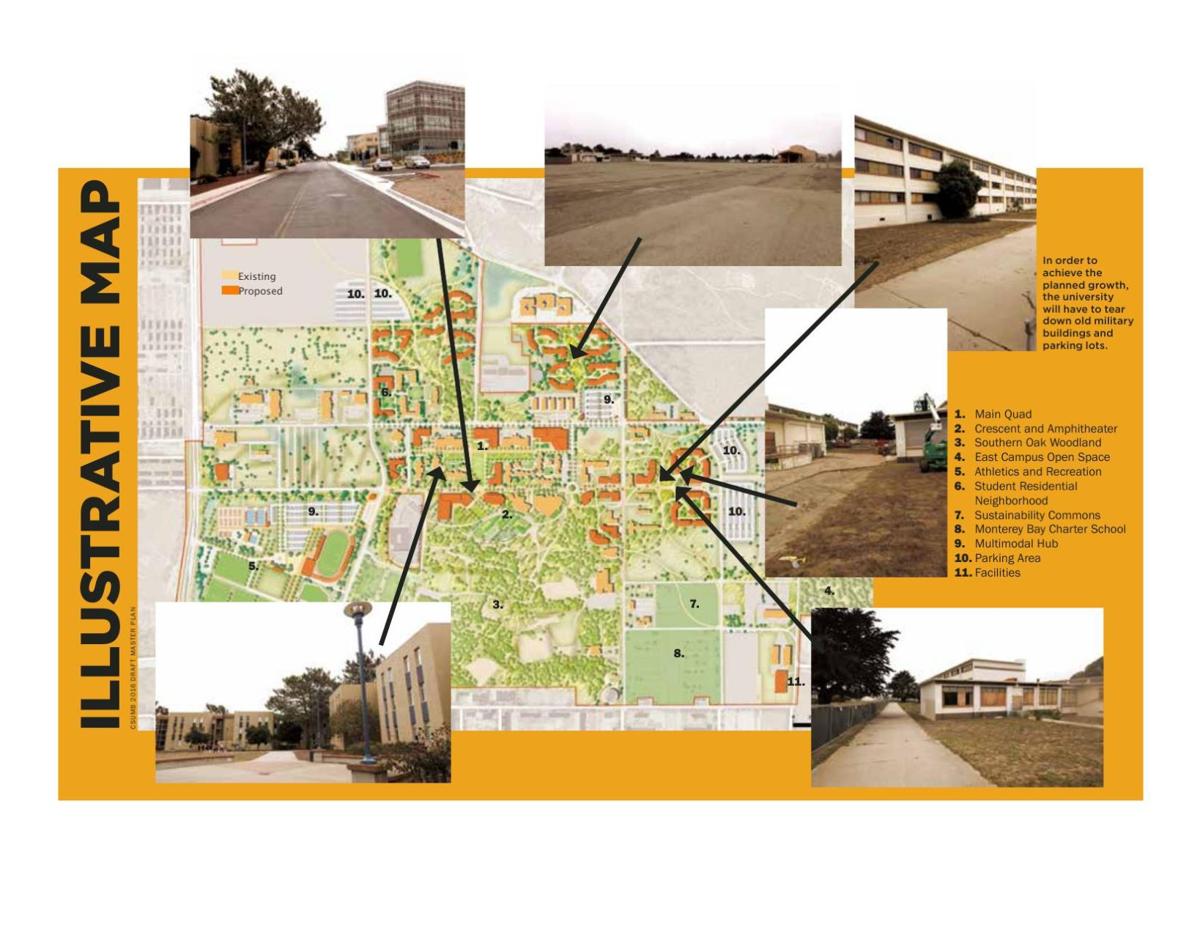
More than a dozen of the boarded-up barracks in Lienk’s view are known as “hammerheads,” because of their design. A student residential neighborhood is slated for the lots where they now stand, but it will cost $1.25 million to tear each hammerhead down – not counting construction.
The price per new bed built on campus is $125,000. This puts the price tag for the 3,520 new beds slated in the current draft of the master plan at a hefty $440 million, four times the 2015-16 base expenditures of $103 million.
When asked if she has any concerns about the university’s reliance on private funding for the planned growth in the coming decade, Lienk shakes her head.
“If that’s the only way it’s going to happen, then I’m fine with it,” she says. “We absolutely need housing for our students. What the university has done to partner with a developer and the city of Marina to building the Promontory housing is a good example.”
: • : • :
The Promontory is an apartment-style student housing development on the northern edge of campus in Marina that opened in 2015. The three beige and brown four-story residence halls, each with a courtyard, stand between undeveloped land and old parking lots. The facilities, complete with a fitness center and student lounges, are available to students in their second year and up.
The property was previously owned by the city of Marina, and was home to what Ochoa calls “terrible, blighted structure.”
“It created a terrible impression coming into the campus,” Ochoa says.
CSUMB teamed up with Los Angeles-based property developer AMCAL, which purchased the lot from Marina. The developer constructed the building with 176 apartments and 569 beds. The university plans to exercise its option to purchase the property this fall for $68.5 million with revenue bonds, and also plans to add 200 more beds.
“This was something we needed, and needed fast,” Ochoa says. “If we went through the process of running it through the standard CSU capital project process it would take longer and it would be more expensive.”
While private control over campus housing could result in higher living costs for students, at the Promontory, the university is the lease-holder and then leases out rooms to students. A double room here is $3,941 a semester, compared to $3,644 in CSUMB’s own residence halls.
Ochoa believes the Promontory – the university’s first public-private partnership for a residence hall – is an example of how CSUMB will build its future student housing.
“If you look at the political realities now, then you have to conclude it’s not likely that the funding cuts we have been experiencing are going to be magically reversed,” says Ochoa in regard to the decrease in state funding. The CSU system currently spends 19-percent less per student than it did in the 2007-08 academic year.
: • : • :
While master plans do shape the trajectory of development, outlining campus needs and desires for myriad stakeholders, they also serve as elaborate sales pitches. Whether competing with other CSUs for scarce state funds, seeking large endowments from wealthy families and individuals or being an attractive opportunity for private developers, the master plan is, in part, designed to attract needed dollars.
At the same time, the plan doesn’t seek to privative all campus buildings and services; privatized development would apply only to residential and recreational buildings.
The university seeks to double the footprint of campus facilities from 1.2 million square feet today to 2.4 million square feet by 2030. CSUMB plans to expand by tearing down blighted building and crumbling, decades-old concrete, leaving nearly half of the main campus grounds open and undeveloped.
Bud Colligan, co-chair of the Monterey Bay Economic Partnership (of which Ochoa is also a board member), believes the way to make that happen is collaboration.
“In general, I’m very supportive of public-private partnerships,” he says. “The key word is partnership. The university has to ensure agreements serve the best interests of students and faculty.”
While a university can’t – and shouldn’t – outsource everything, says Colligan, there are areas where it makes sense.
The 2016 master plan reflects, for better or worse, the changing nature of public universities: To grow, the private sector must see an opportunity to turn a profit.
Christopher Placco is CSUMB’s vice president for planning and development. While presenting on the master plan draft on April 28 at the Carpenter’s Union Hall in Marina, Placco told a full crowd, “We can’t build a 21st-century university with 20th-century financing.”



(0) comments
Welcome to the discussion.
Log In
Keep it Clean. Please avoid obscene, vulgar, lewd, racist or sexually-oriented language.
PLEASE TURN OFF YOUR CAPS LOCK.
Don't Threaten. Threats of harming another person will not be tolerated.
Be Truthful. Don't knowingly lie about anyone or anything.
Be Nice. No racism, sexism or any sort of -ism that is degrading to another person.
Be Proactive. Use the 'Report' link on each comment to let us know of abusive posts.
Share with Us. We'd love to hear eyewitness accounts, the history behind an article.