
ONE OPTION IS A WARM, LUMINOUS YELLOW, ANOTHER MIGHT REQUIRE SUNGLASSES, A THIRD IS RELAXED AND SOOTHING – and these are just three shades from the palette of yellows available on 2023 model year Chevrolets. Yet in the current market there are few customers willing to risk such daring hues.
A few years into the 2020s and the automotive color wheel is dominated by routine shades. Black, white and especially gray or silver adorn close to 80 percent of all new vehicles sold in the U.S. according to a survey by iSeeCars, the automotive locator and research firm.
Call it inconspicuous consumption. It’s a fixation that – at least to those in the collector car world – makes little sense. “In the malaise period of the ’70s the palette was more interesting than today,” observes Aaron Robinson, an editor with the insurance and lifestyle firm Hagerty.
And it’s not a new phenomenon. The three unremarkable colors began to take hold of the car-buying public’s imagination (or lack thereof) in the 1990s. But even rolling the survey clock back and including data from 1971 on, only red and blue join the three at the top of the popularity scale.
“A lot of people see white or gray as practical,” reasons Ken Gross, an automotive historian and longtime Pebble Beach Concours d’Elegance judge, who also served as executive director of the Petersen Museum. At least in terms of what they drive, he adds, “I think people are less expressive today.”

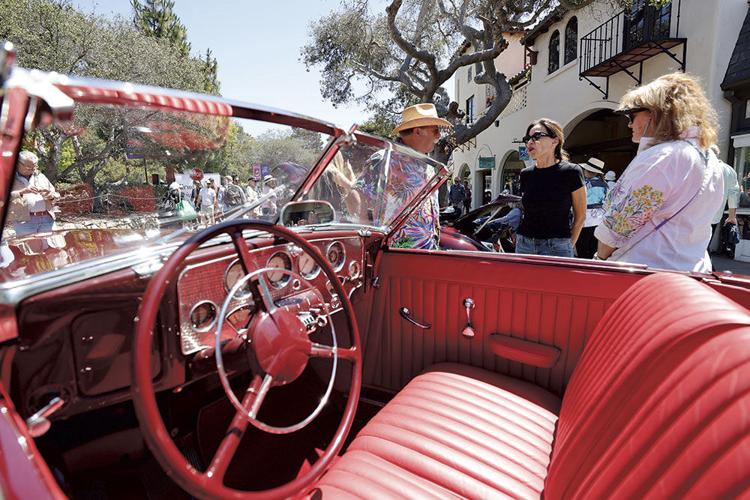
In previous decades, red often spilled into the interior.
SO WHERE HAVE ALL THE COLORS GONE? Despite the proliferation of grayscale over the past two decades, automobiles have a colorful past. There were the names – Sassy Grass, Panther Pink, Calypso Coral and Venetian Yellow. The palettes paint an image of time and place, from Henry Ford’s obsession with black to the exuberant two-tone pastels of the 1950s.
“It’s one of the reasons vintage cars are a big business,” explains John Kraman of Mecum Auctions. “They are different – that’s what makes those cars have so much appeal.”
When a potential consignor contacts the auction house popular for its televised events about the value of a particular car, Kraman’s standard response is a quick “What color is it?” He is not being dismissive when he asks the question. A lot hinges on the appearance of a vehicle.
Red and black, he says, are valued in the collector market. Plum Crazy is one of the signature shades of the sought after 1970 Dodge Challenger or Plymouth Hemi ’Cuda.
“I can tell you a beige car is not going to have the same appeal,” Kraman says.
There are three eras when bold colors ruled the road. American muscle cars rode on Baby Boom youth culture through the early 1970s. In 1972, as ’60s car culture was coming to an end, Ontario Orange Metallic was one of the leading sellers for Corvette. This period followed the turquoise, lavender and corals of the 1950s.
“Those ’50s colors – I call them Esther Williams bathing suit colors,” Gross says with a laugh.
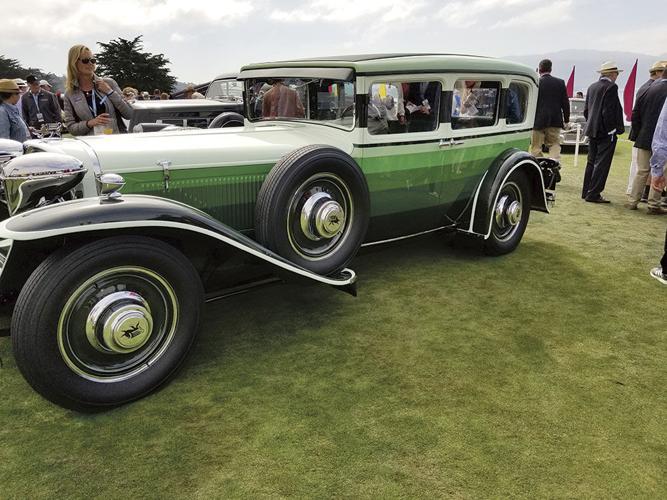
But it was the Roaring ’20s when the auto industry first realized that a paint scheme could pay dividends. Despite Ford’s famous quip that a buyer could have any color on a Model T, as long as it is black, scholar and vintage restoration expert Gundula Tutt says, “There was an explosion of color – especially at General Motors. It suited the age.”
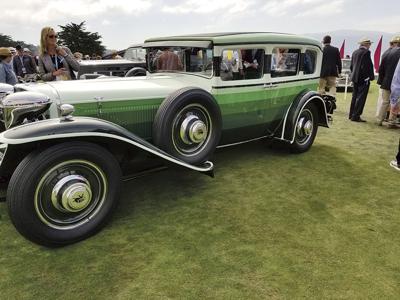
Chevrolet offered the likes of Chermonte Cream and the clever Bolling Green (yes, that’s their spelling), as well as shades of blue with names that would not pass today, such as Buddha and Coolie. An advertisement for a Victory Six Sport Sedan by the Dodge Brothers highlights a stunning yellow body with slick black trim. Hupmobile displayed in their ads an orange car with black trim and a beige roof – a tri-tone effect. At Buick, to go along with the evocative Etoile Blue and Longchamps Green, there was Romany Red – among 48 color options for the 1930 model year.
During the decade, manufacturers began to assemble teams to develop new and distinct paint schemes. GM sent representatives to the Paris fashion shows to learn what was trending. Companies also began employing catchy names. Why would anyone buy a plain brown car when they could have Connaught Brown?
By the late 1920s, even Ford had opened the spectrum. An advertisement for their 1928 Ford Sport Coupe touted the Arabian Sand tone, gushing in part that “Women’s eyes are quick to note and appreciate the trim, graceful lines of the new Ford, its exquisite two-tone color harmonies, the rich simplicity and quiet good taste reflected in every least little detail of finish and appointment.”
The revolution began with the development of Duco, a new lacquer paint technology from DuPont, working with GM. Duco dried in hours and accepted different pigments. After flirting with a few different colors when the Model T was released, Ford backtracked to black because it dried quicker than other colors – an important factor for an assembly line operation. When Duco was introduced in 1923, everything changed. Advancements in paint and application technology continued in the following decades, allowing for new looks over time.
“I can tell you a whole story about that, but do we have the time?” Tutt says. She is highly regarded in the international collector community. Through her company, Omnia Restoration in Freiburg, Germany, Tutt and her team work with concours quality vehicles. She is also known for her forensic work to uncover the precise shades of the past. Tutt also wrote the book on automotive coatings. Her doctoral dissertation is a study of the “History, Development Materials and Application of Motor Vehicle Painting Between 1900 and 1945.”
“Somebody told me ‘that sounds as interesting as watching paint dry,’” she recalls with a chuckle.
The professor is more troubled than perplexed by the current modesty when it comes to color. “Today’s owners of historic vehicles want to apply today’s views,” Tutt points out. “That’s why there are so many silver [vintage] cars. It’s a pity.”
It can also prove costly – both in the collector market and when it comes to trading in a daily driver. According to research by iSeeCars, while white or black rank as the most popular colors in each of the states, it is the despised yellow that brings the biggest return come trade-in time. Based on a three-year ownership span, yellow cars depreciate at 13.5 percent of MSRP. Orange also holds its value relatively well, losing 18.4 percent of original price. Both fare far better than the average depreciation rate of 22.5 percent.
Both silver and black lose more than average, ranking near the bottom of the list.
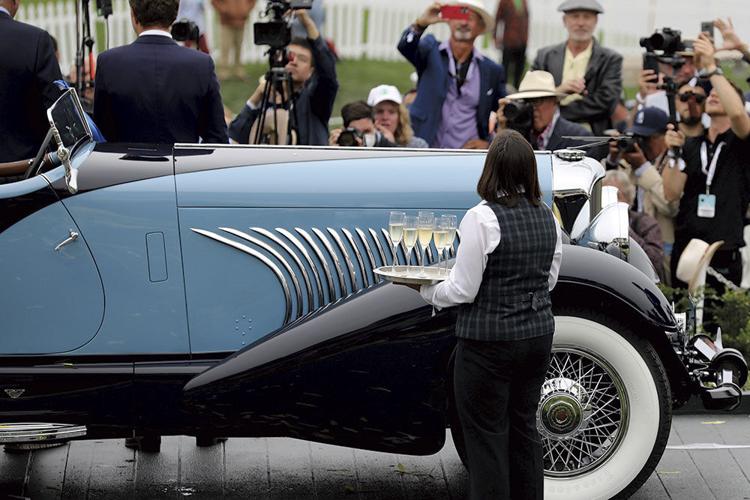
“It’s a fun topic, but it’s also a serious topic because it really does radically change the value of a car,” explains Kraman of Mecum Auctions. “The number-one thing people first notice is color – and it’s the thing that resonates most.” Gross agrees. He points out that in the early years of concours – both in Europe and the U.S. – the gatherings were akin to fashion shows. Indeed, designers such as Coco Channel would be invited to create outfits as vivid as the vehicles.
“When you look at what drives the price up, one of the factors is the rarity of the color – and that’s probably because nobody bought it,” he says with a laugh. “That isn’t to say black can’t be stunning.”

EVEN WITH THE GLEAMING COLORS OF THE 1920S, BLACK WAS THE BIGGEST SELLER – perhaps residue from the Model T phenomenon. Maroons became popular as the 1940s approached. Manufacturers elevated the somber tone with names like Royal Maroon (Buick), Regal Maroon (Chrysler) and Port Wine Maroon (Chevrolet). Hupmobile’s Clay Rust may be one of the more unfortunate name choices of the 1930s. Still, Kraman observes, “The evolution of color is fascinating.”
Car culture took off in the aftermath of World War II, with Americans moving to the suburbs, and teenagers and young adults beginning to wield economic power. Color followed.
“When you look at pastels, it’s optimistic and youthful – the American dream coming true,” Tutt says.
That spirit continued through the 1960s, at least in terms of car culture. In December of 1968, the Detroit Free Press published an article on the influence of color on car sales, citing the “flowered tops” and “bold stripes.” The author quoted the chief stylist of Dodge at the time, Bill Brownlie, as saying, “Tastes are getting wilder.”
During this time, the enthusiasm for expression was not limited to exterior coatings, either. AMC turned to design houses like Gucci and Cardin, as well as the denim stylings of Levi’s, to guide interior trim on some models.
“We have to talk about interiors,” Kraman says. Suspecting that most modern schemes involve black, gray or tan, he points out that in previous decades, “There were two or three colors, there was houndstooth, tone on tone, plaid – all that is gone.”
Between 1971 and 1979, almost 22 percent of cars were a shade of blue, the most popular color of the decade according to Daily Infographic. Gray was the outcast of the disco era, accounting for just 4 percent of cars on the road. In the ’80s almost half of all Americans drove blue or red vehicles.

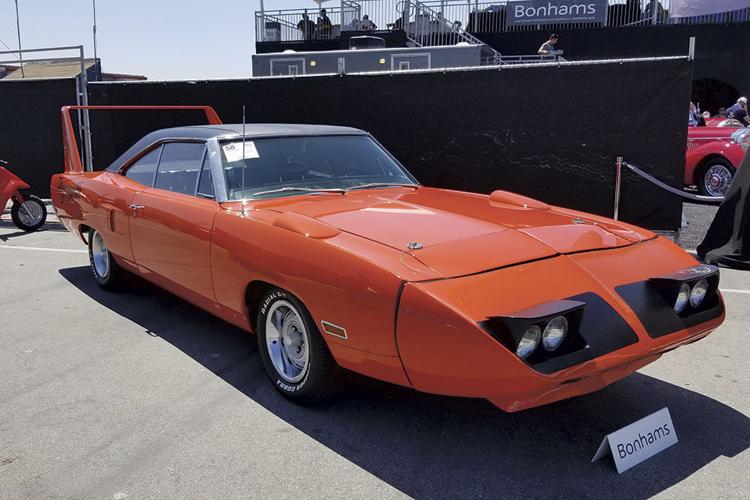
The 1970 Plymouth Roadrunner Superbird painted in Vitamin C, introduced to cap a colorful decade.
But the colors were beginning to fade. Through the ’80s, green cars made up 11 percent of all sales. In the ’90s, however, that figure had plunged to 4 percent.
So how did we end up in a monochrome rut? Black, white and gray are perceived as timeless and sophisticated. Their popularity ensures that vehicles in those colors don’t languish on the dealership lot. Cost is another factor, as many manufacturers tack on an added charge for premium tones.
For Kraman, shopping habits also play a role. Even after supply chain issues of the past few years forced more buyers to special order new vehicles, Cox Automotive, the parent company of the auto pricing guide Kelly Blue Book, estimates that two-thirds of Americans prefer to scan what’s readily available on the dealership lot.
And yet, there are colors – wild colors – available. Even today, one sees pops of brightness from the sea of gray.
“The one common denominator is that color is very important,” Gross says. “It always has been and probably always will be.”


(0) comments
Welcome to the discussion.
Log In
Keep it Clean. Please avoid obscene, vulgar, lewd, racist or sexually-oriented language.
PLEASE TURN OFF YOUR CAPS LOCK.
Don't Threaten. Threats of harming another person will not be tolerated.
Be Truthful. Don't knowingly lie about anyone or anything.
Be Nice. No racism, sexism or any sort of -ism that is degrading to another person.
Be Proactive. Use the 'Report' link on each comment to let us know of abusive posts.
Share with Us. We'd love to hear eyewitness accounts, the history behind an article.