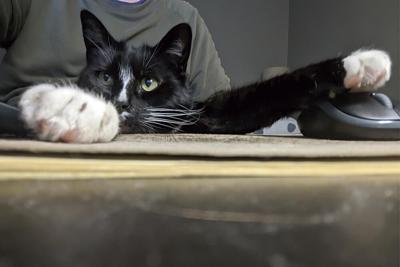

Cats are actually just tiny hunters. Left to their own devices, they are “true carnivores” – their food sources are animals they catch and eviscerate.
But most domestic cats as humans keep them are a little different, and about 30 to 40 percent of feline patients at Toro Park Animal Hospital are overweight or obese, says veterinarian Loly Hogans. She attributes that primarily to the fact that when cats are spayed or neutered, they stop making certain hormones that act as appetite suppressant. Couple that with the relatively sedentary lives of many indoor or mostly indoor cats, and you have a recipe for weight gain.
There is no one-size-fits-all fix, but Hogans says there are a few guidelines to keep in mind. One: the serving sizes recommended on cat food are generally for unaltered animals; she suggests more like one-third of the label.
And of course, kibble includes some type of grain, so she suggests incorporating wet food.
Then there’s portion control. “I do not recommend free-feeding cats, unless they are kittens,” Hogans says. She suggests automatic feeders that dispense food, or to set meal times as you would for a dog: “They learn quickly, like in two to three days. An hour before dinner time, my cats would come and find me.”
Ultimately, more activity and less food intake – the same guidelines that work for a lot of humans – work for cats who are overweight.


(0) comments
Welcome to the discussion.
Log In
Keep it Clean. Please avoid obscene, vulgar, lewd, racist or sexually-oriented language.
PLEASE TURN OFF YOUR CAPS LOCK.
Don't Threaten. Threats of harming another person will not be tolerated.
Be Truthful. Don't knowingly lie about anyone or anything.
Be Nice. No racism, sexism or any sort of -ism that is degrading to another person.
Be Proactive. Use the 'Report' link on each comment to let us know of abusive posts.
Share with Us. We'd love to hear eyewitness accounts, the history behind an article.