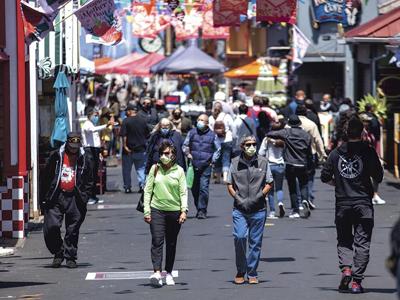

ARMIES AND NAVIES DURING WORLD WAR I HAD A REAL CHALLENGE OFF THE BATTLEFIELD. Waves of infection would run through soldiers and sailors, taking them out of commission. How to stop it? Doctors and scientists studied pathogens trying to figure out just how they created these waves of illness, according to a 2020 article in the medical journal The Lancet. In 1919, bacteriologist W.W.C. Topley found a clue in studying groups of mice: New mice susceptible to illness introduced to an existing group of mice kept the infection going. Stop introducing susceptible mice and the infection ceased.
In 1923 he and another scientist, G.S. Wilson, coined the term to describe what happens as “herd immunity.”
Herd immunity is simply when enough people in a community have built up antibodies against a virus, either through having been sick from it or through vaccination. “There is a tipping point when there is no one left for the virus to infect and it will go away, that’s what we’re aiming for,” says Montage Health’s infectious disease expert, Martha Blum. Vaccination is always the preferred method.
Vaccination keeps most people safe, unlike letting people get sick and having a significant percentage either develop disabilities or die. Before the first Covid-19 vaccinations took place in December, more than 350,000 U.S. residents died as a result of the virus. Since vaccines were introduced, the death toll has fallen to the lowest levels since the early days of the pandemic. And that’s without having reached herd immunity yet.
What is the percentage needed to reach herd immunity? It depends on which expert you talk to, but the range is between 65 to 85 percent, with most falling in the 70-80 percent range.
Even then, transmission won’t completely stop. “A lot of this depends on what community you are talking about. People move around, go from place to place. There could be pockets, certain neighborhoods, where vaccination rates and immunity are much lower so if someone new moves into the area you could see little outbreaks happening,” Blum says.
As of May 24, 60 percent of eligible people in Monterey County have had at least one shot of a Covid-19 vaccine. The Centers for Disease Control reports that as of the same date, 49 percent of people ages 12 and up had received at least one dose and 39 percent were fully vaccinated.
Blum says the rate of return for the second shot is over 90 percent in the county, and some of the less than 10 percent may have received a second shot outside of the county. That is good news since in the case of the Pfizer and Moderna vaccines it takes two shots to be effective. (Along with the Johnson & Johnson vaccine, dubbed the “one and done,” people are vaccinated must wait two weeks until after their shot to consider themselves fully vaccinated.)
Will Monterey County reach herd immunity? Mahendra Poudel, infectious disease specialist for Salinas Valley Memorial Healthcare System, says local doctors are hopeful based on how far the county has come in its vaccination efforts. But there’s still more that has to be done, he says. The county has likely reached everyone who was anxious to be vaccinated and are now working on those who have either taken a wait-and-see approach or who are hesitant. Data released on May 14 by the U.S. Department of Health and Human Services estimates that 12 percent of Monterey County residents are “hesitant or unsure,” with nearly 4 percent “strongly hesitant.” Doctors acknowledge there are some who will never vaccinate.
So far, the continuing research on how the Covid vaccines are working shows them performing better than they did in clinical trials. That being said, the rise of new variants or not enough people getting the vaccine means that annual or biannual booster shots “could be a real possibility,” Poudel says. “If I had to make an intelligent guess I would say it could happen.”
Blum agrees it’s a “reasonable expectation” that boosters will be needed. “We’re not far enough along to know how long-lasting the immunity is,” she says, either from vaccines or from having been infected. Currently, vaccine manufacturers know they are good for at least six months.
Blum says it’s possible that after a year or two boosters will be recommended, and it will be similar to – or maybe even the same as – getting an annual flu shot. “There’s a lot of confidence that they’ll be able to make combinations,” incorporating both flu and Covid strains, she says.


(0) comments
Welcome to the discussion.
Log In
Keep it Clean. Please avoid obscene, vulgar, lewd, racist or sexually-oriented language.
PLEASE TURN OFF YOUR CAPS LOCK.
Don't Threaten. Threats of harming another person will not be tolerated.
Be Truthful. Don't knowingly lie about anyone or anything.
Be Nice. No racism, sexism or any sort of -ism that is degrading to another person.
Be Proactive. Use the 'Report' link on each comment to let us know of abusive posts.
Share with Us. We'd love to hear eyewitness accounts, the history behind an article.