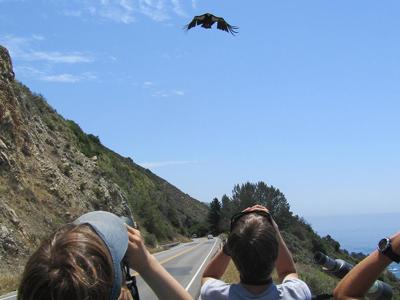

It wasn’t until after the fact that Heather Gaya realized handling dead calves might be considered gross. Her instructors at condor camp in Big Sur had opened a freezer full of calf, rabbit and rat carcasses – condor food – then sent Gaya and her cohort out on a night hike. They drove stakes through the dead animal to keep it in place on a steep slope, so the next day they’d be able to watch condors feed.
“They just acted like this was a normal daily activity,” Gaya recalls.
For the condor biologists at Ventana Wildlife Society’s base camp, deep in Big Sur at the end of a steep 17-mile dirt road, this was and is a normal activity. (They set out the food – mostly stillborn calves donated from ranches, free of toxic lead bullets – after dark to help ensure that condors don’t start to associate humans with food.)
Three-day condor camps give teens the opportunity to work alongside field biologists – not watching demonstrations, but doing actual science, including unglamorous tasks.
Besides feeding North America’s largest landbird, kids also track them using radio telemetry and record their movements on a clipboard, data that then gets recorded into a database alongside the data professionals record. “The fact that our data was equally valuable definitely made it feel like I was contributing,” Gaya says.
For Gaya, who’s now a senior at Whitman College in Washington and plans to pursue a PhD in evolutionary biology and ecology starting next year at the University of Minnesota, condor camp was a turning point. Prior to that, she’d envisioned going into computer engineering like her dad. But being outside, camping deep in Big Sur and doing science expanded her view of what being a scientist could look like.
“It was actually going out and working with the wildlife and the ecosystem, while being in the ecosystem,” she says.
The program also converted her into a bird enthusiast. “I hadn’t ever seen a condor, and wasn’t entirely sure of the difference between vultures and condors,” she recalls. “They’re weird ugly birds, and they don’t even have vocal cords so they make weird noises. [The camp] turned it into an actual animal.”
That’s exactly the goal of Ventana Wildlife Society in bringing teens out to the field for these short programs (night one is at Andrew Molera State Park, night two at the base camp): They’re aiming to inspire a new generation of scientists, like Gaya, but also to get people to care about the weird, ugly birds the nonprofit is devoted to protecting. The large scavengers, which help complete the food web, are endangered due to DDT and lead poisoning from spent ammunition.
“Condor camp is ideal for teens interested in getting first-hand experience,” says Alena Porte, VWS education manager. “For others, even if they don’t go into biology, it’s a great opportunity to connect with nature. It’s more likely someone will steward the environment if they’re connected with nature.”
As for Gaya, she’s considering specializing in ornithology for her PhD.





(0) comments
Welcome to the discussion.
Log In
Keep it Clean. Please avoid obscene, vulgar, lewd, racist or sexually-oriented language.
PLEASE TURN OFF YOUR CAPS LOCK.
Don't Threaten. Threats of harming another person will not be tolerated.
Be Truthful. Don't knowingly lie about anyone or anything.
Be Nice. No racism, sexism or any sort of -ism that is degrading to another person.
Be Proactive. Use the 'Report' link on each comment to let us know of abusive posts.
Share with Us. We'd love to hear eyewitness accounts, the history behind an article.