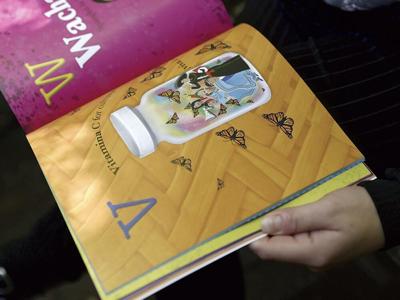

MONARCH BUTTERFLIES, a symbol of immigration, dance around and inside a jar that also has other important Latin ingredients: music, dance, and beloved characters. This jar might remind you of recycled containers Latino families use to save their leftovers and salsa in the fridge: You don’t know what you’re going to find inside. This is the imagery in Vitamina C for Cultura, the second book of children’s Spanglish literature by Suzanne García-Mateus and Mando Rayo, and illustrated by Martha Samaniego Calderón. García-Mateus is a bilingual education professor and director of the Monterey Institute for English Learners at CSU Monterey Bay, and Rayo is a Texas-based storyteller and taco-focused journalist.
Their first book, Vitamina T For Tacos, was an alphabet book all about tacos – F is for fajitas, J is for jalapeño, O is for onion and E is for esquites, corn with mayonesa, butter y chile. It’s told in Spanglish, a hybrid language many Latinos, Hispanics and Chicanos have used for generations. The second book continues in Spanglish, this time revolving around costumes, celebration and activism.
Vitamin C for Cultura shows different scenes like the letter T for watching telenovelas (soap operas) with your grandma, R for resistencia, and M for mariachi music. Some letters feature names and illustrations of famous people, like Dolores Huerta, an activist and co-founder of the United Farm Workers, and Ch for El Chavo del Ocho, a fictional character from a Mexican sitcom of the same name.
The new book also mentions a number of important social movements including women’s rights, Zapatistas (a movement that seeks indigenous people’s autonomy in Chiapas, Mexico) and Black Lives Matter.
“This whole idea around social justice is really embedded in this book,” Rayo says.
“I see this book as a great way to jumpstart a conversation about resistencia – resistance – or about the use of Spanglish or anything that Dolores Huerta and Cesar Chavez stood for,” García-Mateus adds.
Rayo says many Latinos grew up speaking only Spanish at home, but English outside of home – in some places, they were punished or ostracized for speaking Spanish. The celebration of Spanglish in these books is a way of reclaiming their dual-language reality. “Now is an opportunity to take it back and to show this younger generation that they can embrace their culture,” says Rayo, who speaks Spanglish and has an accent. “It’s OK to have an accent, it’s OK to speak in your own way. It’s OK to use Spanglish.”
On the W page (that’s for Wachalo, Spanglish for Checkalo) the illustration shows a man wearing a green T-shirt that reads: “Tu español es bello,” meaning “your Spanish is beautiful.” García-Mateus says these books are written and illustrated with the goal to celebrate kids’ bilingual and bicultural identities, and make them feel proud to speak Spanish. “A way to celebrate nuestra cultura,” the tagline reads.
The book also goes beyond the authors’ own Mexican heritage, to include Puerto Rican and other Latinx people as well. Characters in the books reflect a range of ages, skin colors and also feature androgynous looks.
“We want to speak to a larger audience,” García-Mateus says. “I think leaving that open is good for readers to decipher and then talk about whether or not the intention was there.”
García-Mateus wants kids to know there are books out there that represent their culture and background. “There’s people like us, like Mando and Martha and I, and that we’re here and that were present, and that we see them.”


(0) comments
Welcome to the discussion.
Log In
Keep it Clean. Please avoid obscene, vulgar, lewd, racist or sexually-oriented language.
PLEASE TURN OFF YOUR CAPS LOCK.
Don't Threaten. Threats of harming another person will not be tolerated.
Be Truthful. Don't knowingly lie about anyone or anything.
Be Nice. No racism, sexism or any sort of -ism that is degrading to another person.
Be Proactive. Use the 'Report' link on each comment to let us know of abusive posts.
Share with Us. We'd love to hear eyewitness accounts, the history behind an article.