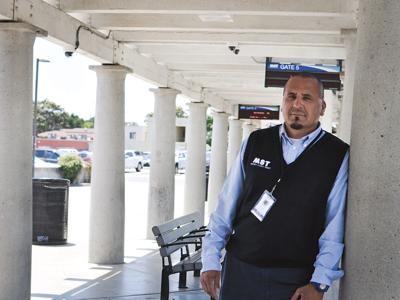

BEFORE BECOMING A BUS DRIVER FOR MONTEREY-SALINAS TRANSIT, Castroville resident Ruben Cano worked a particularly physical job at a warehouse. He hated it. But 13 years ago – “on Aug. 23,” he says, to be precise – he applied and got the job to become a coach operator for MST. He loved it then and still loves it now. He loves the simplicity of his job despite the long hours. He likes being able to interact and help people from all walks of life, despite the demanding responsibility of always having to be on time.
Cano wouldn’t have it any other way. Currently, he’s on a rotation as an interim operations supervisor, and he’ll switch off after six months with other equally or more experienced coach operators in this position to make sure things outside of the bus – like coordinating routines and upholding customer service – run smoothly. But when he is in the driver’s seat, he wakes up for his workday when most people are sleeping.
His earliest shifts start at 5:30am, and he wakes up at 3:30am. “I’m slow!” he says with a laugh. “I need my morning routine.” Like clockwork for almost 13 years, he’ll take a shower, have his breakfast and his two cups of coffee and then he’s off to work a nine – to 13-hour shift. Depending on the time, day and route, he could be driving a 35-foot bus or 45-foot Greyhound-sized bus.
“Overall, I like everything about it. It’s getting people from point A to point B,” Cano says. “But at the same time, it’s a lot of responsibility. You’re driving a 40-foot bus full of passengers through traffic.”
That responsibility includes getting riders to work or school or doctor’s appointments on time. During the pandemic, that sense of importance, urgency and responsibility held steady, even with reduced ridership and a plexiglass divider between him and his passengers.
Part of what Cano loves about his work is interacting with all kinds of people. “Everyone uses the bus,” he says. “I’ve met people who have had a DUI so they can no longer drive, and people with medical disabilities that don’t allow them to drive. Some people just don’t want to deal with all the expenses of having a car. Some days it’s a transient person who doesn’t have enough money.”
Cano deals with the diversity of riders with a sense of generosity. If a person can’t afford the fare, he doesn’t question it. “I’ll explain, ‘Hey, we don’t give out free rides, but for this time I’ll give you one.’ Or if they’re a few cents short, I’ll just let them on. What’s a few cents?”
Even during the pandemic, interacting with passengers from all backgrounds and circumstances remained a constant while doing his job. Sometimes, it involves doing more than just driving. “There are people with disabilities or anger issues, but it’s about staying humble and great communication,” he says. (Luckily, he adds, he’s never been yelled at or had to diffuse a fight. “It’s calm compared to bigger cities. You hear all kinds of stories from San Jose or Los Angeles.”)
There are some differences in how Cano does his job due to the pandemic. There’s the plexiglass divider, and early on the number of passengers was limited.
There’s also the stuff that the passengers don’t get to see, like strict sanitizing protocols, left to a different team after Cano is done with a particular bus for the day. “We work as a team,” he says. “It’s a good team to be a part of. I’d pick this job any day.”

(0) comments
Welcome to the discussion.
Log In
Keep it Clean. Please avoid obscene, vulgar, lewd, racist or sexually-oriented language.
PLEASE TURN OFF YOUR CAPS LOCK.
Don't Threaten. Threats of harming another person will not be tolerated.
Be Truthful. Don't knowingly lie about anyone or anything.
Be Nice. No racism, sexism or any sort of -ism that is degrading to another person.
Be Proactive. Use the 'Report' link on each comment to let us know of abusive posts.
Share with Us. We'd love to hear eyewitness accounts, the history behind an article.