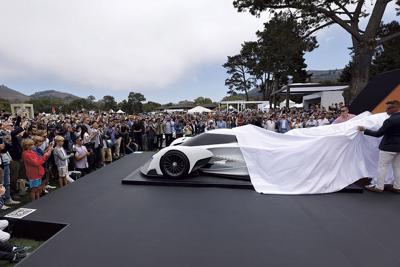

PAUL HAGEMAN PAUSES FOR A MOMENT. He has been chatting about two significant performance cars from the past, the Lamborghini Miura and the McLaren F1, but in the middle of the conversation a realization intrudes.
“The thought hadn’t occurred to me that the Concours is older than those two marques,” he says after a brief pause.
Pebble Beach Concours d’Elegance began in 1950. Lamborghini launched in the 1960s, while the McLaren F1 was a ’90s phenomenon. But the reason for his astonishment extends beyond a discussion of cars or timelines.
While a Lamborghini Miura – considered by many as the first true “supercar” – has been showcased on the lawn at Pebble Beach in recent years, the 2023 Concours marks the first appearance of McLaren’s F1, the model that ignited supercar mania.
Three F1s are scheduled for display at Concours d’Elegance on Sunday, Aug. 20. And just as they shook the performance car world and punctured bedroom walls with millions of tack holes, the arrival of the sleek machine on the fairway at Pebble Beach is also rippling the staid showcar waters.
Hageman has been a Concours judge and has presented cars from his own collection. At 36, he’s now the youngest member of the Pebble Beach selection committee.
“One of the arguments I’ve made is that we celebrate 1950s racing Ferraris,” he says. “They were that era’s version of the ’90s McLaren F1. What we consider a concours car has to evolve over time.”
Such is the influence of the supercar. But Gordon Murray – the designer behind the McLaren F1 – dismisses some of its iconic status. Defining it as the first of the modern supercar era misses the point, he explains.
“A better way to describe it is that it took supercars to a different level,” he says. In creating the F1, Murray didn’t sacrifice performance. But he also refused to place 0-60 and top speed marks ahead of the driving experience.
“The only reason I calculated the top speed was that I had to work out the ratio for sixth gear,” Murray points out.
More than two decades after revealing the F1, he’s back at it. As head of Gordon Murray Automotive, he has crafted two new supercars – the F.33 and the F.50 – that are the antithesis of what his original beast unleashed.
That’s where any story of the modern supercar and the future of concours cars must begin.
Murray made his reputation as technical director of winning Formula 1 racing teams, first at Brabham and then McLaren, where he contributed to consecutive championships in 1988, ’89 and ’90 before shifting to performance road cars.
“At the time the McLaren F1 was built, it represented everything they knew – it was cutting edge,” observes Aaron Robinson, editor for the lifestyle and collectible car insurance firm Hagerty. “Now he’s deliberately making a retro piece.”
The F.50 and F.33 evoke the suave lines of sports cars from earlier decades. They sit just a little higher to accommodate the potholes and speed bumps that keep many supercars garaged. Murray eschews computerized aids, preferring an analog machine powered by internal combustion.
“It’s as if they don’t want to acknowledge the last 20 years have happened,” Robinson says.
The high-speed exploits of the McLaren F1 were eventually overtaken by the Bugatti Veyron and others as innovative technologies became available.
“We’re not following any trends,” Murray acknowledges. “There seems to be a race to make the most outrageous design.” He’s referring to the sculpted air intakes, the angles molded into the body, the diffusers and stance, all designed to take advantage of aerodynamics, as well as to set the car apart from run-of-the-mill sports cars.
Murray believes that other designers look for a horsepower number or speed. Those targets, and information gleaned from the wind tunnel, guide the look of most supercars.
“Engineering has reached a point where it’s hard to make something that’s stylistically interesting,” Hageman agrees, applying Murray’s complaints to family cars, as well. “From a car guy’s perspective, sometimes there’s a lack of newness.”
Ferrari was one of the first manufacturers to rely on wind tunnels to finesse the design for their road vehicles. According to Robinson, the Ferrari Enzo was the first sports car to reveal the appearance of top speed.
“Speed isn’t necessarily pretty, a lot of people don’t realize that,” he says. “Mathematics and string – that’s how the most beautiful cars were designed.”
Yet the unique aesthetic is considered one pillar in the definition of a supercar. On that point, most people agree. To sort out the nuances between supercar, the more intense hypercar, or the more common sports and muscle cars becomes more difficult.
Sean Evans, writing in New York magazine, noted that “very few supercars are hypercars, but all hypercars are indeed supercars,” which sounds clever enough. In general, those who have ventured into this nebulous territory consider performance – in terms of horsepower, speed and engineering – price and production numbers as factors, too.
In Evans’ analysis, the Corvette – with its low six-figure price tag and large numbers coming off the assembly line – falls short, as do other desirable models.
Murray adds “driving experience” to the definition. By this he means the raucous growl of the engine, the feel from the driver’s seat, even the tug on the steering wheel as the car burrows into a corner.
“It’s a car you have to drive,” explains Dario Franchitti, four-time IndyCar champion and three-time winner of the Indianapolis 500, referring to the T.50. “It gives you the emotional connection of an old-school car.”
Franchitti is likely to say good things about the T.50 and T.33. He works for Gordon Murray Automotive and is on the waiting list for a T.50.
But others see it as a benchmark car, akin to the McLaren F1 – although perhaps pointing to the past rather than the future.
“I think it will be the last conventional supercar,” Hageman says of the T.50. “Automotive technology will pull us away from the gasoline engine.”
And that has helped bring modern supercars into the concours mix.
Robinson sees in the fading influence of Baby Boomers on the collector market that is both fascinated by the same eras – road cars from the ’20s to the era of American muscle – and open to new categories. “The collector world has been celebrating to death the post-war cars,” he says. “Some people are fatigued by that.”
Lamborghini has been recognized at Concours in the past. Rafael Gabay, a resident of the Philadelphia area, is showing a lime green 1968 Lamborghini Miura T400.
“When you compare the cars of that era, it was very innovative in shape, very innovative as a mid-engine car, and it was one of the fastest cars of the era,” Gabay says. “You’re seeing a design that is still relevant.”
For those reasons, many identify the Miura as the first supercar – although there are those who peer as far back as the Duesenberg Model SJ of the 1930s, the Mercedes 28/95 from the early 1920s or even the 1913 Mercer Type 35-J Raceabout.
One of the first mentions of the term can be found in a November 1920 edition of London’s The Times, where an advertisement suggested “If you are interested in a supercar, you cannot afford to ignore the claims of the Ensign 6.”
But Murray is having none of it.
“You can argue that there were cars in the 1930s that had a greater performance envelope than all other cars at the time,” he says. “But the Miura was the first real motorcar to have all those elements of a supercar.”
And that includes driving experience, at least according to Gabay. “It’s very responsive,” he notes. “And that growl is beautiful.”
The Gordon Murray Automotive T.50 and T.33 may spark the next revolution in supercars or mark the internal combustion swansong. But there’s no question that the F1 he designed while at McLaren caused a stir at the time. It is also signaling change at the showcar level, even as it graces the lawn at the Pebble Beach Concours.
“That’s where Pebble’s inclusion of ’70s, ’80s and ’90s is a good thing,” Hageman says. “It’s bridging the gap to a new generation while its showing an older generation that what they love about those [older] cars continued for several decades.”


(0) comments
Welcome to the discussion.
Log In
Keep it Clean. Please avoid obscene, vulgar, lewd, racist or sexually-oriented language.
PLEASE TURN OFF YOUR CAPS LOCK.
Don't Threaten. Threats of harming another person will not be tolerated.
Be Truthful. Don't knowingly lie about anyone or anything.
Be Nice. No racism, sexism or any sort of -ism that is degrading to another person.
Be Proactive. Use the 'Report' link on each comment to let us know of abusive posts.
Share with Us. We'd love to hear eyewitness accounts, the history behind an article.