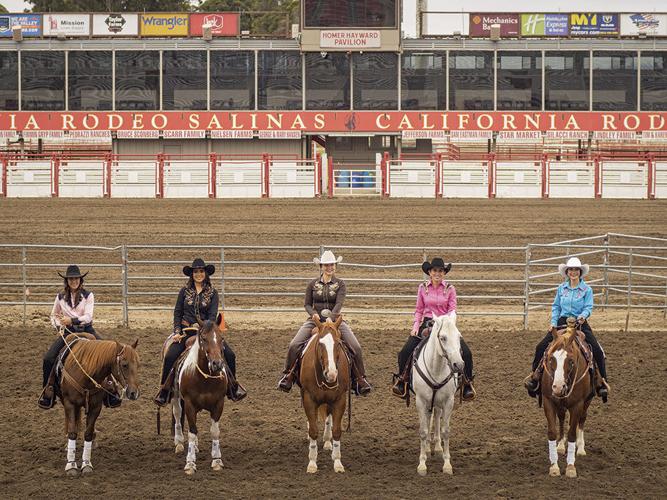
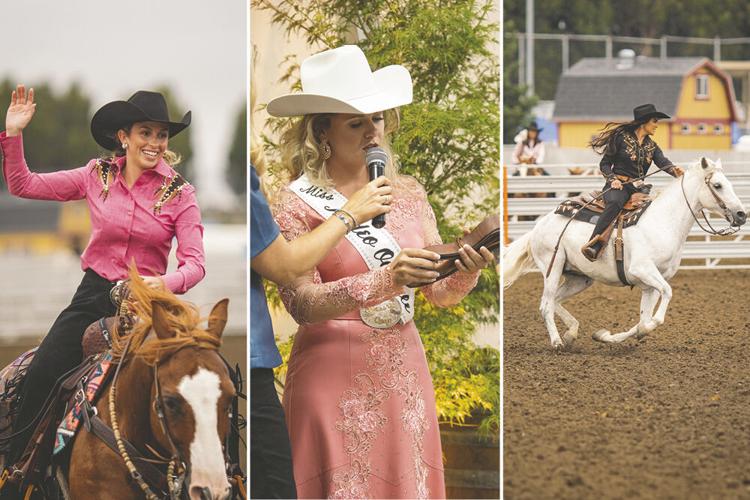


From left to right: Macee Nunues, from the Sierra foothills, competes in the horse-riding competition on July 7; this year’s five contestants for who would become the next California Salinas Rodeo queen; Soledad’s Karina Leyva shows off her equestrian skills during the July 7 horse-riding competition.
ON AN OVERCAST MORNING ON FRIDAY, JULY 7 AT THE SALINAS SPORTS COMPLEX, A GROUP OF SIX YOUNG WOMEN, EACH SITTING ASTRIDE A HORSE, WAIT IN THE OFFING OF THE FACILITY’S RODEO ARENA. In the stands are friends, family and other spectators – about 60-70 people, all told – and they are there to watch the first event, which is a test of riding skills.
Though the Miss California Rodeo Salinas competition has the sheen of a beauty competition, it’s how one rides horses that garners the most points: 40 percent. The breakdown of the rest of the scoring is 30 percent on appearance (judged as a combination of appearance and style), 20 percent for personality and 10 percent for performance on a written test.
The purpose of these metrics is so Miss California Rodeo Salinas – royalty for the biggest rodeo in the state, dating back to 1911 (and the only one in America pronounced ro-day-o) – can serve as an ambassador both for the event and the sport throughout the coming year. How one presents herself to the public is critical. And on this Friday morning, how one rides a horse is the first test.
The emcee of the horse-riding event is Grace Erickson, Miss Rodeo from 2013 and a Hollister native. She tells the prospective royalty – and the crowd – what they’re about to be asked to do. Mayson Bothwell, last year’s representative, rides out on each occasion to demonstrate.
One after another they ride out and perform a series of maneuvers. After each demonstration, they exit the track, watch their competitors ride, and then return for the next demonstration. They do a trot, an extended trot, they lope, put their horses in reverse and so on.
Then they have to ride in a pattern, like a figure 8, during which they must stop their horse in the middle of the arena, dismount, remount, and carry on.
After remounting, one contestant, Rose Escobar lets her horse rip around the curve at a sprint, the only contestant to do so.
To the uninitiated, it’s not clear if that’s a good or a bad thing, but it is fun to watch.
Meanwhile, two pairs of judges are examining skills from different parts of the stands, taking notes and scoring the performances.
Later in the competition the contestants randomly switch horses and are asked to perform maneuvers on a horse they’re unfamiliar with – Miss Rodeo has to travel throughout the state over the course of the coming year, and will often have to ride horses they’ve never met.
Those in the crowd are quiet, but watching attentively, and depending on whether it’s one of their friends or family members riding, shooting pictures or video.
There isn’t a lot of chatter once the event ends after 10am, but the vibes are suffused with pride: all the contestants showed well, and these young women, and likely their families and friends, have put in a lot of work to get them to this day. Becoming a Miss Rodeo – or even competing to become one – requires a community of support. For one, it’s expensive: a good horse can cost tens of thousands of dollars. And then there’s the cost of feeding and boarding the prized animal. And even for the uninitiated, it’s evident that participating requires a lot of practice and training.
It’s also clear that a bond develops between young women who all share a love of Western culture, horses, and the rodeo itself.

(left) Macee Nunues, from the Sierra foothills, competes in the horse-riding competition on July 7. (center) Jamestown’s Karissa Rogers answers questions during the personality and appearance competition. (right) Soledad’s Karina Leyva shows off her equestrian skills during the July 7 horse-riding competition.
“It was the best time ever,” says Erickson, who emceed the horse riding event, and who won the crown in 2013. About the rodeo in general, she adds, “Being a queen, you get to be a tiny part of it, and it’s the coolest thing to be a part of – the people are great, the volunteers, there’s so much great tradition. It was truly an honor to be a part of it.”
Erickson still keeps in touch with the others. They gather for reunions every five years – the next is in 2025. The rodeo is something she fell in love with when she was 4 years old, and becoming Miss Rodeo was a longtime dream.
“It’s something I always wanted to do,” she says, adding that her mother has a picture of her as a kid wearing a “way too big” cowboy hat with a crown on top of it. The people she met, the organizations she helped advocate for were all part of what made it rewarding. But the high she gets every year now comes during the rodeo in Salinas, the state’s biggest rodeo.
“There is probably no better feeling than doing our fly-by track wave at Salinas. When queens are introduced after the grand entry, queens make their entrance on horseback at full gallop waving to the crowd, and it’s the best feeling ever.”
Jynel Gularte, a friend of Erickson’s, and who grew up in Gonzales, was crowned a year later, in 2014.
She says not every queen competition around the country includes horse-riding as a component, and that it speaks to the region’s “ties to our vaquero and Spanish roots.”
Even though it’s expensive to compete, Gularte says, it’s achievable for those who really want it. “If you want something, you work to make it happen – a lot of these girls raise money with fundraisers,” she says. “Sometimes, you just have to get creative in life.”
What’s clear in talking to both Erickson and Gularte is their enduring love for the event, and their joy in remembering their own experiences being a part of it, something they’ll carry with them for the rest of their years.
Later in the day there’s a scholastic test of sorts – worth 10 percent of the scoring – that challenges knowledge beyond the arena. As an ambassador for a year, Miss Rodeo must be able to converse and make presentations. There are also one-on-one interviews with six other judges – different than those overseeing the horse riding competition – and those will help determine the results of the two remaining categories: personality (30 percent) and appearance (20 percent).
Gularte says the “appearance” category is interpreted as a presentation of Western style.
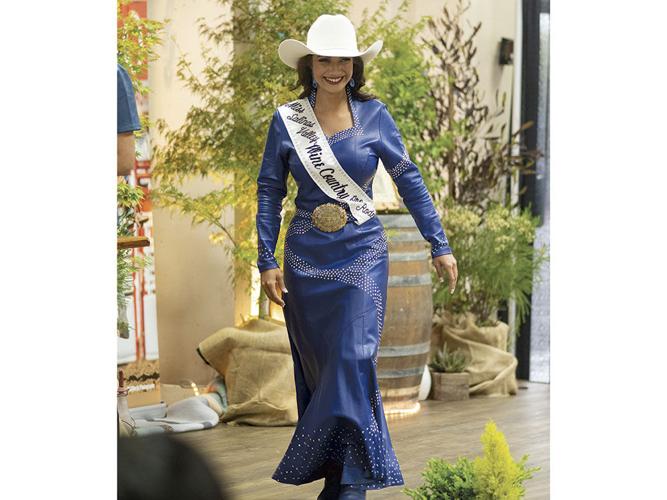
In the evening, the Rodeo room at the Salinas Sports Complex is packed to capacity with dozens in attendance, and one-by-one, the contestants come out, do a red carpet walk and several twirls, before being asked five questions – some of them different for each contestant – by KSBW’s Brittany Nielsen.
Nielsen asks them what they like do outside of the rodeo, what the last year has been like in preparing for the event and about the life lessons they’ve learned during the process. There is a question about social media and also about how solve homelessness (that seems like a big ask of young women when generations older than them still haven’t cracked that code). Then there is a question about a piece of tack – horse equipment – that they have to name and describe its purpose.
More questions come about horses and how to care for them. The contestants are dressed up in fancy Western garb and wearing white cowboy hats. As in the horse-riding competition, they all perform well. It’s hard to say who’s got the upper hand. The winner won’t be announced until an awards banquet the next morning, but all of the contestants are glowing, beautiful, and soaking up the moment.
“It’s a tough cowgirl contest – a cowgirl that has good poise, and is well spoken and that can go out in front of 1,000 people and speak,” Escobar says. “You’ve got to have good hair, but that goes along with having good poise and being a lady.”
The California Rodeo Salinas is both a local rodeo and a statewide one – it’s the biggest, the best – and women from all over the state compete to be Miss Rodeo. This year there were two local participants, Karina Leyva from Soledad and Escobar from Greenfield.

Greenfield’s Rose Escobar, seen here on July 7 during the personality and appearance portion of the contest, was crowned Miss California Rodeo Salinas on July 8.
The next morning, July 8, Escobar is crowned for the 2023-24 year. Speaking about the whole journey a few days later, she says, “I’m so excited, I am so blessed to do it,” adding that when she was 7 years old, she did a project while attending Spreckels Elementary about what she wanted to do when she grows up. She made a buckle.
Escobar, 20, now works in Monterey for Merrill Lynch as a client associate, and was never able to attend college. She grew up in the Alisal neighborhood of Salinas without much money for more than what was needed. Every time she wanted to go to rodeo, she had to save up for it. She’s been working since she was 15. Both of her parents lost their jobs when Covid hit and she had to help make up the slack.
Some of the money her parents had put away for her to attend college she instead put toward a barrel-racing horse, which has paid off; she’s won a number of competitions.
Escobar credits her parents for making this whole dream come true – and also Gularte, who’s been her coach in the run-up to the competition.
“She’s helped four girls win this title,” Escobar says. “I couldn’t have done it without her.” 🐴


(2) comments
Here're two lovely quotes re: the subject at hand:
"The eighteen-year-old rodeo queen and her princess told me that rodeo people, including themselves, 'hated Democrats, environmentalists, and gays.' I was astonished that their political and social outlook could be reduced to such simple platitudes of hate. And why?" (--from "Rodeo Queens and the American Dream," by Joan Burbick, Public Affairs, NYC, 2002)
"Women should not rodeo any more than men can have babies. Women were put on earth to reproduce, and are close to animals. Women's liberation is on an equal to gay liberation--they are both ridiculous." (--a Wyoming steer wrestler, in the 1982 book, "RODEO: An Anthropologist Looks at the Wild and the Tame," by Elizabeth Atwood Lawrence, Univ. Tenn. Press)
Rodeo is not a "sport" - It's mostly hype, a macho exercise in DOMINATION, an activity condemned by every animal welfare organization on Planet Earth, due to its inherent cruelty. It needs to end.
Two anecdotal quotes, one from 2002, the other from 1982 LOL, are not enough to condemn a historical practice. To add to that, you recently commented that true ranchers do not participate. This is entirely untrue. I went to a ranch rodeo just yesterday and had a wonderful time. It is a shame that you were not there. I think you would have found it particularly edifying.
Welcome to the discussion.
Log In
Keep it Clean. Please avoid obscene, vulgar, lewd, racist or sexually-oriented language.
PLEASE TURN OFF YOUR CAPS LOCK.
Don't Threaten. Threats of harming another person will not be tolerated.
Be Truthful. Don't knowingly lie about anyone or anything.
Be Nice. No racism, sexism or any sort of -ism that is degrading to another person.
Be Proactive. Use the 'Report' link on each comment to let us know of abusive posts.
Share with Us. We'd love to hear eyewitness accounts, the history behind an article.