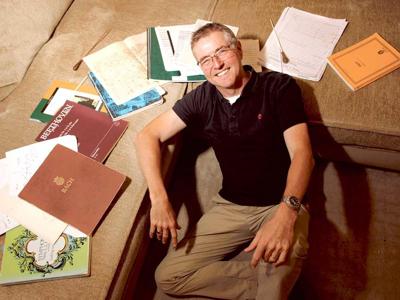

In programming the 81st Carmel Bach Festival, Artistic Director and Principal Conductor Paul Goodwin says that themes and concepts were not as important to him as impact and variety.
“That said, there are some important milestones in the festival,” he writes by email from London before arriving in Carmel for rehearsals.
He’s infusing joy into the opening with the majestic opera Carmina Burana by Bach devotee Carl Orff; building on past performances of Italian and French opera, here with German opera from Handel to Wagner; and including pieces by Leonard Bernstein to celebrate the conductor/composer’s 100th birthday.
Goodwin’s prone to throwing a curve ball (or, in the vernacular of his native England’s game of cricket, a swing ball) into the festival’s proceedings. One of them is I Hear America Singing, directed by festival Associate Conductor and Chorale Director Andrew Megill, sung by the Carmel Bach Festival Chorale, and accompanied by a lone pianist.
“In my efforts to promote all kinds of international composers,” Goodwin continues, “sometimes American composers do not have their fair share of festival time, so when Andrew Megill came up with this fascinating program of all American choral music, I jumped at the chance of presenting it.”
It’s a one-night-only performance, July 26, on the Sunset Center’s main stage, divided into two acts, organized into five parts, and jammed full of American hymns, spirituals, folk songs, music set to poems, and jazz standards. It’s all in English, but supertitles of the lyrics will still be projected above. The festival’s dramaturge and master class director, David Gordon, will conduct a pre-concert lecture to get the audience oriented, then will open the concert by reading from Walt Whitman’s poem “I Hear America Singing.”
“I hear America singing, the varied carols I hear,/ Those of mechanics, each one singing his as it should be blithe and strong,/ The carpenter singing his as he measures his plank or beam.”
“It’s a real American experience,” Gordon says.
In the first section, comprised of music set to sacred texts, begins with two short, exalted pieces – “Glory to God on High” and “Slow Traveler” – by Jeremiah Ingalls, a New Englander from a musical family whose father died during the American Revolution. Ingalls was part of the First New England School, from which a uniquely American religious music emerged outside of European antecedents, and he set religious texts to secular/popular music.
“Psalm 67” by modernist American composer Charles Ives takes a more stately turn, but wrings beauty out of its bi-tonal harmonies. And you might hear Ives in the next number, Stephen Paulus’ “Pilgrim’s Hymn,” composed in 1997 and perched delicately between solemnity and awe. The popular, sprightly and robust “Hark! I Hear the Harps Eternal” – written by composer, conductor and teacher Alice Parker (who is 92 years old now), an important arranger of folk song, hymns and spirituals for influential conductor Robert Shaw – ends that section with the confidence of an anthem.
She’s a good bridge to the folk songs section, which ranges from Mack Wilberg’s arrangement of the song “Cindy,” which may trace its lineage to a black folktale and that includes a hoe-down section, to Craig Hella Johnson’s arrangement of Stephen Foster’s “Hard Times Come Again No More,” which sounds like a Celtic dirge or lament.
An intermission follows, which should give people time and space let all the music swirl around and seep in, and reflect on the chorale singers whom Gordon describes as youngish, spirited, bright, an “ensemble of solo singers.”
“Most of them have full-time solo careers rest of the year,” he says. “It’s great to give them a chance to shine on the main stage.”
They’ll appear in many of the festival’s concerts, accompanying the orchestra or chamber ensembles, but I Hear America Singing is constructed like a showcase for their vocal talents. Act 2 opens with tributes to American poets Walt Whitman, Emily Dickinson and Langston Hughes.
The tribute to Whitman’s “Jubilant Song,” set to music by Dello Joio, features syncopation, rhythm changes and propulsive tempo, all characteristic of early jazz music and all employed to dynamic effect. There are musical settings for two of Dickinson’s poems, both compelling narratives that display her sense of drama.
But lines from Hughes’ “Fire” might evoke grins as much as guilt: “Fire, Fire, Lord!/ Fire gonna burn ma soul! / I been stealin’/ Been tellin’ lies,/ Had more women/ Than Pharaoh had wives.”
The fourth section, two songs from the Great American Songbook, is like having dessert mid-meal. Julie Knowles’ arrangement of Jerome Kern’s “Just the Way You Look Tonight” is less swinging than Frank Sinatra’s definitive take, but it slows down the tempo and bends notes in a sweet way. And The Real Group’s arrangement puts a precise, uptown, scat-singing spin on Duke Ellington’s “It Don’t Mean a Thing.”
The fifth and final section, African-American Spirituals, opens with William L. Dawson’s exultant arrangement, which keeps the vernacular and elevates the majesty. “Elijah Rock” is a fun piece, full of starts and stops, a showcase of singing. And it all ends with Moses Hogan’s arrangement of “Ride on King Jesus,” an exultant ending to a concert that, without irony or cynicism, celebrates voices in praise of God and America.
“[Megill] creates concerts designed to enter into your heart,” Gordon says.
That’s just where the power of this concert is aiming.
I HEAR AMERICA SINGING begins with a pre-concert lecture at 6:30pm, performance at 7:30pm, Thursday, July 26, at Sunset Center, San Carlos and Ninth, Carmel. $35; $55; $68; $79. 624-1521, bachfestival.org/i-hear-america-singing


(0) comments
Welcome to the discussion.
Log In
Keep it Clean. Please avoid obscene, vulgar, lewd, racist or sexually-oriented language.
PLEASE TURN OFF YOUR CAPS LOCK.
Don't Threaten. Threats of harming another person will not be tolerated.
Be Truthful. Don't knowingly lie about anyone or anything.
Be Nice. No racism, sexism or any sort of -ism that is degrading to another person.
Be Proactive. Use the 'Report' link on each comment to let us know of abusive posts.
Share with Us. We'd love to hear eyewitness accounts, the history behind an article.