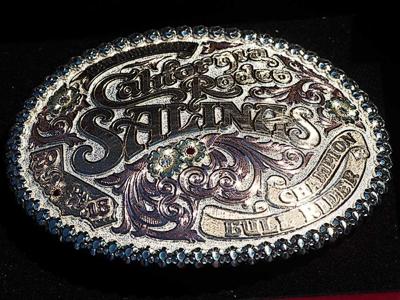
In certain parts of the South, the word “Coke” refers to any soft drink, from Dr. Pepper to Sprite. Fortunately, the regional dialects are not as severe – or bizarre – when applied to rodeo. But there are differences.
In Salinas, the rodeo is pronounced with the traditional Spanish emphasis, “ro-DAY-oh.” In other places, such as the Fort Worth Stockshow and Rodeo in Texas, it’s pronounced “RO-dee-oh.”
Other places avoid the matter entirely. The rodeo in Pendleton, Oregon? That’s called the Pendleton Round-Up.
I say ro-dee-oh, you say ro-day-oh. But call the whole thing off?
Rodeo has been around for awhile. Although often seen as a Wild West activity that began as ranch work and developed into sport during the late 19th century, rodeo is rooted in Spanish and Mexican culture. Colonial Spaniards introduced horses and cattle to the Southwest of what would become the United States.
It was vaqueros – not cowboys – who were essential in introducing both the skills and terminology that would later become the rodeos of today. The word “rodeo” itself stems from the Spanish word for round up, according to Mandy Linquist, who runs marketing and public relations for the California Rodeo Salinas.
“It’s pronounced ro-DAY-oh here because of the Spanish word rodear, which means “to round up” – and we still use that pronunciation for our name as a nod to the Spanish heritage,” Linquist reports.
After the Civil War, as settlers moved west, English-speaking cowboys became more common than Spanish-speaking vaqueros. Like their predecessors, they continued to work the range. They also held competitions to test their skills including roping, branding, herding, and other forms of training wild horses, according to the Texas State Historical Association.
These are some of the same skills practiced as sport today by rodeo competitors. (They’re also still skills that apply on working ranches.)
The California Rodeo Salinas will have historical figures and information booths about the rodeo and those who have participated throughout the years. It’s a way to tell spectators where the sport came from, just as the Spanish pronunciation continues to serve as a reminder of the historical background that created what we know today as a rodeo – however you say it.


(1) comment
Pronunciation is irrelevant here. Be aware that nearly EVERY animal welfare organization in North America condemns rodeo due to its inherent cruelty. Rodeos were outlawed in the United Kingdom (England, Scotland, Wales) in 1934. Can the U.S. be far behind? The late Cesar Chavez had this to say (from a 1990 letter to ACTION FOR ANIMALS): "Racism, economic deprival, dog fighting and cock fighting, bullfighting and RODEOS are cut from the same fabric: violence. Only when we have become nonviolent towards all life will we have learned to live well ourselves." Pope Francis has said much the same in his 2015 Encyclical on Climate Change. Words to live by. Sincerely, Eric Mills, coordinator ACTION FOR ANIMALS Oakland
Welcome to the discussion.
Log In
Keep it Clean. Please avoid obscene, vulgar, lewd, racist or sexually-oriented language.
PLEASE TURN OFF YOUR CAPS LOCK.
Don't Threaten. Threats of harming another person will not be tolerated.
Be Truthful. Don't knowingly lie about anyone or anything.
Be Nice. No racism, sexism or any sort of -ism that is degrading to another person.
Be Proactive. Use the 'Report' link on each comment to let us know of abusive posts.
Share with Us. We'd love to hear eyewitness accounts, the history behind an article.