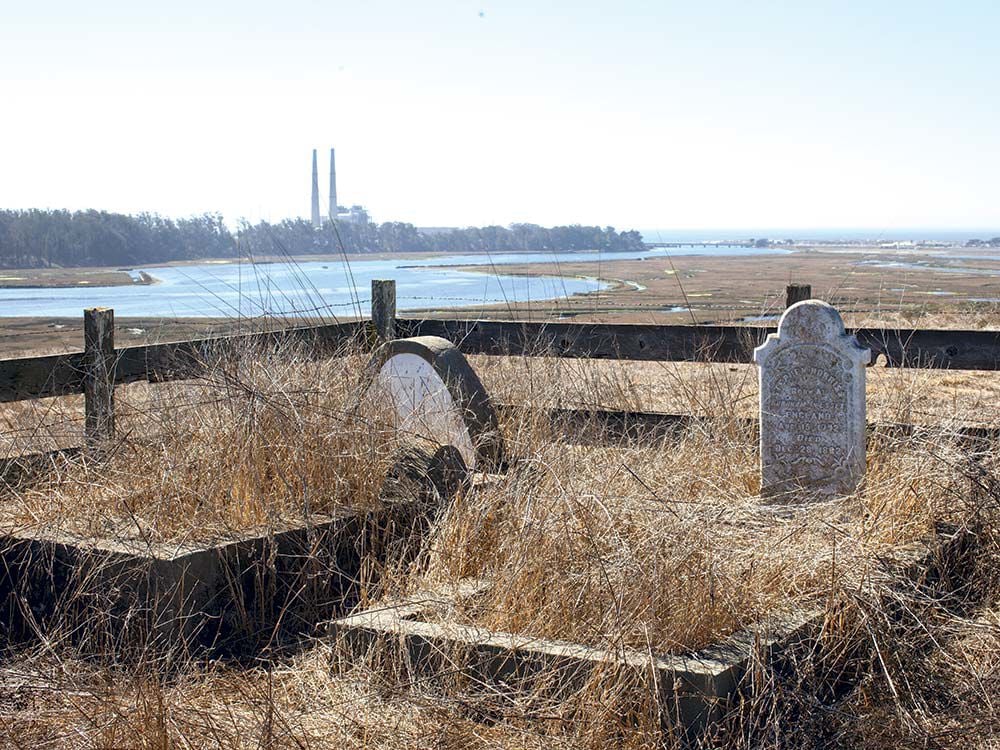

ON A WINDSWEPT PATCH OF GROUND OVERLOOKING ELKHORN SLOUGH AND MOSS LANDING LIE THE GRAVES of English immigrant Stephen Norriss, his Scottish wife Charlotte Elizabeth, their daughter Charlotte Roadhouse, her husband Joseph, and others from the Norriss and Roadhouse families, including their “Darling Babe,” as inscribed on a very small gravestone half buried in dirt.
The gravestones of the small family cemetery, on a crystal clear mid-October day, are obscured by dead grass growing haphazardly everywhere in the rectangular plot of land. The only dash of color among the brown grass and faded gray headstones is a lone pink naked lady flower blooming near the foot of Joseph’s grave, where he was laid to rest in 1871. His mother-in-law preceded him in death by two years in 1869. Stephen Norriss died in 1882 and his daughter Charlotte Roadhouse died in 1901.
The two men of the family came to the slough in 1852, purchasing grazing land for cows and horses. They each had a ranch on opposite sides from each other, Joseph to the north and Stephen to the south. (Roadhouse named the slough “Elkhorn” because the inlet’s shape reminded him of an elk’s horns.) They had the same arrangement in death: Stephen and his wife are buried on the south end of the cemetery and Joseph and his wife are on the north end.
How they came to lie there is the stuff of family lore. After dinner on Christmas Day, 1860, the families took a walk on the Roadhouse Ranch and picked the spot where they would all be buried, according to an account by the Norriss’ great-great-granddaughter Ethelda Bruce Copley, in the January 1973 edition of the now-defunct local magazine Game & Gossip. It’s a peaceful place with sweeping views of the slough, Monterey Bay and the sea beyond. (Copley died in 1974 and is buried in King City Cemetery.)
The Roadhouse Ranch eventually became part of the Packard Ranch, owned in part by Julie Packard, executive director of the Monterey Bay Aquarium. Ranch foreman Pedro Rodriguez, who’s worked on the ranch for 33 years, says he remembers a woman he believes was a descendant of the family who came decades ago at least twice to pull weeds and clean off the gravestones. Years later, another woman, also a relation, came all the way from New York to visit the site. No one has come around since then, he says.
The little family cemetery is not accessible to the public. It is one of more than 55 known cemeteries in Monterey County, from Prunedale to Bradley. Some are in plain view, while others are tucked away, like the Roadhouse-Norriss resting place.
There are more little family burial plots that are documented but largely unknown to the general public, like the Hambey family cemetery in Prunedale, founded in 1887. According to a 1985 news report, the family knew of 125 people buried there, although it was unknown then who all of them were, since 21 were without gravemarkers. And some of the people buried there showed up uninvited. The Hambeys moved to the Central Valley in the 1930s and didn’t return until years later, only to find some local residents made their way into the cemetery without anyone asking permission. The family erected a fence in 1954 to keep it from happening again.
Sometimes being out of sight means winding up being out of mind, which leads to unsettling results. In November 1991, a construction crew was excavating land near the intersection of Blackie Road and Commercial Parkway outside of Castroville when a skull fell out of loose earth being scooped up and rolled down an embankment. A total of 38 bodies were unearthed, according to news reports.
Archeologists determined from clothing buttons and coffin nails that the site was used as a cemetery between 1840 and 1870. A 90-year-old man came forward who thought it might have been his family’s cemetery, but there was no way to confirm. A fire in 1915 destroyed county records that might have shed further light. He had a vague memory that the plot had been divided in half between Catholics and Protestants. When it came time to move the bodies to a mass grave at the Moss Landing Cemetery, arrangements were made for a priest and a minister to preside over the ceremony.
One theory for why the Castroville family burial ground may have fallen into disuse was that the Moss Landing Cemetery was founded in 1869. Forty years later, the California State Legislature approved the creation of public cemetery districts, special districts that taxes residents to pay for the building and maintenance of cemeteries, like the Moss Landing Cemetery located within the Castroville Cemetery District. Monterey County formed eight districts between the 1930s and 1950s in unincorporated areas. They are overseen by board members who are appointed by the Monterey County Board of Supervisors to governing boards.
According to a 2015 report by the Local Agency Formation Commission of Monterey County, the districts inter about 9 percent of the more than 2,400 people who die each year. Cemeteries maintained by incorporated cities, like Cementerio El Encinal in Monterey and El Carmelo in Pacific Grove, account for more burials, along with other cemeteries run by private companies, churches and nonprofits. A small number of North County residents who reside within the Pajaro Valley Public Cemetery District are buried in one of five of its cemeteries in South Santa Cruz County.
When these districts were formed, most were taking over the care of cemeteries already in use, including early pioneer cemeteries. The Cholame Valley Cemetery District, in the Parkfield area, is a good example. When it was formed in 1959, the community wanted the district to maintain four small cemeteries established in the 1800s by families. Two are on private land and no longer in the district, the Parkfield-Todd and Imusdale cemeteries remain, with only about one burial within the district each year. In 2015, the district had zero income and only about $1,700 in assets.
The LAFCO report states plainly that “the business of cemeteries is changing.” More Americans are choosing to be cremated – in 2010, 40 percent of all Americans who died were cremated – which means a strain on cemetery finances. Some are adapting by adding in facilities for cremations, but smaller, older cemeteries like those in Cholame Valley’s district, as families move on or pass on, may one day be forgotten themselves.


(0) comments
Welcome to the discussion.
Log In
Keep it Clean. Please avoid obscene, vulgar, lewd, racist or sexually-oriented language.
PLEASE TURN OFF YOUR CAPS LOCK.
Don't Threaten. Threats of harming another person will not be tolerated.
Be Truthful. Don't knowingly lie about anyone or anything.
Be Nice. No racism, sexism or any sort of -ism that is degrading to another person.
Be Proactive. Use the 'Report' link on each comment to let us know of abusive posts.
Share with Us. We'd love to hear eyewitness accounts, the history behind an article.