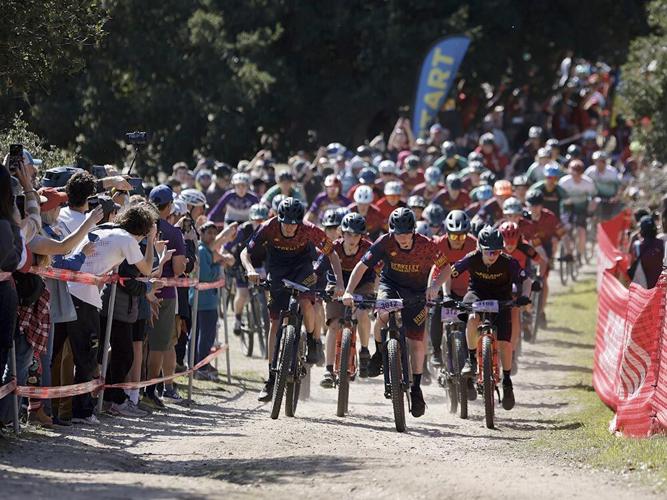

THE OPENING DAY OF ANY SPORT’S SEASON BRINGS WITH IT A SENSE OF ANTICIPATION, felt by all the athletes, coaches and parents. This particular February morning on the rugged grounds of the old Fort Ord near East Garrison was no different.
“We are all here for the same reason – we love to ride and we love to race,” said Jack Denny, a senior and captain of the Salinas High School mountain biking team before the day began. “It’s fun to see some of the same people from last year.”
But the morning was also wild, colorful and chaotic, at least to the novice eye. The NorCal league season opened with a race in Monterey County on Feb. 24. There were 45 teams from the Central and East Bay regions alone, with all teams bringing over 1,000 riders – high school and middle school squads, with athletes divided into classes like JV1, JV2, Freshman D1 or D2 and varsity – tearing over two distances, a 12-mile run for freshman riders and a 20-mile track for the other classes.
Salinas High is one of the oldest high school mountain biking teams in the state, and probably the country. It’s also one of the larger teams on campus, with 42 boys and girls making up the spring 2024 roster.
“We worked really hard to reach out to new riders this year,” says coach Bob Agan. Sponsors have provided loaner bikes for student-athletes without their own ride. There are 25 volunteer ride leaders, adults who work with the team in practice and on race days.
Over the 10 years Agan has been directing the Cowboys MBT squad, he has watched the sport grow dramatically. There is now a separate race for middle school riders. And more than 700 competitors routinely show up at NorCal events.
Just over a month later, as they prepare for a practice loop that will take them from the Toro Park neighborhood along Highway 68 to the steep inclines at the Badger Hills Trailhead on Fort Ord National Monument, coach Jill Eisner points out that it was not too long ago when none of this existed. There was baseball, football, basketball, volleyball, even tennis. But a mountain biking team at Salinas High?
“I wish they would have,” she says with a rueful smile.

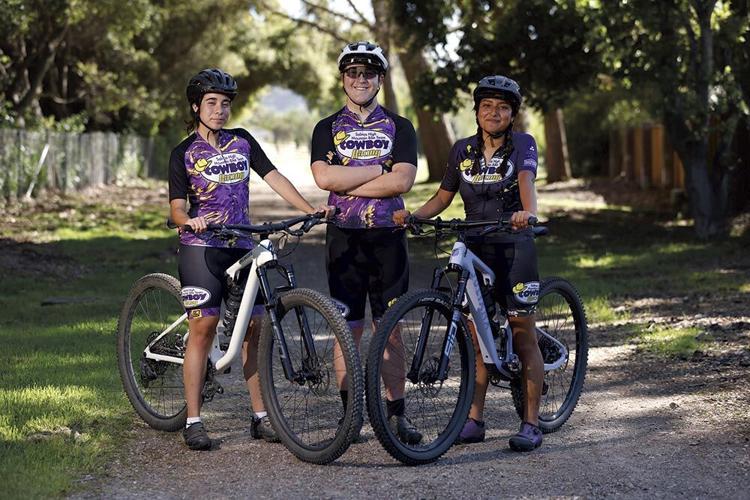
Salinas mountain biking JeSalinas mountain biking Jennifer Morillo Vega, captain. Jack Denny, captain and Diana Rivera. (Left to right)nnifer Morillo Vega, captain. Jack Denny, captain and Diana Rivera. (Left to right)
As the story goes, Berkeley High School math teacher and avid rider Matt Fritzinger wanted to start a cycling team. A few students showed up, however there was little for such a team to do in 1998 but ride area trails and enter adult races like the Sea Otter Classic. According to the Marin Museum of Bicycling, his riders quickly grew frustrated.
To address the situation, Fritzinger launched the NorCal High School Cycling League – now shortened to NorCal – in 2001. Salinas was one of the first five schools to form a team and join. Within a few years there were 30 schools involved and over 400 riders. By 2016 Fritzinger and others had formed the National Interscholastic Cycling Association and there were 10,000 students competing in races around the country.
Just why the sport is booming depends upon who you ask. Denny says he rides more for the exercise than the thrill of victory, and that he plans to keep mountain biking as a casual activity in the future. “I joined my first year and I’ve come back every year,” he adds.
Yet for many, the sense of camaraderie that develops on the trails between teammates, coaches, volunteers and competitors is the main attraction. The NICA rulebook emphasizes supportive behavior.
A 20-mile course careening over dirt and gravel, down rocky ravines or rutted and slippery jumps can be daunting, explains Jennifer Morillo Vega, a junior and, like Denny, a Cowboys team captain. “But even if you’re slowing down, the girls I race with will give you positive words,” she points out. “It keeps you going.”
Mountain bike racing is different from road racing. There are few smooth surfaces, there is no peloton and little is to be gained from drafting. The demands of the terrain are different, as well.
To pass another rider on a narrow track requires coopatition. It’s a word coined by auto racing driver Darrell Waltrip to describe the combination of cooperation and competitiveness necessary between two racers to keep it challenging but also safe.
Diana Rivera, a junior, first became interested in the sport because her brother was on the Salinas team. The bonding that takes place hooked her.
“I really like the sense of community,” she says. “It’s not who won, but that you finish.”
Of course, points are awarded based upon team and individual performance during each event. And riders want a podium finish. But athletes of different levels are on each roster. As they ride, coaches and ride leaders are alongside to encourage and to teach, particularly during practice.
“That’s what is unique about our sport,” Agan observes. “We do what the kids do – ride along with them.”
“The coaching happens as we ride,” Eisner adds. “It takes all of us.”
One of the changes both coaches have witnessed over the years is in the composition of the teams. Morillo Vega may not have been keen to ride competitively when she was a freshman. She was inspired, however, by a revelation.
“My aunt told me I had to try,” Morillo Vega recalls. “She said, ‘Back in my day there were barely any girls on the team.’”
In February at East Garrison, 36 Cowboys took part in the races. Of these, 12 were girls. Morillo Vega estimates that at any one event, just over 20 percent of participants are female.
She and Rivera are both GRiT Ambassadors. The acronym means Girls Riding Together, a NICA program developed to encourage more girls to become involved in cycling.
“Our goal is 25 percent by 2025,” Rivera says.
Agan has noticed the difference. Not only are there more students taking part, the talent level is on the rise. Former NorCal riders are now competing in the World MTB series and in international events like the Tour de France. But he points to an even bigger transformation.
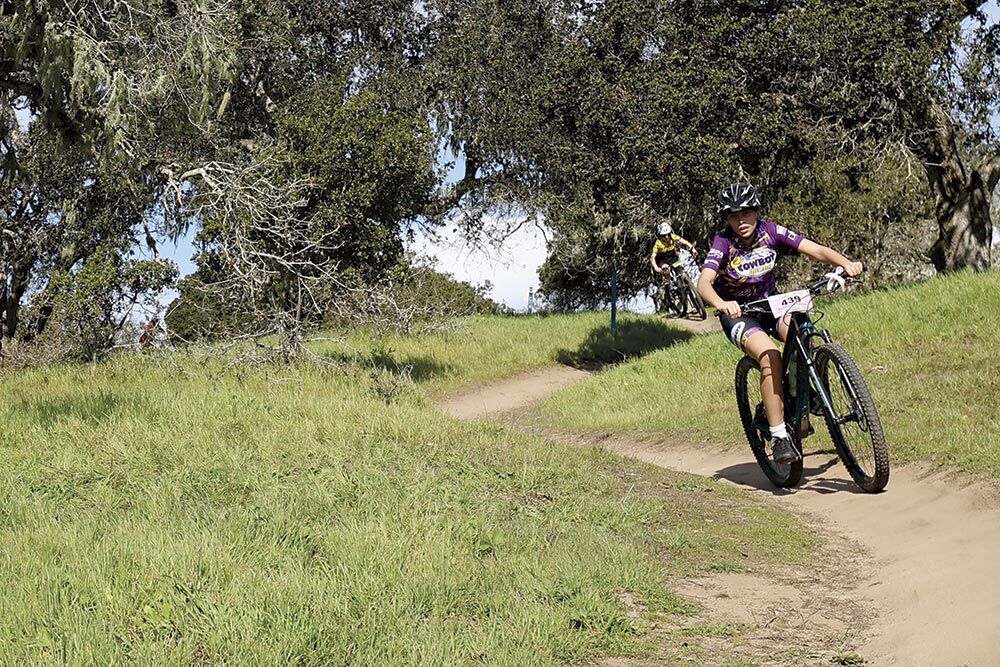
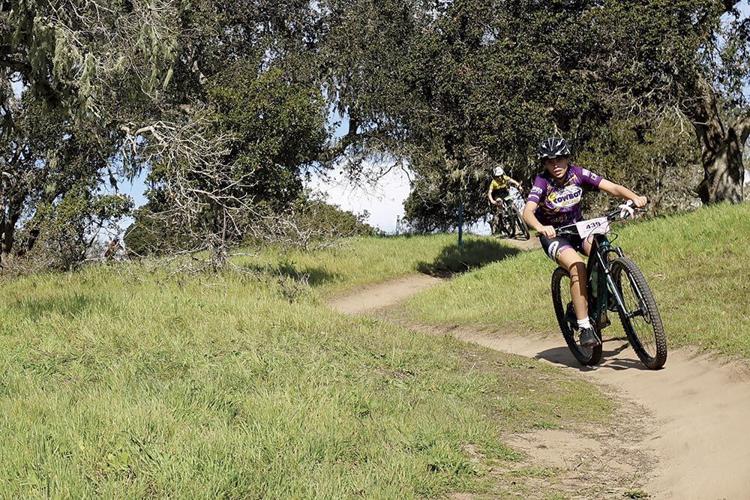
Salinas sophomore Brianna Casillas navigates the trail during the girls JV2 race.
“There is a huge amount of diversity with kids from all backgrounds and ability levels riding and competing,” he points out.
In fact, one of the best known and most admired professional riders is world mountain bike and cross country champion Kate Courtney, who was born in Marin County, has ties to the area and often races at the Life Time Sea Otter Classic.
Both Morillo Vega and Rivera single Courtney out as an inspiration – Rivera for the champion’s outreach to young women and Morillo Vega for her attitude.
“She’s always positive,” the Cowboys captain says. “She keeps it real.”
Salinas is a school team. Rancho San Juan High School also fields a strong school team. There is an option for other riders, Monterey County's composite squad – the Monterey Bay Lightfighters – made up of individual riders from schools across the Monterey Peninsula.
For the season opener in February, the Lightfighters fielded 14 riders. Of these, six are from Monterey High School.
Mountain bike racing is a growing sport. On the high school level it is lauded for the sense of community that develops and the confidence it inspires.
And as a social studies teacher at Salinas High, Agan recognizes another benefit for students who might not be interested in wrestling, soccer or other activities.
“Today I collected grade checks,” he says before disappearing toward a Fort Ord trail with the rest of the team. “That’s a good thing high school sports does.”
Note: This story has been corrected to include the Rancho San Juan High School team.




(0) comments
Welcome to the discussion.
Log In
Keep it Clean. Please avoid obscene, vulgar, lewd, racist or sexually-oriented language.
PLEASE TURN OFF YOUR CAPS LOCK.
Don't Threaten. Threats of harming another person will not be tolerated.
Be Truthful. Don't knowingly lie about anyone or anything.
Be Nice. No racism, sexism or any sort of -ism that is degrading to another person.
Be Proactive. Use the 'Report' link on each comment to let us know of abusive posts.
Share with Us. We'd love to hear eyewitness accounts, the history behind an article.