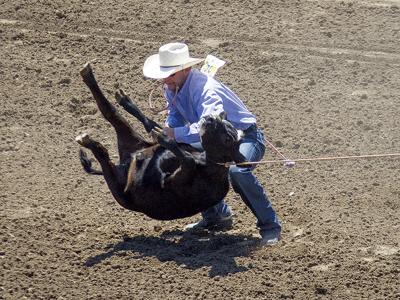

TO THE UNTRAINED EYE, SOME RODEO EVENTS LOOK LIKE VICIOUS HUMAN-ANIMAL BATTLES. Put them in context, and they start to look more like practices used by ranchers in the American West for well over a century.
Consider tie-down roping, in which a cowboy’s object is to lasso a calf as quickly as possible – from horseback – then to dismount from his horse, tie three of the calf’s legs together, and remount his horse, all while the horse is responsible for ensuring the rope is tight, with no slack.
Change the background from a rodeo arena to an open pasture. All of a sudden, these same actions are not for sport. They are a method for cowboys to isolate a sick or injured calf for medical treatment.
“The roping events, they are done on a ranch still to this day,” says Scott Dorenkamp, livestock program and government relations manager for the Professional Rodeo Cowboys Association. Other events, like saddle bronc riding – in which an athlete tries to stay on a bucking bronco for eight seconds – emerged from the practice of training unbroken horses. “These are all derived from ranch activities,” Dorenkamp notes, although not all activities are still common practices.
Dorenkamp is accustomed to explaining the origins of rodeo sports to urbanites who have little or no context to make sense of them. He collects data from the professional rodeo circuit nationwide, including the California Rodeo Salinas, and reports that animal injuries occur less than 0.1 percent of the time.
That’s not to say injuries do not occur. In 2014, the Animal Legal Defense Fund sued the California Rodeo Salinas on behalf of the group Showing Animals Respect and Kindness, claiming onsite veterinarians had violated the California Penal Code by failing to report animal injuries to the California Veterinary Medical Board. The group allegedly discovered at least 49 animal injuries over two years, during which time just four injuries were officially reported.
“By their very nature, rodeos entail a serious risk of injuries to animals,” according to the suit. “Rodeos frequently cause trauma to the animals that are forced to participate.”
In 2016, Monterey County Superior Court Judge Thomas Wills ruled in favor of the Rodeo.
“The Court finds there is no triable issue of material fact… SHARK has failed to show that the Rodeo engaged in unlawful acts or practices,” Wills wrote.
SHARK appealed the ruling, but later abandoned the case.
In papers submitted to the court, injuries are indeed documented. In a letter to the California Veterinary Medical Board providing a livestock injury report for 2013 (one of the years of concern in the nearly decade-old case), Tim Eastman, the veterinarian for the event, documented injuries day by day.
Thursday there were none. On Saturday and Sunday, a steer and a calf were injured, one outside of a formal rodeo competition event. “Both animals that were casted are bright, alert, and responsive,” Eastman wrote. “They are both also walking and eating very well.”
On Friday, there was a fatality after steer #78 turned in front of a competitor’s horse, causing both to stumble. “The horse stepped on the steer’s neck causing a fracture/luxation at approximately the level of C3-C4. He was deceased by the time he left the arena.”
It’s the potential for scenarios like these that gets attention from animal welfare groups (including SHARK’s lawsuit). PRCA rules are meant to preempt some concerns. For example, a veterinarian is required to be onsite during PRCA-sanctioned events, like the California Rodeo Salinas.
Beyond that, in Salinas, SPCA Monterey County’s humane officers also have full access to the grounds to monitor for any rough handling or injuries to animals, a practice that’s been in place for 20-plus years. (This access is at the invitation of rodeo officials, not a legal requirement; the SPCA does not accept a donation or a fee from the rodeo.)
“This is a very visible event in our community that has the potential for injury to animals,” says SPCA spokesperson Beth Brookhouser. “If us being there can in any way prevent suffering of even just one animal, that’s very important to us.”
The humane officers respond to over 900 reports of animal cruelty in Monterey County every year, mostly concerning cats and dogs but also livestock.
“The rodeo is hard because we still have our normal number of calls coming in – it is a very busy time of year,” Brookhouser says.
She adds that what humane officers are looking for in general are signs of neglect or cruelty, that a law has been broken. They are investigating for compliance with California’s 53 statutes relating to animal treatment and welfare. Brookhouser notes that a lot of calls that come in about dogs raise concerns about animals that are left outdoors at all hours, or are never walked or exercised. But that is legal – state law requires just that dogs have access to food, water and shelter.
Of course, the law doesn’t resolve questions about ethical treatment of animals.
“My animals sleep on my bed every night,” Brookhouser says. “They are treated as full members of the family. Other animals are not so lucky. A conversation our humane officers have daily is, there is no state law that requires that you love your animal.”
Dorenkamp notes that working animals – not just in rodeo, but also police dogs or other service animals – are trained to fulfill a certain function.
Rodeo animals are of course working animals, but they are working for the purpose of human sport and entertainment. Does that make rodeo unethical? Dorenkamp’s answer is that the purpose of the animal is up to its human to determine. “I own them. As long as I am taking care of them, and making sure they’re healthy, am I allowed to make a living with them? I think I am.”
(Dorenkamp, also a pro rodeo athlete himself, keeps two 20-plus-year-old horses that formerly performed in the rodeo at his Colorado home. “They’re old, all they do is eat hay and drink water, and get brushed,” he says. “They earned the right to stay on the place until they die.”)
Dorenkamp’s invitation to skeptics: “Come to the rodeo and watch with an open mind. Walk around, look at the animals and see how well taken care of they are.”


(5) comments
https://www.youtube.com/watch?v=vmYFKlUnlXE
1995 HSUS rodeo video
Note the photo above, a graphic depiction of ANIMAL ABUSE. One of these calves suffered a broken femur at last weekend's California Rodeo/Salinas, and was euthanized on-site. At this same rodeo in 1995 (I was there) a roping calf suffered a broken back, and was not immediately euthanized, but simply trucked off to slaughter, terrified and in agony. I was told it took two days. Not acceptable! REAL working cowboys/girls never practiced calf roping as a timed event. These are mere BABIES, folks. Aren't we better than this? For starters, howsabout BREAKAWAY roping only?
SEE PRIZE-WINNING RODEO DOCUMENTARY, "BUCKING TRADITION" - www.buckingtradition.com (also available on YouTube).
I was present at the 1995 California Rodeo/Salinas when FIVE animals suffered and died: two horses on the racetrack (broken leg; heart attack), and three in the arena: wrestling steer with broken neck; horse with broken neck in the "wild horse race" (since dropped). Worst of all, a roping calf suffered a broken back. Not euthanized, "Painkillers given?" I asked. "No," was the response, "that would ruin the meat." The calf was simply trucked off to slaughter, no doubt terrified and in agony. I was told it took two days...
Only in the aftermath of the mayhem did the PRCA adopt a 1996 rule requiring on-site veterinary care at all their sanctioned events. The great majority of the estimated 5,000-10,000 U.S. rodeos don't provide even this basic care, to their ever-lasting shame.
Rodeo is condemned by nearly EVERY animal welfare organization in North America due to its inherent cruelty. Rodeo has almost NOTHING to do with ranching. For most of the animals, the rodeo arena is merely a detour en route to the slaughterhouse. Real working ranch hands never routinely rode bulls, or rode bareback, or wrestled steers, or barrel raced, or practiced calf roping (terrified BABIES!) as a timed event. Nor did they put irritating flank straps on the horses and bulls or work them over in the holding chutes with painful "hotshots," kicks and slaps. Some "sport"! Indeed, rodeo is not a true "sport" at all. Rather, it's a bogus, macho exercise in DOMINATION. It needs to end.
The media needs to stop promoting this blatant cruelty. I was present at the 1995 California Rodeo/Salinas when FIVE animals suffered and died, all in the name of "entertainment." Only in the aftermath of the mayhem did the PRCA adopt a rule requiring on-site veterinarians at all their events. The great majority of the estimated 5,000-10,000 U.S. rodeos don't provide even this basic care, and animal injuries and deaths are commonplace. Even Cesar Chavez was an outspoken critic; ditto Pope Francis.
The United Kingdom (England, Scotland, Wales) outlawed rodeos back in 1934, followed by Germany and the Netherlands. Can the U.S. be far behind? Rodeo has had its brutal day and now--like those Confederate statues--belongs in the Dustbin of History, R.I.P. BOYCOTT ALL RODEOS, THEIR ADVERTISERS & SPONSORS. FOLLOW THE MONEY.
Welcome to the discussion.
Log In
Keep it Clean. Please avoid obscene, vulgar, lewd, racist or sexually-oriented language.
PLEASE TURN OFF YOUR CAPS LOCK.
Don't Threaten. Threats of harming another person will not be tolerated.
Be Truthful. Don't knowingly lie about anyone or anything.
Be Nice. No racism, sexism or any sort of -ism that is degrading to another person.
Be Proactive. Use the 'Report' link on each comment to let us know of abusive posts.
Share with Us. We'd love to hear eyewitness accounts, the history behind an article.