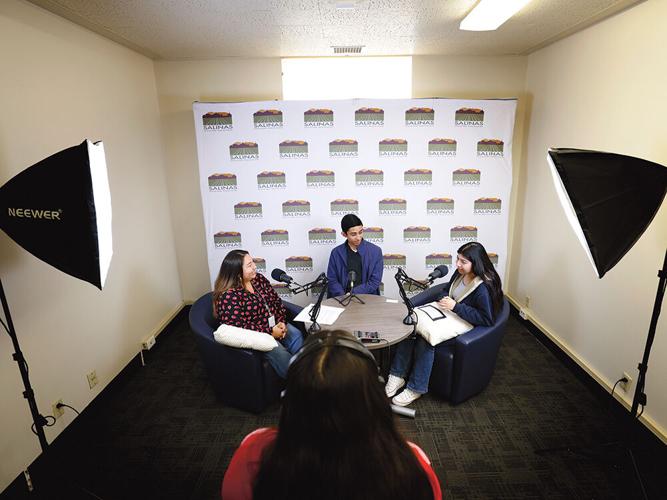
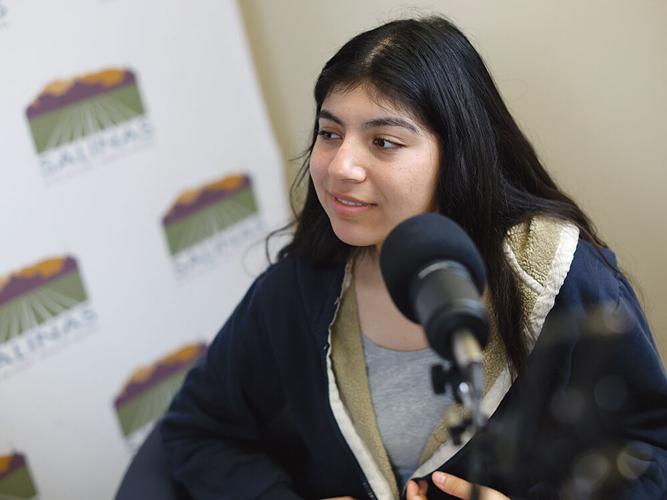


Guissel Villalobos (foreground), a communications specialist with the City of Salinas, listens in on headphones as youth interns Daisy Guerrero (from left) and Juan Camacho interview Brenda Granillo for the Salinas NOW podcast.
There are two things Osbaldo “Oz” Lucero loves to talk about: Salinas and soccer. Sometimes it’s one or the other, but oftentimes in combination.
In 2013, Lucero had season tickets to the San Jose Earthquakes, loving every minute of it. But when he got back home to Salinas, he noticed that there really wasn’t anyone talking about the team, even in such a soccer-crazed city.
“I would have fun out there in San Jose,” Lucero recalls. “Why aren’t people talking about this? It’s pretty cool.”
He set about bridging that gap between the pros in San Jose and the numerous local leagues and players in Salinas. His blog – salinassoccer.com – was born that same year, covering the latest from the Earthquakes while also following local high school soccer games and leagues.
The blog satisfied Lucero’s love for storytelling, even if there weren’t many actually reading the stories he was telling. Browsing Twitter one day, he came across a post for a podcast created by comedian Adam Carolla – and a lightbulb went off.
“I was like, ‘whoa, this is the future. This is how my generation is going to share information, on this thing called a podcast,’” he says.
A dozen years later, thanks to some friends, a generous business owner and a pair of Guitar Hero microphones, the Salinas Underground Podcast is now more than 340 episodes deep, filled with stories straight from the movers and shakers of Salinas themselves, and helped launch Salad Bytes Media, a podcast production company.
Podcasting, both locally and internationally, has grown exponentially since Lucero’s fateful Twitter scroll. While the cost of entry into this world is relatively minimal, the time and effort it takes to stay there is much more. What podcasters hope to get out of their shows depends on what they put into it.
A podcast, as defined by Merriam-Webster, is “a program (as of music or talk) made available in digital format for automatic download over the internet,” and the term was first known to be used in 2004.
At the very minimum, if you have a cell phone and a laptop, you can be a podcaster. Today’s smartphones have such high-quality microphones and cameras built into them that, with a little bit of effort, you can look (and sound) like a professional.
But podcast listeners today expect much more. They don’t want to be distracted by the sounds of a coffee shop behind you, nor do they want to squint to see your face in a dimly-lit room.
Podcast experts say the following equipment is non-negotiable: microphone, headphones, camera (if it’s a video podcast) and a capable computer.
On the lower end, such a setup for audio-only is roughly in the lower four-digits. Initial costs are less if you already have a computer. Expect to add at least $100 for a camera, or nothing if you already have a phone made within the last few years.
The more advanced the setup, the likely crisper quality of the podcast. An audio interface, which acts as a bridge between your microphone and computer, improves the sound. Expect to throw down at least a couple hundred dollars here.
A microphone arm and stand not only allows you to adjust the position of the microphone, putting it in the perfect position to capture sound, but it just screams “podcast.” Add another $100 or so here.
For more advanced podcasters, there are numerous other tools to list, such as shock mounts, pop filters and lighting.
When Lucero started the Salinas Underground Podcast with his friends Jose Lopez and Juan Hernandez, the setup was a bare minimum: two USB microphones from the Guitar Hero video game, each connected to a laptop.
Using Audacity editing software, Lucero would hit “record” at the same time for each of the microphones, then the friends would chat, each laptop creating its own audio file.
“I would take both files and combine them into one, but it would sound like shit,” Lucero says.
The trio began recording the show in 2014 inside XL Public House in downtown Salinas on Sunday nights, with the owner picking up their tab to show support.
The podcast’s equipment has come a long way since those Guitar Hero microphones.

Chris Cain, a criminal defense and immigration attorney, launched his Defensible podcast, interviewing people in the local criminal defense world.
The mics have been upgraded (Lucero says they are $400 apiece), which feed into a RODECaster Pro audio mixer using Mogami audio cables. A PC is used for editing, using REAPER software. All in, Lucero estimates the setup is valued at $2,200, not including an office space in Oldtown Salinas for recording, which is outfitted with a curtain and other materials to improve acoustics.
For video podcasts, the venue is key – or at least the wall behind the podcaster is.
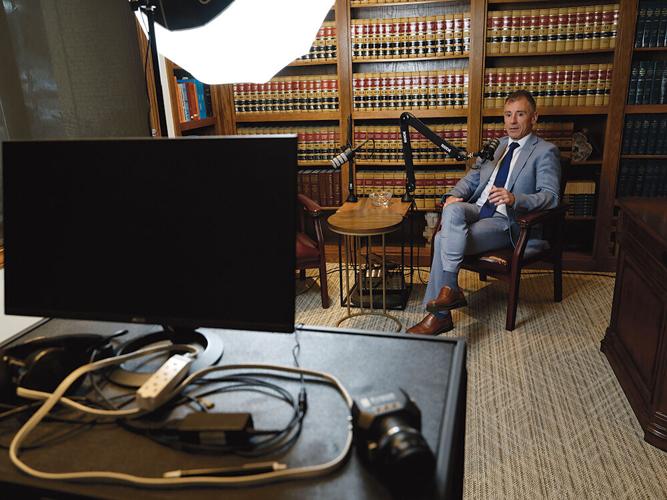
Chris Cain, a criminal defense and immigration attorney based in Salinas, launched his Defensible podcast early in 2024, where he converses with various criminal justice professionals.
Part of his office has transformed into a podcast studio, conveniently located among his library of law books, making for a background that’s appropriate for the topics being discussed, yet not visually distracting.
In addition to the audio equipment, Cain’s setup has tools specifically for video: three Blackmagic cameras (one to focus on Cain, another for his interviewee and a third to capture both of them), as well as studio lighting equipment. Cain says a Hartnell College film student helps with the setup through a paid partnership.
“Sound and lighting is very important,” Cain says. “The office where I film is great because it has the background of the law library. It also has really good acoustics.
“You can’t just set up in a closet.”
Casey Grover, a Monterey addiction medicine physician, launched his podcast, Addiction Medicine Made Easy; Fighting Back Against Addiction, four years ago (see story, page 5).
Grover says he does two types of episodes, one he calls a “monologue” episode, where he asks a question about something he’s curious about and then does the research to be able to understand it and teach his audience. The other type of episode he does is interviews, where he and a guest discuss a specific topic.
The monologue episodes take two to six hours to research and write. Those take less time to record and edit. For interviews, he used to just record the interview and release raw audio, but as his podcasting skills have improved and he’s upgraded the software he uses, he will take two to six hours to edit them. He says it takes from 30 minutes to two hours just to take out all the “ums” and “ahs.”
Other professionally produced podcasts can take over 100 hours or more to create, and have entire teams working on them.
“It’s just me,” Grover notes, although putting in the hours to learn about podcasting has resulted in improvements, including much better audio quality than when he began in 2021. That being said, he recognizes he doesn’t have the ability to add some common podcast features like layering music throughout the episode.
He says it’s fairly inexpensive to get into podcasting. He pays $10 a month for software, an audio editing service is $200 a year. He bought a microphone, a couple of lapel mics and uses his own laptop. To avoid an echo, he uses a spare room in his home with soft items that absorb sound, including carpeting and a couch. He set up a table, chair and microphone in the room.
“The biggest cost is my time,” he says. He says it’s not worth it to him to accept advertising – the payback would be small and he’s worried it might create a perception of bias.

Everett Alvarez High School senior Daisy Guerrero is one of the youth interns who host the Salinas NOW Podcast.
“Welcome to the Salinas NOW podcast.”
These words open each episode of the City of Salinas’ new podcast, with the name spoken in harmony by the multiple hosts who lead each show.
That is an important element for the youth-led podcast, says Guissel Villalobos, a communications specialist with the city, helping to break the ice before the actual icebreaker question – “If you could be any animal for the day, which would you choose and why?”, “What is one food combination you like that is random?” and so on.
The podcast, now 10 episodes strong, formed out of the city’s youth internship program, with local high schoolers choosing a project to work on.
Everett Alvarez High School senior Daisy Guerrero decided on creating a podcast, recruiting other youth interns Juan Camacho and Natalie Vasquez, with the help of Villalobos and Salinas’ Community Relations Manager Sophia Rome.
They started by reaching out to other successful podcasts around California to find out not only how to get started, but what to talk about on their show.
They eventually settled on city and government news, with the goal of informing people throughout Monterey County about the things going on in Salinas, while also reaching the young people of the city.
So far, guests on the podcasts have included Salinas Regional Soccer Complex General Manager Jonathan De Anda, Hitchcock Road Animal Services Administrator Cindy Burnham and Alisal Union School District Deputy Superintendent Monica Anzo.
Guerrero says the podcast helps the students learn how to carry on a professional conversation.
“It takes a lot of confidence,” she says. “You’re literally talking while everyone’s staring at you.”
But talking isn’t the hardest part, she notes.
“I like talking a lot,” she says. “Everyone says I talk too much, but it’s a good thing to me. I’m learning about different things doing what I love.”
Most of the city’s podcasts have been recorded in an office inside the post office on West Alisal Street, while others have been in the rotunda where City Council meets. Chairs sit around a small circular table, where two microphones sit on stands, in front of a wall adorned with the City of Salinas logo (a background for future video recordings of the podcast).
While Villalobos uses Adobe Premiere to edit the audio, she notes that the process is youth-driven. As such, the future of the podcast relies on the next generation of students, as the current podcasters are all seniors about to graduate in the summer. Recruiting is underway.
For Cain, his podcast is a chance for the public to learn more about the interesting people who tackle complex issues in the criminal justice world – something that not many (if at all) are doing on local podcasts, he says.
It’s also an opportunity to promote his services.
“My thoughts were to have a platform where I could have better reach to the public and let them know I’m here and I want to fight for their rights,” Cain says.
With today’s general public having a short attention span, not everyone will want to sit down and listen to an hour-plus podcast in one go. Cain notes that many podcasts find success in releasing short clips from each episode on social media – the trick is finding something catchy that’ll grab people’s attention, and encourage them to check out more.
Cain has taken to Instagram and TikTok to post short clips from his podcast, featuring quotable material with his guests (such as why murder suspects may be better off with a public defender than a paid attorney), as well as one-off videos made especially for social media (“Can Drake Sue Kendrick?” is a link you can’t help but click).
“I’ve had a number of clips that have gone really viral,” he says.
While the Salinas Underground Podcast may have gotten its start because of Lucero’s love for the city, its larger purpose is to combat the popular narrative that Salinas is a dangerous town filled with gangs.
“It bothers me when people get down on Salinas,” he says. “It’s still a pretty sleepy town. I want people to realize that they live in an interesting town with some really, really interesting people.”





(0) comments
Welcome to the discussion.
Log In
Keep it Clean. Please avoid obscene, vulgar, lewd, racist or sexually-oriented language.
PLEASE TURN OFF YOUR CAPS LOCK.
Don't Threaten. Threats of harming another person will not be tolerated.
Be Truthful. Don't knowingly lie about anyone or anything.
Be Nice. No racism, sexism or any sort of -ism that is degrading to another person.
Be Proactive. Use the 'Report' link on each comment to let us know of abusive posts.
Share with Us. We'd love to hear eyewitness accounts, the history behind an article.