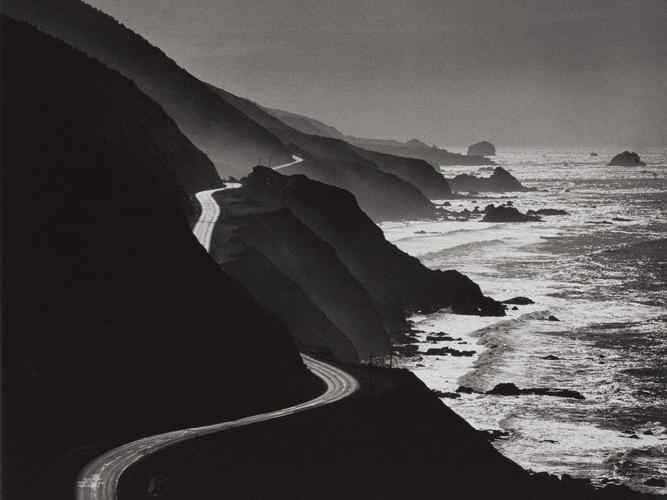

Henry Gilpin’s iconic shot of Highway 1 from 1965 remains the ultimate and perfect Big Sur “postcard” photo, and is displayed alongside other black-and-white photography in A Sense of Wonder, one of four Big Sur-themed exhibits showing simultaneously.
BIG SUR’S 75 MILES OF RUGGED AND SPECTACULAR COASTLINE have beckoned generations of creatives, wanderers, seekers and tourists. Often described as a place “where extremes meet,” this magnificent region is characterized by stark contrasts: stunningly beautiful, yet subject to the violent forces of nature; isolated, yet home to a supportive local community; environmentally fragile, yet economically dependent on tourism.
Big Sur captured the national consciousness during the mid-20th century, although this highly praised region was often idealized and frequently misunderstood. Some romanticized Big Sur as a paradise or a utopia; for others it represented the last vestige of the wild and free American West. Big Sur became an idea as much as a location, what author Lillian Bos Ross described as “not a place at all, but a state of mind.”
An eclectic group of artists came to Big Sur during the mid-century in search of solitude and connection with nature. Many were seeking an escape from what author Henry Miller described as the “air-conditioned nightmare” of conservative post-war America. These individuals formed an arts community that welcomed unconventional lifestyles and encouraged freedom of expression. Working in a wide variety of mediums – watercolor, printmaking, collage, mosaic, textiles, ceramics and sculpture – no two artists took the same approach to their work.
The exhibit A World Apart: Big Sur in the Mid-Century features artists working in and around Big Sur from the 1950s through the 1970s, many of whom are historically under-recognized. The art and archival material on display draws from Monterey Museum of Art’s permanent collection and from galleries, libraries, historic sites and private collections. Many works have never been in a museum exhibition. A World Apart explores how this unique place and time in California history produced an innovative and eclectic community of artists.
BIG SUR’S INDIGENOUS INHABITANTS, including the Esselen, Salinan and Rumsen tribes, lived in harmony with the land for over 6,000 years, until Spanish missionaries appeared on the California coast in the 18th century.
By the late 19th century, American homesteaders had settled in Big Sur. These hardy pioneers supported themselves in a variety of industries before the advent of tourism provided new economic opportunities.
The influential poet Robinson Jeffers, who eventually settled in Carmel, had a deep connection to Big Sur and California’s Central Coast. In 1914, the young Jeffers, who had yet to make a name for himself, traveled from the Monterey Peninsula to Big Sur on a horse-drawn wagon. During the day-long journey, he was entranced by the landscapes and people he encountered. From then on, Big Sur would loom large in his verse. Jeffers’ poetry introduced the concept of Big Sur as a world apart, a place offering refuge from a “civilization dying at the core.”
His work also stressed the importance of protecting this remote and idyllic landscape, setting the stage for mid-century efforts to control development in the area. Contemporary artists Gordon Newell and David Ligare both cite Jeffers as a major influence and one of the reasons they moved to the area.

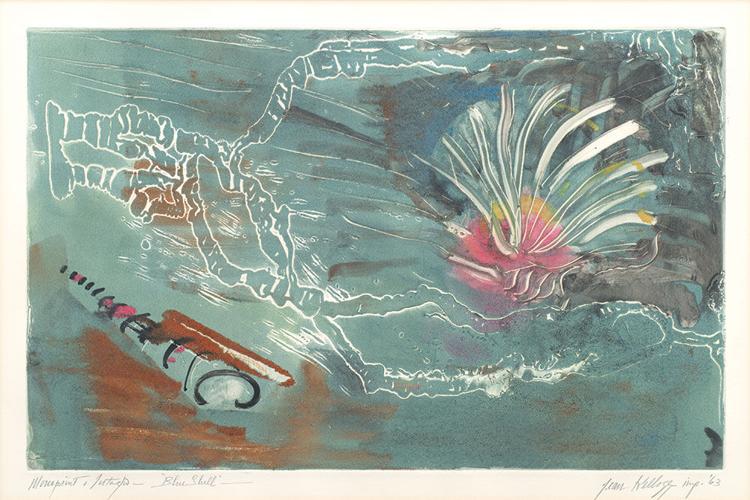
Jean Kellogg Dickie’s “Blue Shell” from 1963. The artist routinely featured tidepool imagery in her work and liked to make art at Partington Point. She led the charge in successfully fighting against the development of a granite quarry there.
IN 1937, HIGHWAY 1 EXPANDED SOUTH, opening Big Sur to automobile traffic and tourism. Labor for this construction was primarily provided by convicts who lived in barracks along the coast; construction workers blasted through cliff sides, leaving many locals distressed by the destruction of the landscape. When the road was completed after nearly two decades, the abandoned shacks at the Anderson Creek work camp provided inexpensive housing for bohemians who came to Big Sur, including the artist Jean Varda.
Varda, perhaps finding Big Sur’s isolation too challenging, eventually relocated to Monterey. He moved into an old red barn on Hawthorne Street, where he received a visit from his favorite author, Henry Miller.
Today, Miller is recognized as a significant figure in American literature. When he first met Varda in 1944, Miller’s novels were not yet commercially successful; he was struggling financially and needed a place to stay. Varda introduced Miller to Big Sur, setting off a chain of events that would forever change the region.
Miller lived in Big Sur for 19 years and was at the center of a bohemian circle that included his creative neighbors on Partington Ridge. Mosaicist Louisa Jenkins had a studio there, as did Dorothy Bowman, who often painted with Miller. Close friends Harry Dick and his wife Lillian Bos Ross, longtime Big Sur residents, also had artistic pursuits. Dick was a painter and sculptor, and Ross penned The Stranger (1942) and Blaze Allan (1944), bestselling novels about pioneer life in Big Sur. (Her books are displayed in the show.)
Primarily known for his writing, Miller was also a painter, a practice that recharged his creativity. “I turn to painting when I can no longer write,” he explained. “Painting refreshes and restores me.”
He earned a modest income from selling his watercolors, helpful before his commercial success as an author. Miller encouraged his friend and assistant, Emil White, to paint as well. Despite being untrained and colorblind, White took to it immediately; his unique style is characterized by detail, pattern and what Lawrence Ferlinghetti described as an “innocent imagination which exists beyond place and time.”
Miller also attracted visitors from further afield. His controversial and explicit novels were popular with the Beat Generation. Enticed by Miller’s presence, these Bay Area beatniks traveled down the coast to escape city life and clear their heads. As poet Richard Barker explained, “we need that country place – that Big Sur – and the balanced state of mind it makes.”
Beat poets Ferlinghetti, Jack Kerouac and Allen Ginsberg – to name just a few – experienced Big Sur in ways that informed and influenced their work. During the mid-century, Highway 1 served as a physical and spiritual conduit between the bohemian communities of San Francisco and Big Sur.
Most Big Sur artists preferred to be left alone to delve inward and discover their own creative paths. Many felt that solitude was essential, and they regarded their studios as private – almost sacred – spaces. Sculptor Edmund Kara explained, “I want to be alone… The less distraction, the more intense the focus.” Emile Norman described his studio as “my private place. I don’t want anybody down here when I’m working.”
“The artists up here have never been a particularly close-knit or homogeneous group… Some were gregarious, others practically hermits,” Emil White said.
Another local stated, “There is no ‘art colony’ to be found here.”
Geographically distant from established art centers, few Big Sur artists were influenced by mid-century art movements such as abstract expressionism; instead, they took individualized approaches to their work with an emphasis on craft, design and tactile materials. Many spoke of the artistic freedom they experienced in Big Sur; sculptor Barbara Spring explained that “freedom is very important, and freedom is what you need.”
This freedom supported independent thinking and experimentation. Spring incorporated fiberglass in the interiors of her sculptures to reduce their weight and refined the exteriors with a chainsaw, while Dorothy Bowman and her husband Howard Bradford were innovators in the technique of fine art silk screen printing (serigraphy). Emile Norman invented a process to seal his wood mosaics by applying layers of epoxy colored with different hues of sawdust, explaining “every time I do a work of art, I learn something. I’m an experimenter.”
Although they derived personal satisfaction from their creative work, most Big Sur artists were financially dependent on the sale of their art. Norman had his own gallery in Carmel, and Ligare shipped his paintings to a gallery in New York. Bowman and Bradford made their living making serigraphs and had art dealers on both coasts. Local artists also benefited from tourism, which provided a new market for their work. Tourists who dined at Deetjen’s Big Sur Inn could purchase wooden bowls carved by the proprietor, Helmut Deetjen. Additionally, artists relied on the Coast Gallery, where they dropped off artwork and returned to pick up their proceeds, leading them to affectionately refer to this Big Sur institution as “The Bank.”
While many artists subsisted on the sale of their artwork, some regarded the opportunity to work independently as more important than any financial success or critical acclaim. “[My] sculptures have nothing to do with money or what somebody wants,” Kara said. “They have to do with myself.”
Creating small sculptures from leftover fragments of her husband’s larger pieces, Emilia Newell dedicated her life to making art, but rarely sold or exhibited her work. Sculptor and ceramicist Loet Vanderveen affirmed, “I love doing what I do. I don’t care at all about leaving a mark.”

“Stone Age Japan” by James Suzuki shown in Human Nature.
MOST BIG SUR ARTISTS were drawn to – and impacted by – the natural world surrounding them. During the mid-century, a time of explosive growth and suburbanization in California, Big Sur remained wild and undeveloped. Seascapes, ocean creatures, abundant wildlife, and majestic trees were constant sources of inspiration for the artists in the region. The influence of the area’s remarkable flora and fauna can be seen in Emile Norman’s stylized bird forms, Loet Vanderveen’s fluid animal sculptures, and Jean Kellogg Dickie’s colorful tidepools.
Many artists worked with natural materials found in their environment. Newell favored stones found on Big Sur beaches for his sculptures, while Kara’s friends and neighbors brought him wood from abandoned orchards and the surrounding forest.
The creative work of authors, poets, photographers, and artists glorified Big Sur, attracting even more visitors and threatening the very things that make the region so prized. The tension between development and conservation – a struggle that continues to this day – was already in place by the mid-century. Dickie stood alongside other Big Sur residents to fight the proposed construction of a granite quarry at Partington Point, her favorite place to sketch and paint. Artist and environmentalist Margaret Wentworth Owings and her husband Nathaniel Owings were instrumental in the creation of the Monterey County Coast Master Plan in 1962, limiting development in Big Sur. Margaret co-founded Friends of the Sea Otter and worked to remove a bounty on mountain lions.
These artists, fiercely protective of Big Sur’s unique and fragile ecosystem, influenced the burgeoning environmental movement of the 1960s.
Despite the challenges of growing tourism during the mid-century, Big Sur continued to offer solace and potential for spiritual growth. The Esalen Institute was established in 1962 to advance the human potential movement. Benedictine monks have worshiped at the New Camaldoli Hermitage since 1958. As many will attest, Big Sur’s otherworldly natural beauty inspires a spiritual connection to something greater than oneself.
Many artists of the period were in touch with Big Sur’s spiritual side; some created works with mystical, dream-like qualities, while others interpreted psychological and emotional aspects of the human experience. Irene Lagorio’s recognizable Big Sur archetypes – a condor taking flight and a mysterious forest bathed in moonlight – are surrounded by the threat of wildfire. Kara’s work often depicts characters from mythology and religion. Louisa Jenkins’ unicorn mosaic was commissioned by Una Jeffers (the wife of Robinson Jeffers) and features the mythical creature affixed to Hawk Tower at Tor House in Carmel.
Big Sur in the mid-century was a world apart, where art, literature, nature and community intersected in fascinating and unexpected ways. The region’s extraordinary scenery and unique cultural environment nurtured a group of independent artists who forged their own creative paths.
Largely unconcerned with the whims and fashions of the art world, stimulated by their stunning surroundings, and uplifted by a supportive local community, these artists created a diverse and compelling body of work inspired by the place – and the idea – of Big Sur.


(0) comments
Welcome to the discussion.
Log In
Keep it Clean. Please avoid obscene, vulgar, lewd, racist or sexually-oriented language.
PLEASE TURN OFF YOUR CAPS LOCK.
Don't Threaten. Threats of harming another person will not be tolerated.
Be Truthful. Don't knowingly lie about anyone or anything.
Be Nice. No racism, sexism or any sort of -ism that is degrading to another person.
Be Proactive. Use the 'Report' link on each comment to let us know of abusive posts.
Share with Us. We'd love to hear eyewitness accounts, the history behind an article.