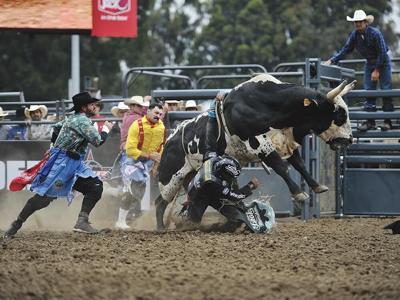

Being on the road, watching dirt fly, animals and riders burst from chutes, seeing arenas in small towns and storied rodeo destinations – that’s how Josh Daries spent a good bit of his childhood,
Raised in Salinas, Daries serves as a cowboy protector, charged with distracting animals after an athlete pitches to the ground. But he’s a former bull rider and grew up watching his family – parents and uncle – participate in competitions.
Daries first took an active part in rodeo starting when he was 5 years old. He says the rodeo life grew on him and became something he is passionate about. “Being around people and meeting people, and then the job riding bulls and then adrenaline – the experience we get to have,” he says of what it is that powers his ongoing love for the sport.
When he was a bull rider he took part in the California Circuit Finals twice, and five times he clinched the California Cowboys Professional Rodeo Association Bull Rider of the Year title.
He no longer lives in Monterey County, but he will be part of the California Rodeo Salinas as a member of a cowboy protection team, with an important role of making sure riders finish their appearances unscathed. Cowboy protectors are rodeo’s firefighters – they are adjacent to the action, looking after the riders. They put themselves between the riders and the bulls to distract animals after the riders are off, so they can walk away.
Daries spoke to the Weekly about his career and what rodeo means to him.
Weekly: What is the difference between a rodeo clown and a cowboy protector?
Daries: [It] used to all be one. Nowadays, a cowboy protector – his sole job is to protect the cowboys or bull riders once they’ve completed or fallen off of their ride. A clown is there for entertainment of the crowd throughout the whole rodeo, or to just kill some time during a downtime or [when] something happens. They also help us protect the riders if needed.
You said you rode bulls when you were younger. To someone who’s not experienced in rodeo, it looks wildly scary. What makes you get on a bull?
I got interested just growing up watching. It kind of became a challenge. I had some opportunities to get on, and some really good people to help me out to start.
Favorite memories?
Freestyle bullfighting – that’s always been a big part of my memories, watching that. And then watching my mom run barrels on the track, which is pretty unique – in a small pattern. Just the whole atmosphere. I do admit I love the old-style grandstands. Those were awesome. That was a pretty cool memory.
Everything evolves, though, and we had to go bigger for seating people.
What do you need to know to be a successful cowboy protector?
You have to learn [an animal’s] movements. You have to learn what they’re thinking, what they want to do. You have to be able to read their movements enough to be able to read a situation – where you need to put yourself in the right spot to get between him and the rider. Being able to kind of read where [the rider] is gonna end up going and which way the bull is going. Being able to slide in there and get the attention of that bull, get between them to distract [the bull], take him away or take the brunt of the hit and keep these guys safe.
When nobody gets run over, hooked or anything, that’s your perfect day.
Are you superstitious? Do you have a ritual before you enter the arena?
No, not really. I stretch.
What is the most valuable lesson you’ve learned from rodeo?
In our profession, life’s pretty short. Most of the time people retire in their late 30s or early 40s. You have to take advantage of every bit of it, because it can just be gone.
So just go out there and put everything on the line, and while you’re doing it try not to hold anything back.
Do you collect any rodeo paraphernalia?
I probably have all my back numbers from when I entered. And every rodeo I go to, I try to collect tokens – drink tokens, just to save and get a bunch of them.
So you’ve seen a lot of great moments and people.
I guess I grew up around a lot of world champions, and my uncle [cowboy protector Joe Baumgartner] was there for a long time – I got to know him. He has been in the finals 14 times, you know.
All the famous people that gravitate around the camp, getting to meet them. It’s an experience a lot of people don’t get to have in their lifetimes.


(0) comments
Welcome to the discussion.
Log In
Keep it Clean. Please avoid obscene, vulgar, lewd, racist or sexually-oriented language.
PLEASE TURN OFF YOUR CAPS LOCK.
Don't Threaten. Threats of harming another person will not be tolerated.
Be Truthful. Don't knowingly lie about anyone or anything.
Be Nice. No racism, sexism or any sort of -ism that is degrading to another person.
Be Proactive. Use the 'Report' link on each comment to let us know of abusive posts.
Share with Us. We'd love to hear eyewitness accounts, the history behind an article.