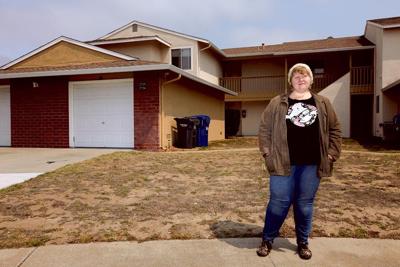

Nayeli Alonso drives a brand-new car and owns a laptop, an iPhone with a broken screen and a clarinet, but she can’t seem to find an affordable room to rent.
At Tommy’s Restaurant in Marina, the 20-year-old CSU Monterey Bay student barely touches her cup of coffee, but she energetically expounds on the difficulties of finding an affordable room. With three jobs, she works an average of 10 hours per week and says her budget for rent maxes out at $500 a month. She can’t work more hours during the fall semester, she says, because she is taking 18 units and wants to get good grades.
Currently, she rents a kitchen pantry in Marina for $200 a month. But she wants out, and besides, the primary tenants have already told her they want her out by the time September comes.
“I have faith in myself. If anything, I know I’ll have a couch to sleep on at a friend’s place or in my car,” Alonso says. After she says it, her almond-shaped eyes get wide. The reality that she could be homeless by the time school starts Aug. 22 is sinking in.
“I know there are a lot of student in the same place I am,” she adds.
Alonso is one of five CSUMB students I spoke to in a period of three days just before school started, who all face being homeless this semester. Another is Byron Norrod, a 25-year-old senior studying human communications. He says he might wind up staying in a tent until a place becomes available in order to attend classes this semester.
“[I] am comfortable enough with my skills to accept the consequences of living in the woods if need be,” Norrod says.
Chelsea Newbold, a 23-year-old biology major, also went through stints of homelessness in the past year. On several occasions, she says she slept at Del Monte Beach, by the wharf, with just a sleeping bag. She learned how to protect her school supplies, groceries and personal belongings from thieves by burying them in holes in the sand and sleeping on top of them.
“It could get scary. You didn’t know if you’d wake up, or if your things would be there in the morning,” Newbold says. “And there were a lot of homeless people – real homeless people – who are mentally ill.”
Police Sgt. Ethan Andrews says that in his 10 years with the Monterey Police Department, he does not recall contacting any homeless students at the beach.
Other nights Newbold says she slept at the Fort Ord Dunes State Park, where she used mounds of sand as shields from Monterey Bay’s cold nighttime winds.
“It was close to campus, so you could walk to class,” Newbold says. “I would often see three to four students in the mornings walking away from the beach to campus.”
Camping at the beach was an option she resorted to before she learned about a group of friends who would sleep at the Tanimura & Antle Family Memorial Library.
“I stayed in the library’s 24-hour computer lab for nearly a week early this summer,” Newbold says. “That’s another place that students will stay because it’s warm, and has bathrooms and a water fountain.”
One thing Newbold, Alonso and Norrod have in common is that they are upperclassmen. When it comes to securing campus housing, freshmen and sophomores are given preference, and are required to live in on-campus housing if they don’t reside within 30 miles from campus, according to CSUMB requirements noted on the website.
The university has approximately 3,750 beds available to students, according to university spokesman Scott Roark, so thousands of students are left scrambling for housing on – and off-campus every year.
In spring of 2016, there were 2,230 freshmen and sophomores enrolled, according to a CSUMB fact sheet. This left 5,050 students, third year and beyond, to compete for the remaining 1,530 beds. Roark says the university has admitted 805 students for the 2016-17 academic year. This is a significant decrease from last year, which is expected to help alleviate the campus housing crunch.
Even if students are accepted into campus housing, affordability remains an issue. Double-occupancy rooms on campus cost an average of $844 a month. The cheapest option is $525 to share a room in an East Campus apartment and the most expensive is the new Promontory Apartments, at $985 per month to share a room.
“Prior to opening the Promontory Apartments, we had a consistent waitlist of 350 students every semester,” says Ronnie Higgs, vice president of Student Affairs and Enrollment Services.
Higgs says 50 percent of students live on campus. “We are one of the largest residential campuses for the CSU, and housing is a huge attraction for parents and students.”
The students I talked to disagree. They believe high costs and lack of availability on campus leave them scrambling for housing off campus, on the Monterey Peninsula. Both Higgs and students say it is common for students to get the runaround from landlords who prefer to rent to working professionals.
Students say it’s become the normal to meet students who are crashing on couches, living in garages, sleeping in tents, cars or at the library. Kanong Vang, a third-year business major, witnessed his classmates floundering as they searched for housing on Craigslist. He decided to start a private Facebook group called “Homeless Otters at CSUMB,” which quickly became a cyber hub for students in search of roommates or rooms.
“I created the group to help not only myself, but to help other students find others who were in that situation,” Vang says. He thought students might be able to pair up as roommates to reduce the cost of expensive off-campus housing options. But scrolling down the Facebook page, the number of posts looking for affordable housing mirror students’ frustrations.
Higgs says the university is aware of four students who were living in their vans last semester. When the university became aware of their situation, the students were referred to CSUMB counselors for assistance. He adds the university’s financial aid office can arrange for temporary housing if it is determined the student is indeed homeless.





(3) comments
Very interesting article. You brought to the forefront a condition all to common for students attending college.
WHERE THE HECK DO I LIVE?
I had a niece that attended U..C. Berkeley a few years ago. Her and 5 others shared a 3-story, 3 bedroom house in Berkeley for (I think) about $5k - $6k a month.
I also find it interesting that priority is given to on Campus accomodations Seems exactly opposite to the standard and customary.
Anyway: Welcome to the real world.
LARRY HAWKINS III
I have room for rent in Marina, very close to CSUMB. Contact me asap! Before the end of August.
I attended college when Reagan was the governor and he had the universities increase enrollments by the thousands with no regard for providing on campus student housing. This resulted in hardships for the students (I spend a year in a junk yard in an abandoned shell of a trailer and another in an open carport and my health was severely damaged) and it creates problems for local workers and their families who cannot compete with multiple students who will pay $500 for a room in a house. There need to be rent controls in the communities and there needs to be leadership from Sacramento and the governor to add housing for students on college campuses. A side note is that colleges do not have to follow local zoning laws and can act with impunity which is something else that needs to change.
Welcome to the discussion.
Log In
Keep it Clean. Please avoid obscene, vulgar, lewd, racist or sexually-oriented language.
PLEASE TURN OFF YOUR CAPS LOCK.
Don't Threaten. Threats of harming another person will not be tolerated.
Be Truthful. Don't knowingly lie about anyone or anything.
Be Nice. No racism, sexism or any sort of -ism that is degrading to another person.
Be Proactive. Use the 'Report' link on each comment to let us know of abusive posts.
Share with Us. We'd love to hear eyewitness accounts, the history behind an article.