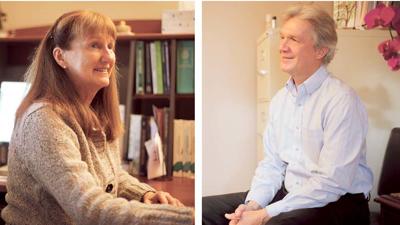

For both Susan and Jeff Turner, Ayurvedic medicine was something they discovered by chance.
Ayurveda is an ancient medical practice that originated in India that some scholars call “the mother of all healing,” and that, broadly speaking, is focused on bringing the body’s different energies into balance.
And while many in Western society might be inherently skeptical of such ancient health care practices, consider this: Yoga, now wildly popular and widely seen as beneficial to health, comes from the same school of thought – old Sanskrit writings known as Vedas – and is in fact intertwined with it. Also, for those who dismiss it as “New Age,” it’s been around for more than 5,000 years. Even some with a Western medical background swear by it.
That includes Susan, a former nurse who traveled to India to volunteer at a camp in the mid-’90s where medical staff performed eye surgeries and treated patients with both Western and Ayurvedic medicine practices. She came to see the two kinds of treatment were complementary.
When she returned to the U.S., she attended an event featuring Vasant Lad – an Ayurvedic physician – “and I was sold after hearing him speak for five minutes,” Susan says.
Around the same time, Jeff’s former wife was suffering from a condition that doctors thought was some kind of chronic fatigue syndrome, but none of the Western treatments helped. By chance, he met an Ayurvedic practitioner, who treated her, “and in a matter of months, she had this great, total recovery.”
As a mechanical engineer and “a problem solver,” Jeff was fascinated. He dropped his corporate career and in 1995, he enrolled in the Ayurvedic Institute in Albuquerque, New Mexico.
It is there that Susan and Jeff – now married – first met, and in the early 2000s, they opened their Monterey clinic, Living Ayurveda.
Much of their work involves taking clients through Panchakarma, a holistic detoxifying process that, along with meals Susan prepares in the clinic kitchen, involves treatments like massage, applications of herb-infused oils to the skin and even eyes, and applications of herb-infused steam.
They also provide coaching – dietary and otherwise – for those suffering from disease or ailments.
But first, one of them will meet with a prospective client before performing any treatment and assess their dietary and exercise habits and “what their daily life looks like,” Susan says. This is to determine which aspects of the body’s energy are out of balance, a decision that determines which treatments they recommend.
Ultimately, they say, the practice can not only save patients money, but solve the problem instead of the symptoms.
“If a patient has adult-onset diabetes, their health care costs until they die can be $100,000-$500,000,” Jeff says, providing one example. “If we can get a client to do their part, typically in three months they can have normal blood sugars again and not need meds. Not only are they not diabetic anymore, they’re much healthier.
“Really the goal of Ayurveda is to restore the body to perform like it’s supposed to,” Jeff continues. “More than 80 percent of meds sold by prescription suppress function, they don’t fix anything. Ayurveda is at the other end of the scale – it’s all about elevating function and upgrading normal body processes.”


(0) comments
Welcome to the discussion.
Log In
Keep it Clean. Please avoid obscene, vulgar, lewd, racist or sexually-oriented language.
PLEASE TURN OFF YOUR CAPS LOCK.
Don't Threaten. Threats of harming another person will not be tolerated.
Be Truthful. Don't knowingly lie about anyone or anything.
Be Nice. No racism, sexism or any sort of -ism that is degrading to another person.
Be Proactive. Use the 'Report' link on each comment to let us know of abusive posts.
Share with Us. We'd love to hear eyewitness accounts, the history behind an article.