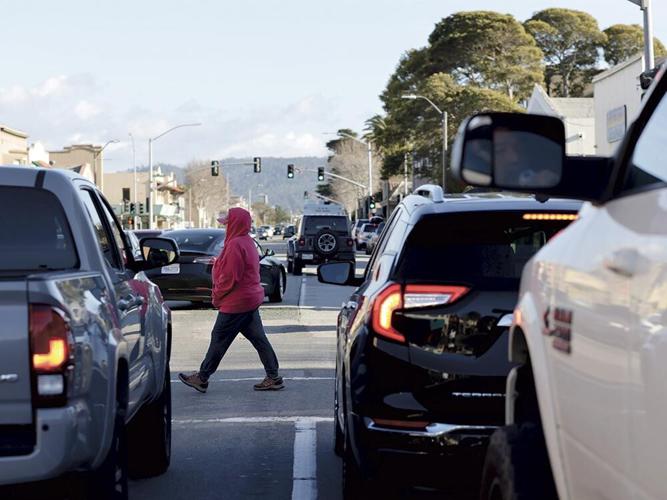


A pedestrian crosses Lighthouse Avenue, a classic stroad.
SOMETIMES HISTORY, GEOGRAPHY AND ECONOMICS CAN HELP OR HURT A GOOD ROAD, as is clear by comparing two of Monterey’s most important thoroughfares: Alvarado Street and Lighthouse Avenue. Alvarado’s history, stretching back nearly 200 years as the center of the growing city’s economic life, laid a foundation for the successful “main street” that it’s become. Lighthouse, on the other hand, has always been a road to somewhere else, struggling as both a road and a business district street, a quintessential “stroad.”
It’s been a balancing act for Monterey officials over the decades, figuring out how to serve the needs of motorists, pedestrians and bicyclists while managing the demands and expectations of residents and business owners. A vision for Alvarado Street forged a decade ago in the city’s Downtown Specific Plan has led to what is now a flourishing destination. The vision for Lighthouse Avenue, laid out in the Lighthouse Specific Plan adopted in 2016, has been clouded by its geography and competing opinions on how to make it work as best it can for all involved.

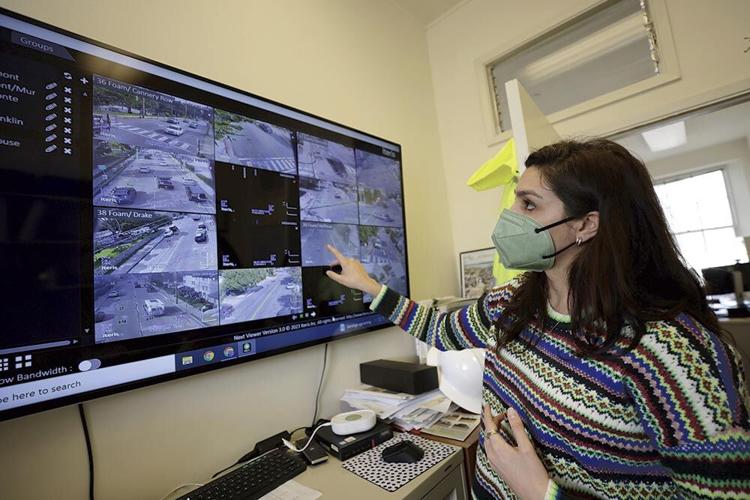
Monterey Engineering Assistant Marissa Garcia monitors the city’s intersections from her office at City Hall using an artificial intelligence software program called SCOOT. It’s connected to traffic lights that adjusts their timing in real time.
FIRE IS WHAT CLEARS OUT THE DEAD WOOD OF A FOREST TO BRING RENEWAL, and it was a fire that eventually brought renewal to Alvarado Street. The T.A. Work building, a prominent structure along the street, burned to the ground in February 2007. It left a gaping hole in the downtown streetscape but the disaster eventually helped spur the city in to create a new plan for downtown that led to a revitalization that brought Alvarado as a street back to life.
Included in the plan was creating sidewalk bump-outs where permanent seating for outdoor dining was installed in front of several restaurants. “It’s one of the best things that ever happened to our downtown,” says Rick Johnson, who served for 22 years as the executive director of the Old Monterey Business Association, as well as the Lighthouse Business District, until he retired last summer. “It gave not just the opportunity to sit outside, but it created an energy on the street. People always want to be where they see people, and that was a great opportunity for downtown.”
The increase in energy along Alvarado is evident on a daily basis. Pedestrians stroll up and down both sides of the street, with numerous restaurants and shops to visit, in almost every kind of weather. It’s not difficult to walk across the one-way, tree-lined street. Parallel parking is available, although it’s more plentiful in nearby parking garages. With crosswalks and bump-outs, it’s not a street where drivers consistently speed. It closes to traffic on Tuesday afternoons for the popular farmers market and on New Year’s Eve for First Night Monterey. It is the true definition of a street, a destination where people shop and meet – it’s not the fast way to get to somewhere else.
Monterey’s Community Development Director Kim Cole says most of what the city envisioned for downtown when the plan was adopted in 2013 has come to fruition, including renovating the bookends of the street – the Monterey Conference Center at the north end and Cooper Molera Adobe to the south. It helped bring Monterey’s downtown out of the Great Recession of 2007-2009, which reverberated for several years among municipal commercial districts like Monterey’s downtown. Today there are few commercial vacancies.
“We were able to get businesses excited about outdoor seating,” Cole says. To encourage buy-in, the city relaxed its rules about adding seating to sidewalks adjacent to the street, leaving a pathway for passersby. Alvarado Street Brewery was the first restaurant to jump in, followed by a few others. The improvements were all funded by businesses. “Outdoor seating definitely made it more pedestrian-friendly,” Cole says. “It made you feel like you are part of an active, vibrant downtown.”
As Alvarado continues to evolve as a downtown destination, there is in the downtown plan a goal of one day turning Alvarado into a two-way street. That plan was set aside by the last Monterey City Council to focus on spending to upgrade city infrastructure like sewers and sidewalks. That wasn’t the only idea for Alvarado, however.
“There was a lot of discussion about shutting down traffic altogether on Alvarado,” Cole remembers. Research shows that to be a success in transforming from a street to a pedestrian thoroughfare, the street in question already must be successful as a destination; the 3rd Street Promenade in Santa Monica is one example of that, or State Street in Santa Barbara. Alvarado had a ways to go before it reached that level of success as a destination.

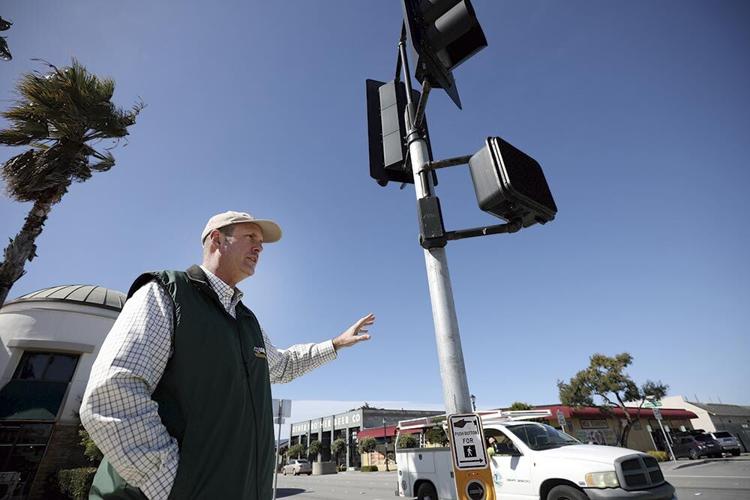
In his work with the Transportation Agency for Monterey County, Todd Muck helps cities (like Seaside, seen here) assess whether their streets and roads are truly serving the needs of the people that live, work and travel on them. He says changes to the built environment take a phased approach, starting with a holistic look at the streetscape before breaking it down into component pieces and implementing specific suggestions.
WHERE ALVARADO SUCCEEDS AS A DESTINATION FOR SHOPPING, restaurants and entertainment, Lighthouse Avenue can’t help where it lands geographically, as one of two ways in and out of Pacific Grove. With an estimated 37,000 cars each day zooming through post-pandemic shutdowns – the highest number pre-pandemic was 56,000, with an average of 50,000-54,000 daily, or 80 percent of the 70,000 daily vehicle trips on Highway 1 – it labors as an effective transportation route, let alone a welcoming destination for pedestrians.
“Lighthouse is not a walking street, it’s a drive-by street,” says Kelly Sorensen, owner of On the Beach Surf Shop. The store has been located at the corner of Lighthouse and Prescott Avenue since 1993. The highly traveled road during rush hours and weekend tourism traffic presents both opportunity and challenge.
“It hinders [business] a little bit. That’s 30,000-plus cars per day at our doorstep, but there’s a deterrent because there is no parking or it’s tough to get to,” Sorensen says. “Lighthouse has been that way forever.”
With narrow travel and parking lanes, it’s not conducive to people feeling safe getting out of and into vehicles parallel parked on the sides of the road. It’s not a street where people would want to sit and eat outside, or take leisurely strolls, with thousands of cars whizzing by. The city’s Lighthouse Specific Plan adopted in 2016 sought to improve conditions along the road, but while some improvements have been made, most of the plan has been on hold to focus on other projects, Cole says.
One of the most helpful improvements – aside from prohibiting left-hand turns in early 2003 – has been the installation in 2018 of cameras at intersections connected to a system that uses vehicle detection and artificial intelligence software to adjust the timing of signal lights and synchronize with other lights in real time. (The cameras are low-resolution and can’t make out details like people’s faces or license plates. They also do not record.)
Monterey was one of the first cities in the U.S. to utilize the system known as SCOOT – Split Cycle Offset Optimisation Technique – software developed in the United Kingdom, says Public Works Director Andrea Renny. SCOOT enables traffic to proceed with few or no stops, which in turn results in reduced fuel consumption and fewer emissions, in addition to improving vehicle travel time and safety. “What we are trying to do is create these platoons of cars that move together and get away from the stop-and-go, stop-and-go,” Renny says. The city has experienced an annual reduction of 20 tons of particulate matter as a result.
After success on Lighthouse, the city has since installed the SCOOT system in other major traffic corridors. The system is overseen on a large monitor from Monterey City Hall in the tiny office of Engineering Assistant Marissa Garcia, who can make manual changes in case traffic spikes.
SCOOT has helped improve traffic flow, but the heavy traffic on Lighthouse continues to be a challenge. As the Lighthouse plan was being created, there were five to six ideas floated – one involved three lanes of traffic flowing out of P.G. in the morning, then flipping that in the evening – but no consensus could be reached among business owners and residents.
To make Lighthouse Avenue more attractive to pedestrians would require removing a lane of traffic, Cole says. That would require an alternative route for overflow traffic, something the geography of the area doesn’t allow for.
Without good alternatives to transform Lighthouse Avenue from road to street, it will remain a stroad.


(0) comments
Welcome to the discussion.
Log In
Keep it Clean. Please avoid obscene, vulgar, lewd, racist or sexually-oriented language.
PLEASE TURN OFF YOUR CAPS LOCK.
Don't Threaten. Threats of harming another person will not be tolerated.
Be Truthful. Don't knowingly lie about anyone or anything.
Be Nice. No racism, sexism or any sort of -ism that is degrading to another person.
Be Proactive. Use the 'Report' link on each comment to let us know of abusive posts.
Share with Us. We'd love to hear eyewitness accounts, the history behind an article.