TO EARN A SEAT ON THE MONTEREY JAZZ FESTIVAL NEXT GENERATION JAZZ ORCHESTRA, the auditioning high school musicians from across the country have to already be the best among their peers, and have had to sacrifice much of their young lives (whether they recognize it or not) in the name of mastery. Yet few, at that point, have had to make the critical decision that draws nearer as graduation approaches: “Do I love music, do I love this art form of jazz enough to turn it into a career? Is a career even possible or worth chasing?”
For a single musician in a single year, the choice is among the most consequential of his or her early life. Expanded over the 51 years of the NGJO program and across the roughly 1,000 musicians who have claimed a seat on the prestigious orchestra, the choice becomes existential, for the art form and the festival.
This is no secret: just as the orchestra is a once-in-a-lifetime opportunity for the musicians, it is also a unique chance for the Monterey Jazz Festival to deepen the next generation’s love for the music and art form, and offer evidence that, yes, a career in this world is attainable, despite the steady arguments behind more practical degrees and career paths.
“Jazz is a great tradition, and it’s an American tradition, and I think it’s sad if we do not bring this opportunity out to communities,” says Claire Kim-Shin, education specialist for the Monterey Jazz Festival. “We want this legacy, this great music, to be carried on.”
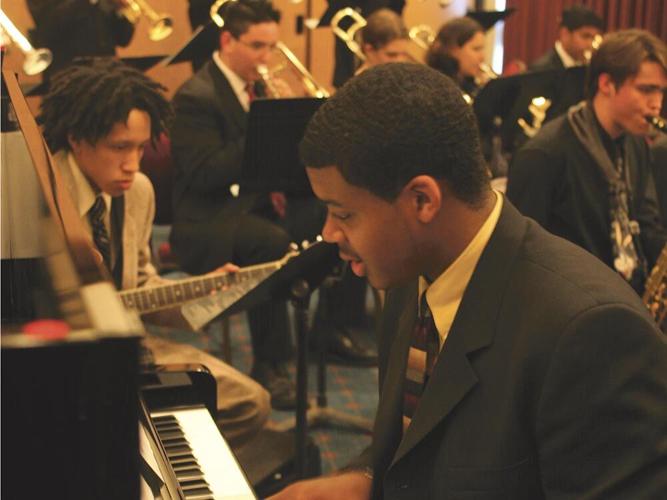
EMMET COHEN, ONE OF THE BIGGEST NAMES IN CONTEMPORARY JAZZ CIRCLES, answers the phone from his home in Harlem, where he is spending a few days ahead of his jazz trio’s West Coast tour that includes dates in Denver, Boise, Seattle, Vancouver and, on Sept. 24, the Monterey Jazz Festival. Cohen, a pianist, gained heavy attention for his pandemic lockdown project, Live From Emmet’s Place, in which he streamed weekly jam sessions from his apartment with his jazz trio. He is also an NGJO alumnus from 2008.
“[NGJO] was something in high school that gave you some clout. It was this springboard to bounce up and off from, that would translate into some sort of a career in jazz,” Cohen says.
When Cohen was part of NGJO, the band traditionally toured Europe ahead of their date at the Monterey Jazz Festival. (The pandemic has stalled this part of NGJO, with no firm timetable for a return.) Once Cohen arrived and began playing with the other musicians in the orchestra, he began to see himself in his bandmates, and the experience deepened from clout and career prospects to a conviction that a life in jazz was possible. He calls the experience “formative.”
“It was a moment where I was like, yeah, I can be a jazz musician. It affirmed my desire and showed me that, OK, I’m good enough to do this,” Cohen says. “It gave me a lot of confidence. Those experiences made me want to be a musician and travel the world forever.”

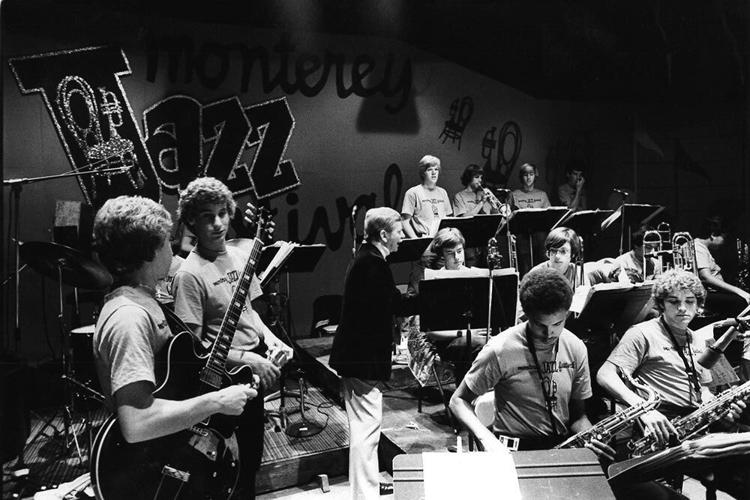
Next Generation Jazz Orchestra musicians play in 1981. The program has been attracting top young musicians from across the country for 51 years.
WHETHER THE NGJO BREEDS SUCCESS OR SIMPLY HAS A FINELY TUNED RADAR for those up-and-coming talents whose success is inevitable is difficult to determine. Either way, the orchestra’s alumni list shows each class brings budding global talent to the stage.
A sample size of graduates over the decades includes Grammy-winning composer Ted Nash (classes of 1975-1977), Oscar – and Grammy-nominated composer Randy Kerber (class of 1975) who helped score classic blockbuster films such as Titanic and A Beautiful Mind; Grammy-nominated saxophonist and smooth jazz giant Dave Koz (class of 1981); world-famous saxophonist Joshua Redman (class of 1986), who even starred in an episode of the PBS children’s cartoon Arthur, depicted as battling famed classical cellist Yo-Yo Ma in a music match; Eddie Barbash (class of 2006) who most recently played in Jon Batiste’s band on Late Night with Stephen Colbert; and widely acclaimed vocalist/bassist Katie Thiroux (class of 2006).
Renowned pianist and composer Kris Bowers can rattle off the names of many of his bandmates from the class of 2006. Bowers, talking from his studio in Los Angeles, says he still talks about the NGJO because it prepared him for a life in jazz “on so many different levels.” Today, Bowers, who has worked on scores for projects such as the films Green Book and Dear White People, and television shows such as Bridgerton, has a few projects in the works, including a Marvel movie and a television series version of The Color Purple. Although he’s not as active in the jazz space, Bowers says the NGJO played an important role in his development.
“Any institution I’ve been a part of where a lot of talented kids came out of it, I feel like they were able to use the skills they learned in these jazz spaces in incredible ways. To me, that is what keeps the spirit of music alive,” Bowers says. “The people who are the best professional musicians often have some sort of jazz training or background, and having a program like this feels incredibly important to foster that.”

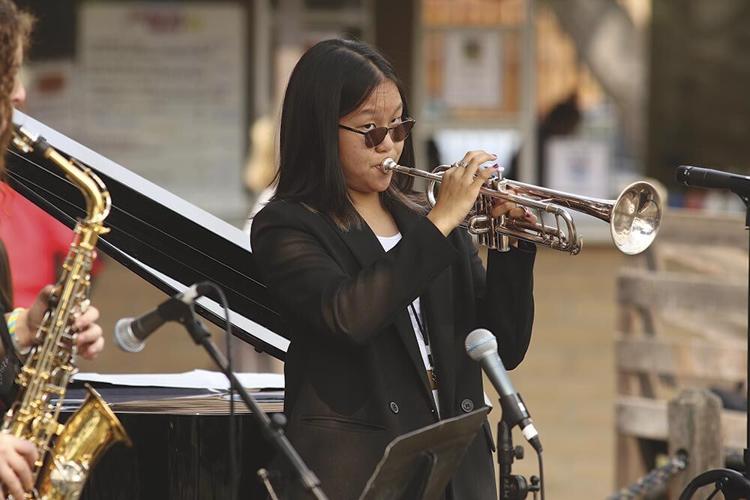
Skylar Tang, a trumpet player, is part of this year’s NGJO. It is her second consecutive year in the orchestra, a rare achievement.
DURING ONE SUNDAY IN MID-SEPTEMBER, HIGH SCHOOL JUNIOR SKYLER TANG PREPARES FOR YET ANOTHER GIG, this time with her trumpet and an accompanying bass player. The evening before, she played a funk show with local Oakland outfit The Flannels. All of this, of course, in between navigating a steady stream of homework and practicing her parts for the upcoming NGJO performance. It is her second consecutive year in the orchestra, a rare achievement in the history of the program.
Tang says for up-and-coming jazz musicians, the NGJO carries a “big reputation,” and attracts the “best musicians from all over the country.” The moment she learned of her first acceptance into the orchestra in 2021 remains vivid in her memory: She was dissecting a pig in biology class, growing nauseous when her phone buzzed.
“Hold up, did I just get into [NGJO]?” Tang remembers thinking as she battled pig carcass wooziness. “It was a great day, and took away some of the stress from the pig.”
Once she gets to Monterey, Tang’s Jazz Fest experience will be a whirlwind. Tang was set to arrive Wednesday, Sept. 21 at 3pm and sit in for a four-hour rehearsal. Thursday, the following day, rehearsals run for a broken up five-and-a-half hours, ahead of a small concert at CSU Monterey Bay. The band practices again for two hours on Friday, three hours on Saturday, and then on Sunday for an hour before they take the Jimmy Lyons stage at the Jazz Festival at 12:30pm. Tang is ready to be wowed all over again.
“Being on that stage really inspired me last year. I got back and all I wanted to do was practice and make music,” Tang says. “Everything was slightly more overpowering than usual. But you know, once you count off a tune you can’t just stop it. You’re in it, and you gotta just let it happen and ride with that feeling.”
NEXT GENERATION JAZZ ORCHESTRA performs 12:30-1:20pm Sunday, Sept. 25. Jimmy Lyons Stage.


(0) comments
Welcome to the discussion.
Log In
Keep it Clean. Please avoid obscene, vulgar, lewd, racist or sexually-oriented language.
PLEASE TURN OFF YOUR CAPS LOCK.
Don't Threaten. Threats of harming another person will not be tolerated.
Be Truthful. Don't knowingly lie about anyone or anything.
Be Nice. No racism, sexism or any sort of -ism that is degrading to another person.
Be Proactive. Use the 'Report' link on each comment to let us know of abusive posts.
Share with Us. We'd love to hear eyewitness accounts, the history behind an article.