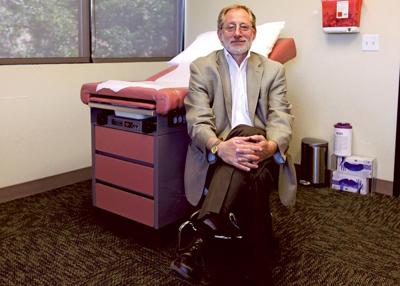

When physician John Hausdorff came to the Monterey Peninsula in 1996, he went into practice with two other oncologists. His partners wanted to introduce him to the local medical community by having him give a lecture, known as “grand rounds,” at Community Hospital of the Monterey Peninsula. Grand rounds is an event where everyone from doctors and nurses to administrators gathers in a lecture hall to hear someone speak about an interesting case, or new trends in medicine or present new research about a specific topic.
Hausdorff figured since he was a cancer doctor, he would talk about lung cancer: “They said, ‘boring,’” he says. “Then I suggested something else and again they said, ‘boring.’”
But in 1996, the state of Oregon was fighting an injunction against implementation of its Death With Dignity Act, which voters had passed two years earlier by 51.3 percent to 48.7 percent. It would be more than a year until Oregon successfully quashed that subpoena in 1997, and aid in dying was one of the hottest topics going at the time. So after his first two suggestions were shot down, Hausdorff then suggested to his partners that he talk about “assisted suicide.”
The response to that suggestion: not boring. And the response by the medical community was even bigger.
“Nobody was talking about it then, and the lecture hall was packed,” Hausdorff says. “It will be a very different talk now than it was then.”
It will be a very different talk indeed when Hausdorff, an oncologist in private practice with Pacific Cancer Care and medical director of CHOMP’s Palliative Medicine Service, gives another grand rounds on a day yet-to-be determined in May. The subject will be the same – assisted suicide (a term he balks at even while using it, because as he puts it, “Is it really suicide if you’re going to be dead in a month?”) and what questions physicians can expect to receive from patients about California’s own End of Life Option Act.
The act, spearheaded by state Sen. Bill Monning, D-Carmel, goes into effect June 9. It will enable adult patients who are of sound mind and who have a terminal diagnosis with less than six months to live to seek a prescription that will allow them to end their owns lives at a time of their choosing.
The End Of Life Option Act isn’t a hospital-focused bill – most of the activities authorized under the law will happen in a doctor’s office and a patient’s home.
But someone has to write those prescriptions and that’s where the doctors come in. Two doctors must agree that the patient seeking the prescription is terminal, and then one has to issue the prescription. So when I reached out to CHOMP to talk about how the Monterey County medical community was going to deal with the new law, they directed me to Hausdorff, who is also medical director of Hospice of the Central Coast. And when I got him on the phone and asked how he and his colleagues were going to deal with the new law, he laughed and said, “Great question!”
What followed about a week later was an epic, two-hour conversation about the End of Life Option Act, palliative care, how doctors need to work better with patients to address end-of-life issues and why not as many patients might avail themselves of medical aid in dying as initially thought.
The interview has been edited for length and clarity.
Weekly: So when I initially asked you how physicians were going to handle the new law, you laughed and said nobody is really sure yet. How is it being addressed in the medical community?
Hausdorff: We don’t yet know how they are going to handle it, but they are going to handle it. There’s no organization behind it. Each hospital is going to sit down and figure out how they’re going to approach this, and, having talked to the people who run the show, I know that CHOMP’s administration has said the first step is to have a dialogue with our own medical staff and get their feedback and thoughts, because this is a doctor-centered intervention. It’s about patients, but nothing happens without docs at all. So that dialogue is in the works. We’ve drafted some questions that will be sent to the medical staff.
What’s the initial feedback look like?
Nobody is arguing about the law. Everyone seems to have accepted it. But the administration and I clearly feel that education of the physician in particular, and the whole hospital staff, is paramount. This is a new law and none of the physicians have experience with it – how could they? Like most issues of consequence, the amount of misinformation and preconception gets in the way.
This is huge. Huge. There’s really two very separate components here, and the second is what the law says and what you have to do – the really practical stuff.
But that’s preceded by, how does a responsible physician respond to requests? It’s particularly huge because many physicians are against assisted suicide. Suicide is a bad word, because is it really suicide if you’re going to be dead in a month? Increasingly, advocates are phrasing this as assistance in dying.
What do you expect will happen during your grand rounds?
My audience will be a mix of people who support it, who are against it and those who don’t know where they stand. Where they all stand in common is that they will all be asked. The answer to patients shouldn’t be, “I don’t do that,” or “I’ll sign you up.” The answer should be, “Talk to me, what’s going on, why are you asking and where are things?” The question is an entry point to a physician-patient dialogue to find out what’s going on, and for a small group of people at the end of the process, to determine if assistance in dying would be appropriate or wanted.
Nothing means anything out of context, and the context of this is that assistance in dying is an amazingly insignificant piece of good end-of-life care. Although it’s very nice that it’s available, and there are a small number of patients for whom it’s necessary, the real highlight is that end-of-life care is poorly delivered and inadequate. And that’s facilitated hugely by physicians who don’t know when to stop, and patients and families who don’t know when to stop and who are afraid. That’s why it matters.
Why don’t physicians know when to stop?
Many don’t want to let go because they weren’t trained in it. Their understanding of their role is to treat. Ultimately, when they can no longer make you better, it’s interpreted as failure and we don’t want to fail.
Good end-of-life care gets no attention, no press and it’s riddled with fear and misconception. Good end-of-life care is really about the timing of the transition from active medical care to home-based, comfort-focused care, which is almost always best done through hospice.
And the timing of that transition is hugely problematic. Probably the two biggest players that many physicians don’t want to let go – and equally important – are patients and families who understandably don’t want to stop. They’re afraid, understandably. There’s a denial of death in this culture.
Where does hospice care fit into this equation?
It’s a spectacular creation, amazingly misunderstood and feared. It’s about no more hospitals, no more tests, no more blood work, no more scans, no more ER and it’s almost always home-based care and it’s all about comfort.
The nurses come to you, the social worker comes to you, the chaplain comes to you. There’s a doc who is peripheral but they occasionally come to you too. The requirement is the physician thinks you have a high likelihood of less than six months to live. You don’t have to die in six months – I’ve had patients in hospice for two years.
And the framework for it is palliative care, which is also totally misunderstood.
That’s a lot of misunderstanding going on! What’s the difference between the two?
Ninety percent of physicians and the public believe palliative care and hospice are the same thing. But palliative care is a multidisciplinary service that tries to maximize quality of life, before you’re ready to prepare for end-of-life care. It’s all the things you say you want: I want symptom management, I want my pain well controlled. It’s identifying depression as a result of your diagnosis – everyone who gets cancer gets significant depression – and identifying and treating it is huge. And it’s figuring out your support network of people who could be brought into place.
It’s clarifying that the patient understands the diagnosis and has some idea of the prognosis.
You’ve referred to context a few times, so put this all into context: What’s good end-of-life care and where does aid in dying fit in, if at all?
The problem with this whole topic is the hysteria, that people and the press help to fan as though dying is this terrible, horrible, monstrous and always painful thing and that physician assistance is a fabulous way out. But good end-of-life care at its essence isn’t about assisted suicide in the slightest – it’s open dialogue with the treating physician, realistic goals of care and ongoing discussion as to when to make the transitions. So many docs weren’t taught this stuff.
Do I believe in the right to control my own destiny as a terminally ill patient? Yes, I do. Was this legislation carefully crafted by Bill Monning and does it have sensible safeguards? Yes it was and yes it does.
Things to Know
On March 30, Senate Bill 1002, authored by state Sen. Bill Monning, D-Carmel, passed out of the Senate Committee on Health on a 7-2 vote. The bill would require the California Department of Public Health to establish a toll-free telephone number to receive and respond to questions about California’s End of Life Option Act. The act goes into effect on June 9; SB 1002, on the toll-free phone number, will next be heard in the Senate Committee on Appropriations. A date for that hearing has not yet been set.
On Saturday, April 16, CHOMP holds an event on National Healthcare Decisions Day, including discussions on the benefits of advance care planning; how to have those conversations; the risks and benefits of cardiopulmonary resuscitation; and documents used and the nuts and bolts of completing them. Speakers include Dr. Steven Packer, M.D., president and CEO of CHOMP; Joy Smith, R.N., an oncology educator; and Dr. John Hausdorff, M.D., medical director of CHOMP’s Palliative Medicine Service.





(2) comments
I take exception to the polling.
I have found (serving 60 fair booth days) that about half of the public thinks they are in favor of such a law, that is until they learn about the flaws in the laws that create new paths of elder abuse with immunity. Once they learn that a predatory heir may steer the signup process and then forcibly administer the lethal dose without oversight, they all said, “I am not for that!”.
Anyway all of these Oregon Model bills,, including CA's have the same flaws that eviscerate flaunted safe guards.
For example how many times have you nodded your head when the proponents declared that the lethal dose must be self-administered?
Well, read the language of the law/bill and you will find that there is no means provided to insure that marketing point. For example “self-administrate” was mentioned 11 times in the 8 page Minnesota SF 1880 and yet there was no means provided to confirm that the lethal dose was forced on not, who would know if they struggled and not consented.
In fact what is provided is that there may be no investigations allowed after the death (page 6 of 8 Subd. 12. In addition allowing a stranger that claims to know how the person communicates may speak for them eviscerates all the intended safeguards, page 1 of 8 (e).
Along with allowing predatory heirs and staff to witness even as other family members are not required to be contact.
This is a very dangerous public policy that by their own records in OR and WA is establishing poisoning as the "medical standard of care" for people that have “feelings” of fear of the loss of autonomy.
We are all at risk of abuse by these poorly composed laws/bills.
At your service,
Bradley Williams
President
MTaas dot org
What you are describing is not assisted dying and it doesn't equate whatsoever. How many incidents of these "predatory heirs" have occurred in Oregon? Zero, in the twenty years this option has been available to dying patients. Death with dignity is a right and should be supported by the government and physicians alike.
Welcome to the discussion.
Log In
Keep it Clean. Please avoid obscene, vulgar, lewd, racist or sexually-oriented language.
PLEASE TURN OFF YOUR CAPS LOCK.
Don't Threaten. Threats of harming another person will not be tolerated.
Be Truthful. Don't knowingly lie about anyone or anything.
Be Nice. No racism, sexism or any sort of -ism that is degrading to another person.
Be Proactive. Use the 'Report' link on each comment to let us know of abusive posts.
Share with Us. We'd love to hear eyewitness accounts, the history behind an article.