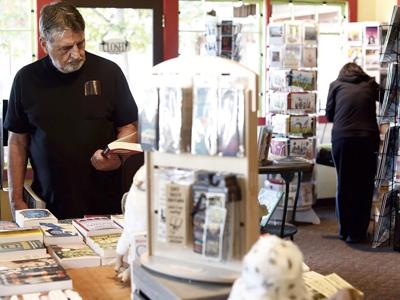

AS ARE OTHER LOCAL BOOKSELLERS, Fernandes reports that she sees “gravitation to classics, to books with beautiful bindings. Or to escape literature, such as travel novels.”
Nell Flattery of BookWorks in Pacific Grove says, “Young people are really reading, and they are reading classics.” Part-bookstore, part coffeehouse, BookWorks never fully closed. “The coffee helped the bookstore survive,” Flattery says about the three difficult months when the bookstore closed and they concentrated on online sales, more as a community service than for profit. But by June 2022, Flattery was surprised by “how busy we were. People wanted to connect and the bookstore was a perfect place to go during the pandemic.”
Trish Sullivan of Downtown Books & Sound in Salinas echoes the same observation: “Interest in books is higher than ever.”
Sullivan says her business is being negatively affected by other factors: the renovation of the Main Street that took over a year and finished in 2022, and the Saturday farmers market that can have the effect of blocking the store entrance. Despite that, on one recent busy, parking-less day, she had six people calling and buying books over the phone. “They were so desperate for their books that I ran out to the parking lot to give it to them,” she says.
She reports on new trends, for example a new take on “pocket books” that look more like a phone than a traditional book and are to be read “socially interactive” – they flip horizontally, not vertically, for example – for convenience. They are full books, even though it’s hard to believe it, looking at the small object that will fit any purse or pocket. “This phenomenon is completely driven by teenagers,” Sullivan says.
Another best-seller out of Downtown Book & Sound’s collection of 60,000 titles, new and used, are “banned books” – those that for various reasons have been banned at some point in time – sold wrapped in gray paper. Customers can’t see the title when they buy them, but Sullivan says these pre-wrapped titles are extremely popular, and some people buy six at once.
Sullivan also sees a trend toward younger readers, and an interest in classics. “The majority of our customers are young people,” she continues. “They always ask about this name that gives me fits: Daa-stoy-ev-skee. ‘Do you have Crime and Punishment? Do you have Brothers Karamazov?’ One kid asked me about The Gulag Archipelago. It’s a hard, hard read.”
“BUSINESS HAS NEVER BEEN BETTER,” says Debra Gavlak, sales manager at River House Books in Carmel. The bookstore was closed for a month during Covid, after which it quickly became profitable again, with a large bump in sales soon after. The store accepted orders and credit card numbers by phone, and delivered books to customers’ doors – competing with the likes of Amazon. (Public libraries also scrambled to figure out a way to do curbside pickup in that era.)
“People were so appreciative,” Gavlak says. “‘We are so glad you are still here,’ they would say. ‘We are so glad we still have a bookstore.’”
But Gavlak also talks about increased book prices and a shortage of some physical books, especially new titles.
Delays are not the only problem that can put the newly regained appreciation for book-buying on hold. The cost of paper increased by 10 percent in 2021, and continues to rise in 2022. The rising cost of transportation – most books are printed in China, Sullivan says – doubles the problem. As a result, new titles generally cost $3 to $6 more per book than in pre-pandemic times.
Most book-buyers are understanding, the booksellers say. And some are rethinking what to read. For example, Fernandes has observed that some readers reacted to increased prices by switching to young adult (YA) literature, which is typically half the price of adult fiction.
“It’s a mature decision,” she says about the idea. “Content easily overlaps,” she adds, offering the example of Hunger Games, a YA book that has huge adult readership.
Publishers work on the assumption that teenagers have less money to spend, so price books accordingly. So while young readers are exploring heavy Russian classics, the adult crowd is opting for titles intended for 13-year-olds. Sounds like the makings of a plot for an excellent novel.



(0) comments
Welcome to the discussion.
Log In
Keep it Clean. Please avoid obscene, vulgar, lewd, racist or sexually-oriented language.
PLEASE TURN OFF YOUR CAPS LOCK.
Don't Threaten. Threats of harming another person will not be tolerated.
Be Truthful. Don't knowingly lie about anyone or anything.
Be Nice. No racism, sexism or any sort of -ism that is degrading to another person.
Be Proactive. Use the 'Report' link on each comment to let us know of abusive posts.
Share with Us. We'd love to hear eyewitness accounts, the history behind an article.