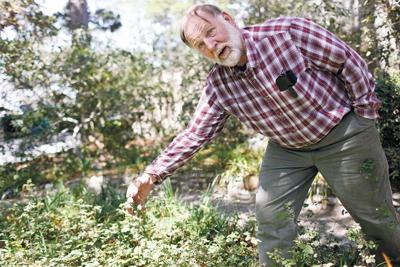

Gov. Jerry Brown’s April 1 mandate to cut back municipal water use by 25 percent probably struck people fond of long, luxurious showers as bad news. Same for gardeners. But a number of local gardeners have proven it’s easy to go low-water and keep the yard looking good. Transitioning to drought-tolerant natives is good water policy, and it also comes with additional benefits like attracting birds and pollinators like bees and butterflies.
The Weekly asked members of the California Native Plant Society’s local chapter for some drought-friendly gardening tips.
Pat Regan starts his day job at 6:30am, landscaping 20 acres of the Santa Lucia Preserve in Carmel Valley with natives, then works as a horticultural consultant in the afternoons. Carol and Brian LeNeve tore out their Carmel lawn when they moved into their home in 1972 – not because they were water-conscious (although they are), but because it’s much better for oak trees. Here’s some of their guidance for gardening in a drought.
~ ~ ~
1. Be patient. The time to plant natives is the fall, not now. “This is a time of year you notice everything is in bloom. But this is not the best time to make a change,” Regan says. The soil is at its warmest in the fall, allowing roots to establish themselves comfortably as the rainy season hits. Short, cool days keep the foliage from going gangbusters, instead focusing growth on the roots, where it belongs early in the plant’s life. Foliage will come in spring.
2. Embrace diversity. Even among the same species, like ceanothus or manzanita, you can find different heights. Head-high and ground-creeping varieties (and everything in between) make it easy to landscape an entire property with natives.
3. Learn to love dormancy. Native plants are adapted to dry, hot Central Coast seasons, though foggy, cooler coastal weather helps plants retain their moisture. (Inland, it’s a little tougher). Natives might get brown as they go seasonally dormant, but they’ll conserve energy and live as much as a decade longer than over-watered natives that bloom longer. Choose flowers that bloom at different times of year. Island snapdragon climbing up the LeNeves’ fence is in full bright red flower right now. “The hummingbirds love it,” Carol says. “I have to be careful never to wear a red scarf outside, because they bomb me.”
4. Put away the rake.Mulch comes in many varieties, from naturally occurring leaf litter to gravel to shredded redwood bark. Don’t rake it up; mulch helps retain moisture and slowly decomposes, contributing nutrients to the soil. And it eliminates bare soil, which is a perfect place for weeds to take root, or just to blow away and erode.
5. Pot it. The LeNeves like some seasonal, colorful flowers when their natives are less perky. So they dig holes, then drop potted plants directly in the ground. It helps retain water when they do water them, and lets them rotate seasonally.
6. Water early on – then lay off. Regan advises against converting a landscape to natives in the spring, because it requires watering (or rain) to help the plants get established (see no. 1). But after about two seasons, you can stop watering. Regan has no irrigation system, and only occasionally hand-waters plants when they get really stressed. He hasn’t applied a drop yet this year. Even established exotic species probably need a lot less water than you’re accustomed to applying. Regan recommends cutting back, no matter what’s in the ground.
7. Make it rain. Or at least store what little rain we get. Cisterns make the rain last, plus the Monterey Peninsula Water Management District offers generous rebates.
8. Be a tattletale. The water district wants to know about your neighbor’s sprinkler that douses the driveway. To report water wasters on the Monterey Peninsula, call the 24-hour hotline at 658-5653. And remember the stage 1 conservation rules, in place locally since the ’90s: Water landscaping no more than twice a week, on Wednesday and Saturday (which is plenty; see no. 6) and only use a hose with an automatic shut-off nozzle attached, “not the old-fashioned way with your thumb spraying it,” says Debbie Martin, conservation technician at the water district.
9. Don’t get too attached. For perspective, Carol LeNeve says buying a native plant is similar in price to buying a bouquet. If it doesn’t last, don’t fret – you still get to enjoy it for a few days or weeks. And don’t blame yourself: “Never, ever take it personally if a plant dies,” Carol says.
10. Buy local – this weekend.
You can get started shopping for natives at the annual MEarth plant sale 10am-4pm Saturday, April 25, at Carmel Middle School, 4830 Carmel Valley Road, Carmel.


(0) comments
Welcome to the discussion.
Log In
Keep it Clean. Please avoid obscene, vulgar, lewd, racist or sexually-oriented language.
PLEASE TURN OFF YOUR CAPS LOCK.
Don't Threaten. Threats of harming another person will not be tolerated.
Be Truthful. Don't knowingly lie about anyone or anything.
Be Nice. No racism, sexism or any sort of -ism that is degrading to another person.
Be Proactive. Use the 'Report' link on each comment to let us know of abusive posts.
Share with Us. We'd love to hear eyewitness accounts, the history behind an article.