


Baking your own sourdough bread. Planting a garden. Adopting a new pet. Nearly a year into our collective pandemic life, these activities are all but cliche. But, like most cliches, they are borne out in reality – stuck at home during shelter-in-place, people are developing new relationships to their animals.
“It’s really just been incredible,” Beth Brookhouser, vice president of communications and marketing at the SPCA Monterey County, says of the surge in adoptions the shelter has seen during Covid-19. Prior to the pandemic, cats and dogs at the SPCA waited an average of five to seven days for adoption requests. Today, those requests come in “instantly.” Combined with fewer surrendered animals arriving, Brookhouser says people wanting to adopt from the SPCA may need to be patient. “It’s a great time to adopt a pet, when you’re able to spend so much time with him or her,” Brookhouser says.
And contrary to what the following list may lead you to believe, it’s not just cats and dogs. People are also adopting horses, guinea pigs and chickens (“hens get adopted so quickly,” she adds.)
What will happen with these pets once the pandemic is over and people start going back into the office, traveling more and entertaining at home remains to be seen. The SPCA has its eyes on at least one potential challenge – new pets, especially puppies, brought home during the pandemic may not have the same socialization experience that they would otherwise.
“There may be some behavior problems that pop up [when life gets back to] normal,” Brookhouser says. “So that’s what our behavior team is preparing for, so that we can help people prepare in advance or be there to help people after they’ve realized that there’s a problem.” The SPCA has developed online training programs around this challenge too.
In the meantime, we asked readers to share their pet stories, and photos, with the Weekly. Read on to meet some of the furry friends living among us.
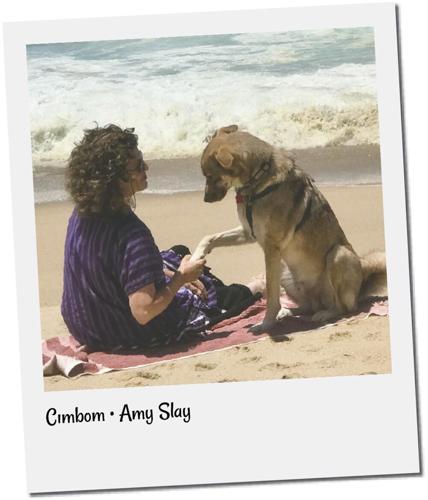
“CIMBOM”, PRONOUNCED “JIMBOM” in English, is a West Asian Village Dog adopted from the streets of Istanbul, Turkey. He first met his human, Elizabeth Slay (also pictured), when she and her husband were living in Istanbul and she started volunteering with street animals.
“Jimbom appeared in our neighborhood when he was around 1 year old, thin and hungry,” Slay writes. “I started feeding and watching out for him daily. When his leg was broken, he needed five months to heal after his cast came off… so my husband and I took him home. Traditionally, Turks don’t keep dogs in their homes, only outdoors for guarding flocks or hunting. Even the vet was of the opinion that a ‘free man’ would never accept apartment dwelling. Once Jimbom had fully mended, we had to make a decision. There was serious debate among our Turkish and expat neighbors over whether it was moral to keep a ‘free man.’ I walked with him late at night in his territory, where his street dog buddies were thrilled to see him. I took off his collar and watched them run and play for a couple hours. When I headed home, Jimbom chose to go with me. This settled any doubt in my mind about what the ‘free man’ wanted.
“My husband said, ‘We didn’t adopt him, he adopted us.’ He flew with us when we moved to California (along with three rescued street cats), another major transition for him. This photo was taken on one of our first walks to the Pacific Ocean after we arrived in Marina.”

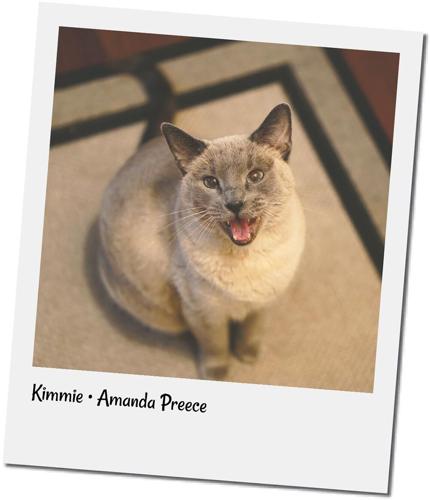
KIMMIE, A “VOCIFEROUS” AND ROUTINE-ORIENTED KITTY who was adopted six years ago from the Humane Society in Idaho, now lives as an indoor cat in Monterey. “She’s an indoor cat, you know, for her safety but also for the benefit of the local wildlife,” says Kimmie’s human, Amanda Preece, who works for the State Parks – including leading birdwatching tours at Asilomar State Beach – and serves on the board of the local Monterey Audubon Society chapter. “It is 3 billion birds every year that are estimated to be killed by cats. It’s a really big deal. Cats are probably the most harmful, direct human cause of wildlife death.
“I love cats,” Preece adds, “but I think people need to be a little more conscious.”

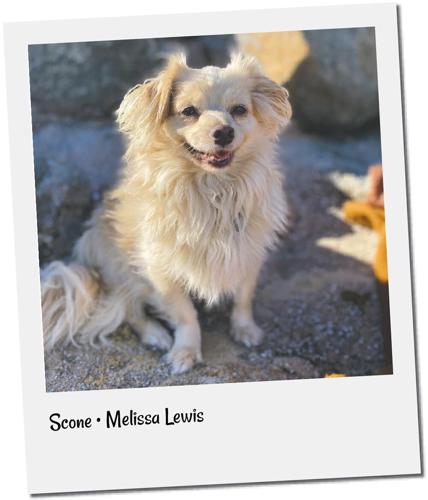
SCONE IS NEW HERE. He and his two humans, as well as their other dog Yucca (“we’re obsessed with food dog names”), just moved to town a couple of weeks ago. A pomeranian and mutt mix, Scone was found on the road in Oakland, with an unclear backstory. At first, human Melissa Lewis says, he was super shy. But now he’s evolved into a quirky, funny, outgoing dog with what Lang describes as a “perma-grin” look on his face. “He’s the best travel dog,” Lewis says. “He comes everywhere with us. He comes on bike rides, on hikes… he’s actually currently in my backpack while I’m walking the big dog.”

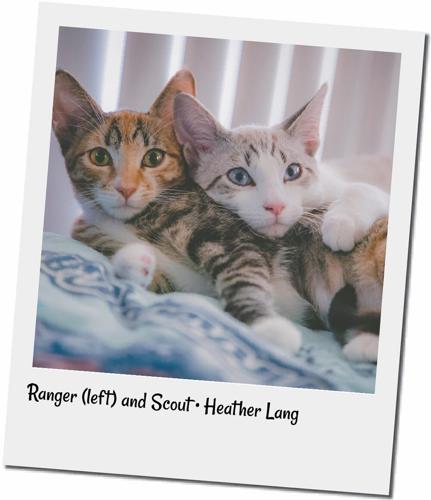
RANGER AND SCOUT ARE SIBLING KITTENS adopted from Furrever Cat and Kitten Rescue in June of 2020. As kittens do, they know how to keep pandemic life interesting. “Ranger loves to sneak into my drawer and steal socks, which she then leaves in random places throughout the house,” human Heather Lang writes. “I’ve found them up in their cat tree, under my desk, on the floor and under the couch… it’s like a dog hiding a bone. The best is when you catch her in the act; she will blankly stare at you for a second and then drop her loot and sprint away. Scout is not shy and loves to lay on his back with his legs up in the air. When both of them are in a funny mood, they do this strange behavior where they will both ‘hug’ the door frame with their ears back, meow, then jump up the frame as high as they can to try to reach the strike plate. Makes me laugh every time!”

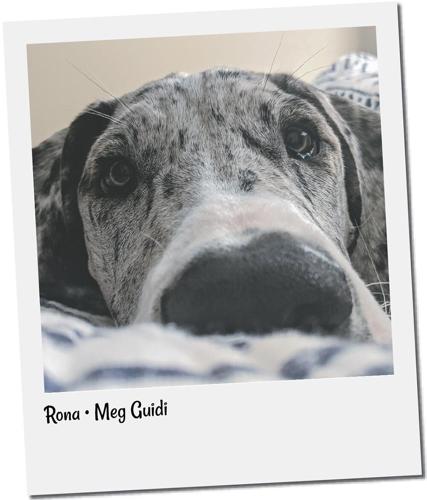
MEG GUIDI AND HER PARTNER CALEB BROUGHT RONA the dog home on the first day of shelter-in-place last March. They’d been thinking about getting a dog, but felt it would be irresponsible because they wouldn’t be home enough. “If it hadn’t been for shelter-in-place, we probably wouldn’t have gotten a dog within the next one to two years at least,” Guidi says. Having Rona (who Guidi describes as an “attention seeker” who “always has to be in the background of the Zoom”) around has been “a really fun distraction,” she adds. “While everything felt like it stopped moving for the year, we marked the passing of the days by Rona’s growth.”
And the name? Well that was a “big discussion,” Guidi says. It was Caleb’s idea, and they both liked the name, but worried about using a name that could bring up unpleasant feelings or memories related to the pandemic. Eventually they did some research, and discovered that the name, now not very popular, means “bringer of joy.” (For what it’s worth we did some research too, and discovered that “Rona” has Hebrew, Arabic and Scottish Gaelic origins, meaning something like “joyful song,” “shining light” or “might,” respectively.)
In the end she became Rona because the name just “totally suits her,” Guidi says.

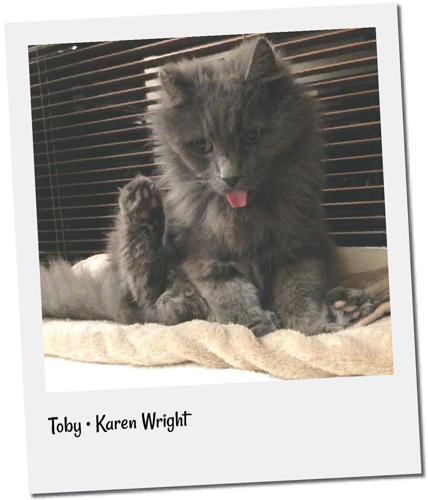
ABOUT FOUR YEARS AGO, TOBY WANDERED INTO A LOCAL FERAL CAT FEEDING AREA. He was friendly enough that volunteers for nonprofit Animal Friends Rescue Project assumed he must have been a house cat at some point in his life. He was also already very old, so AFRP asked volunteer Karen Wright, who has worked with the organization since 2004 and takes on a lot of older “hospice” cats, if she would foster him. She accepted. Much to the surprise of AFRP’s vet clinic team, despite being very skinny and requiring many daily medications, Toby is still living life, enjoying sunny breakfasts on his “catio.”
“It’s almost like nobody told him he was a hospice kitty, and he just decided to stick around,” Wright says.

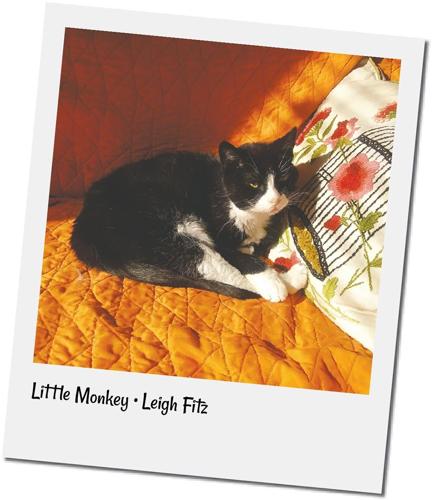
WHEN THE PANDEMIC HIT, LEIGH FITZ DECIDED TO FOSTER LITTLE MONKEY, a 12-year-old tuxedo cat, from Golden Oldies Cat Rescue. Little Monkey had been living on the streets and was very shy at first – it took her a week to stop hiding under the bed. But since then she’s warmed up into a “very, very affectionate” cat. When an adoption opportunity came up for Little Monkey, foster human Fitz decided to keep her. “It’s just nice, because I live alone, to walk in the door and yell ‘hello’ at something,” Fitz says. “I don’t have conversations with her, I haven’t gone full cat lady yet. But I definitely walk in the door and say hello and she’ll run out and I’ll ask her if she wants a snack.”

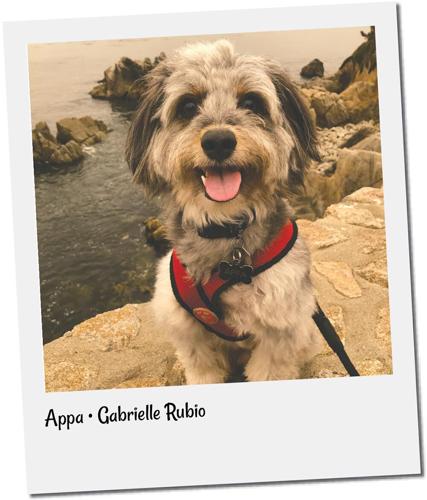
GABRIELLE RUBIO ADOPTED NINE-WEEK-OLD APPA from the SPCA two years ago. “He is the sweetest, most loving dog I’ve ever had,” Rubio writes. “Always happy and friendly toward every creature and human he meets. He loves morning cuddles and just hanging out with me.”
Appa’s “dance party” routine, where he hops around on his hind legs in his Seaside living room, is another pandemic highlight.

HAMILTON, A NEARLY 2-YEAR-OLD WHIPPET (yes, he’s named for the musical) is pictured with Teeny Weeny (given name Rosie), his miniature Dachshund puppy friend. At first, human Judy Miramontes says, working from home with Hamilton (and Rosie when she comes to visit – Rosie belongs to Miramontes’ mother), and trying to keep him quiet during conference calls was a challenge. But by now, she’s used to it.
Plus, people’s pandemic work-from-home setups has given Miramontes a new way to get to know her coworkers. “I work with a lot of people who I had no idea have so many pets,” she says. “So it was fun… we were all just sharing our pets.”



(0) comments
Welcome to the discussion.
Log In
Keep it Clean. Please avoid obscene, vulgar, lewd, racist or sexually-oriented language.
PLEASE TURN OFF YOUR CAPS LOCK.
Don't Threaten. Threats of harming another person will not be tolerated.
Be Truthful. Don't knowingly lie about anyone or anything.
Be Nice. No racism, sexism or any sort of -ism that is degrading to another person.
Be Proactive. Use the 'Report' link on each comment to let us know of abusive posts.
Share with Us. We'd love to hear eyewitness accounts, the history behind an article.