HOMESCHOOLING WAS NEVER GOING TO BE MY THING. Pre-pandemic, I was grateful to send my two high-energy boys into the competent hands of professional educators Monday through Friday. I’d head to my office to work for uninterrupted stretches in my sunny cubicle and have real-life conversations with fellow adults.
Ah, memories.
Now, my work and my kids’ education have been swirled together like mustard and caramel – each a fine pretzel dip in isolation, but so wrong together. I Zoom in our guest room while the boys Zoom at the dining room table. My husband, a self-employed artist with a semi-flexible schedule, guides them when he can. I make special appearances to kick the big kid off YouTube and empty the dishwasher before hurrying back to my laptop and locking the guest room door behind me.
Honestly, it’s madness. But some families have found a formula that’s tolerable, and a key variable is how they’ve reconfigured their homes to accommodate the chaos.
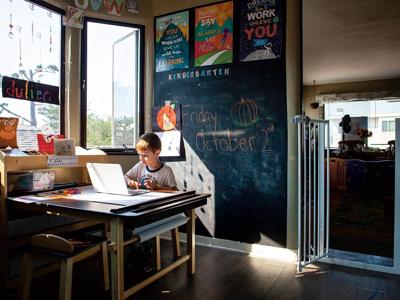
Marquet Miner of Carmel transformed a corner of her 900-square-foot apartment into a Pinterest-worthy learning nook for her River School kindergartner. She replaced a kitchen hutch with an art desk and coated the walls with chalkboard paint. “We’ve altered our living space really drastically,” she says. “My son thrives in structure.”
Miner and her husband also have a toddler, two dogs and a cat, plus a pet-grooming shop downstairs, which they run as a team. In the backyard, they’ve strung up a ratchet strap with gymnastic rings and built a play structure to keep the kids moving.
Still, the family gets overwhelmed at times. “I’ve hid in the bathroom and cried during Zoom,” Miner says. “No amount of creative decor or organization makes it easy.”
In Seaside, Isai Ogarrio partly telecommutes to his job as an administrative assistant. His wife, a software engineer, works full-time from home while their kids, a third-grader at Marshall Elementary and a seventh-grader at Seaside Middle, do distance learning.
The easy changes, Ogarrio says, were buying desks for the kids’ rooms and upgrading their internet. Learning how to navigate the schools’ virtual platforms was harder – “and we consider ourselves tech-savvy,” he says. “My son misses being in school. He needs that interaction with his friends and teachers.”
In Salinas, Nichole Lamb is homeschooling her 5-year-old daughter while running her promotional products company, a specialized skill set she calls “the single-mom hustle.” Lamb planned to redesign her dining room as a screen-free kindergarten classroom, with sturdy storage bins, colorful maps and an alphabet wall border.
But when she made the trek to Ikea in Palo Alto, almost everything on her list was sold out. She asked when the store would be restocked and made a strategic return trip. “I went in through the exit, put everything in my cart, and I got out of Dodge,” she says with a laugh.
Every household with school-aged kids is navigating the pandemic differently, but when you survey thousands of them, the data reveal patterns. Cresta McIntosh, associate superintendent of educational services at Monterey Peninsula Unified School District, starts with the obvious: “Distance learning is not ideal.”
But the surveys show 9 out of 10 parents feel supported by the district. Staff have delivered Chromebooks, headphones and other supplies to students’ homes, set up hotspots, delivered routers and arranged community internet access sites, McIntosh says.
Her advice for parents and guardians: Let your kid help you figure this out. “Work with your child to build routines, to design their working space, so they feel empowered to be part of this distance learning experience,” she says. “And reach out if your kid needs anything! We are in service of our families right now. We have to be, because there’s no other way.”
Laura McKinnon of Seaside mirrors that sentiment from a working parent’s perspective. “If we’re real, we are being asked to do what’s not possible,” she says. “We have to make it possible.”
McKinnon, who runs a yoga studio, and her husband, an electrical contractor, have found part-time child care for their 2-year-old daughter. Their older son, a sixth-grader at Monterey Bay Charter School, does most of his schoolwork at the kitchen table; when it’s too noisy there, he heads into the garage that doubles as his mom’s office and livestreaming set for yoga sessions.
He does most of his schoolwork independently, McKinnon says, but not enough to let her focus for long periods: “When you’re trying to work from home and the kids need your help, you’re always going back and forth. The link doesn’t work, the password is wrong, and you’re making sure they’re staying engaged and not wandering away.”
A daily rhythm helps. McKinnon gets up at 4:30am to work, then circles back to her computer when the toddler is napping and the tween is playing video games. Sometimes balls drop – a missed assignment, a late arrival to virtual class.
“We’ve had days that have been smooth and days we’ve both been in tears,” she says. “Instead of trying to force too high an expectation, sometimes just getting through the day is enough.”


(1) comment
All this happens in the classroom, the parent just never sees it.
Welcome to the discussion.
Log In
Keep it Clean. Please avoid obscene, vulgar, lewd, racist or sexually-oriented language.
PLEASE TURN OFF YOUR CAPS LOCK.
Don't Threaten. Threats of harming another person will not be tolerated.
Be Truthful. Don't knowingly lie about anyone or anything.
Be Nice. No racism, sexism or any sort of -ism that is degrading to another person.
Be Proactive. Use the 'Report' link on each comment to let us know of abusive posts.
Share with Us. We'd love to hear eyewitness accounts, the history behind an article.