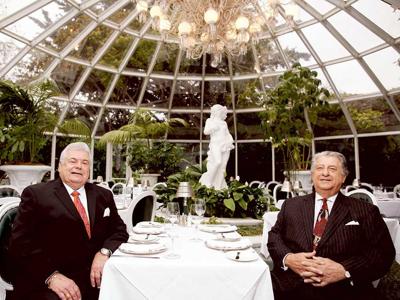

The Sardine Factory celebrated its 50th birthday on Oct. 2.
That a restaurant survived decades on the roller coaster of economic twists and dining trend turns is rare enough. Few places last into even a second decade – much less a second year – without an overhaul. But the venerable Cannery Row destination hasn’t budged in all that time.
“The same owners, the same location, the same name – that doesn’t happen,” says Ted Balestreri, who opened the Sardine Factory with Bert Cutino in 1968.
Both men are completely at ease, telling friendly jokes, laughing and chatting as easily as when they first met, in an economics course at Monterey Peninsula College. The instructor was not amused by their conversation and moved them to the front of the classroom.
Since opening the place, Balestreri and Cutino have counted successes in many forms: the number of celebrities who have come through Sardine Factory’s door, the long list of national and local awards, that they hosted the first U.S. Master Sommelier announcement in 1987, that Ronald Reagan requested their abalone bisque for his inauguration, that Clint Eastwood filmed parts of his directorial debut (Play Misty for Me) in the place and that they expanded from 72 seats to 250, with a wine list topping 12,000 bottles.
They will tell you that love is the single most important ingredient to success and longevity in the food service industry – love for the customer, love for the job, love for the friendships it creates.
“If we made you feel at home, we made a million-dollar mistake,” Balestreri observes. “Our job is to make you feel better than at home.”
What they allude to in their stories, however, is another key to success. As a team, they were (and remain) willing to take risks. Balestreri and Cutino were already food service veterans by 1968, having worked up from entry-level positions in kitchens. Cannery Row – the only place they could afford to set up – was a rundown, blighted stretch. People thought they were crazy. “We didn’t have any money,” Balestreri says. “The lights in the front door were coffee cans – still are.”
When they developed a wine list, placing American wines side by side with the vaunted French labels, people warned they would be laughed out of the industry. “You have to adapt,” Cutino notes.
One thing that has never changed is that thing they believe is central to success. When they swung open the doors for the first time, it was evident: “When people walked in, we were so enthusiastic,” Balestreri says. “That resonated.”


(0) comments
Welcome to the discussion.
Log In
Keep it Clean. Please avoid obscene, vulgar, lewd, racist or sexually-oriented language.
PLEASE TURN OFF YOUR CAPS LOCK.
Don't Threaten. Threats of harming another person will not be tolerated.
Be Truthful. Don't knowingly lie about anyone or anything.
Be Nice. No racism, sexism or any sort of -ism that is degrading to another person.
Be Proactive. Use the 'Report' link on each comment to let us know of abusive posts.
Share with Us. We'd love to hear eyewitness accounts, the history behind an article.