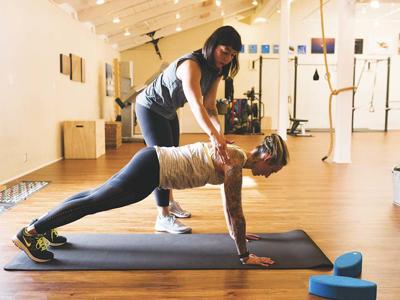

HELLLOOOOO, JANUARY. YOU ARRIVE AND EVERYONE IS SO OPTIMISTIC, SO RESOLVED:Resolved to eat better, resolved to work on their sleep hygiene, resolved to cut toxic substances and people out of their lives. Resolved to drink less, resolved to argue less, resolved to read more classic fiction, resolved to take up a relaxing hobby.
And then there’s the grandaddy resolution of them all: resolved to get in shape, by resolving to exercise more. Come December, fitness companies ramp up their advertising (oh Peloton, what a weird mistake that particular commercial was!) and fitness facilities all roll out the welcome mats, with membership deals on offer. And still, stepping foot – either for the first time in awhile, or for the first time ever – through that welcoming open door of a gym can be a terrifying prospect, regardless of what your current fitness level is and what you hope to achieve.
But the help you might need to reach your goals is there, and it should start with a deep conversation about what you’re trying to achieve. And it starts with the knowledge that your goals are not insignificant.
“I first try to get a ‘why’ out of the person, because you want a compelling personal reason to stick it out when things get hard or things get boring,” says Ariel Johnson, a trainer who teaches yoga flow and high-intensity interval training classes at the Monterey Sports Center and also sees private clients at Be Well Personal Training in Carmel.
Johnson’s own journey melds the unique with the normal. As a child and teen, she was always physically active and trained to become a principal dancer, moving to Canada at age 11 to attend a private ballet academy. As an adult, post-college, she had two children “back to back,” gained weight and got depressed.
And then she started taking classes at the Sports Center.
“The manager noticed me and said, ‘I think you’d be very good at this,’ and I went crazy,” she says.
Going crazy meant taking classes, in basic anatomy and exercise concepts, among others, and then earning certifications in teaching yoga. While she has long gravitated toward yoga, she never stuck to one modality, mixing up her own routine with yoga, cross-training, functional movement training and aerobic exercise.
When she meets a client for the first time, she asks a lot of “why” questions to get to the root of what the person wants to accomplish in their time at the gym, during training or exercising on their own.
“It can’t be a vague resolution of, ‘I want to get fit’ because it’s not enough to stick in your brain. If someone comes to me and says, ‘I want to get strong,’ I ask why they want that,” she says. “And they may say, ‘I want to be able to hike with my family,’ or ‘I want better health markers to extend my life’ or ‘I want to see my grandkids.’
“The more specific you can be in homing in on your why,” she says, “the more I can help a person develop a plan to achieve their goal.”
At Montage Wellness Centers in Marina and Salinas, the “why” question also plays a major role in helping members figure out how to reach their fitness goals. So does the health-risk assessment the center uses with its new members.
The hour-long assessment pairs a new member with a trainer, and encompasses the member’s medical history, goals and baseline measurements on weight, blood pressure, body fat percentage and grip strength, giving a trainer a better sense of how to guide a member through the orientation process and figure out which exercises will be most beneficial.
“The best thing you can do at that assessment is come in with questions that will help answer, ‘What do you want to get out of being here in the facility with your membership?’” says Kellie Morten, Montage’s fitness director. “You have to have the motivation to ask questions, because as a trainer, I have to start with the basics and I want to be realistic.”
The best way to know where to start includes figuring out where the client is at, and going for small successes and incremental progress. People focus so much on weight loss, for example, that they sometimes fail to realize that adding five pounds of weight to a bench press or squat, or adding a pushup, is also a big deal, Morten says.
“Flexibility is a big deal. Sleeping better and feeling better is a big deal,” Morten says. “If you get discouraged, remember why you started in the first place. If I relied on motivation every day, I would never work out. Well, not never, but I remember how good I feel when I’m done. There are more benefits to exercise than just losing weight.”
Being realistic in setting goals also includes figuring out how much time you can commit to exercise and how many times a week you can make it to the facility.
“That informs where I can take their program,” Morten says. “The more successful clients are the ones who don’t rely on me. They come in on their own. There’s 160 hours in a week and if you’re with me for 45 minutes, it’s nothing.
“I can set you up for success and help you make changes, but you have to come in on your own and do what you’ve been taught,” she says. “Nothing is going to change if you don’t do something about it.”





(0) comments
Welcome to the discussion.
Log In
Keep it Clean. Please avoid obscene, vulgar, lewd, racist or sexually-oriented language.
PLEASE TURN OFF YOUR CAPS LOCK.
Don't Threaten. Threats of harming another person will not be tolerated.
Be Truthful. Don't knowingly lie about anyone or anything.
Be Nice. No racism, sexism or any sort of -ism that is degrading to another person.
Be Proactive. Use the 'Report' link on each comment to let us know of abusive posts.
Share with Us. We'd love to hear eyewitness accounts, the history behind an article.