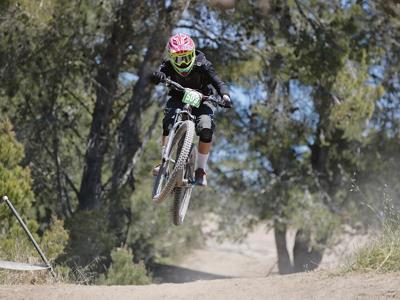

Local bike mechanic Joe Gordis is going to the Life Time Sea Otter Classic this year, maybe rocking a mullet. Not the hairstyle, though. “Mullet” refers to a mountain bike setup where a bike is configured with a smaller wheel – such as a 27.5-inch diameter – in the back with a larger wheel like a 29-inch diameter in the front.
The constant evolution of mountain biking can be seen through the three major categories of configurations: enduro, cross-country and downhill. To the uninitiated these may all look the same, but there are indeed subtle differences which affect the performance on the terrain and the type of race.
Sea Otter Classic has race categories for all three, but according to Gordis, that may be a bit of overkill.
“The terrain is pretty tame in Fort Ord,” he says, “but on a national level, enduro will be pretty steep.”
Enduro mountain biking became popular about five years ago, which prompted several companies to begin producing out-of-the-box enduro bikes. These bikes came with a wider range of suspension movement – known as “travel” – than their cross-country counterparts. Back then, they also boasted smaller wheels, but according to the Work Horse Bicycles mechanics in Monterey, this trend has shifted back mostly to 29-inch wheels.
Enduro racing is a long day, though. Races usually last around four hours, but competitors are only timed on downhill sections. The category gets its name because the race demands cyclists ride back up the hills they’ve descended in different parts of the course. Gordis likens the competition to rally car racing in the automotive world.
Since enduro race competitors aren’t timed up the hills, “mullet” setups may be popular this year, since a smaller back wheel will allow for more stability and speed on downhills where it counts.
If four hours of racing sounds intimidating to a competitor, you’ll likely find them in a cross-country race.
“It’s the most accessible,” Gordis says, explaining that cross-country mountain biking is how to build fundamentals and fitness for more advanced terrain.
In terms of configuration, cross-country bikes will have the least amount of travel and usually have a shorter front fork attached to the front wheel. Both configurations keep the bike lighter, which is essential for cross-country racing. Though cross-country races are typically shorter than enduro races, more time is spent by the rider actually sitting in the saddle and pedaling. But given the relatively easy terrain of Fort Ord as the venue for Sea Otter Classic, cross-country bikes wouldn’t be precluded from competing in the enduro category.
The one category that does require a niche configuration is downhill mountain biking. Exactly as the name implies, downhill mountain biking is a simple race from top to bottom at high speeds. These bikes are not designed for pedaling at all, though they do still have chains and sprockets for competitors to increase their already blazing speed. These bikes also boast the most travel out of all three categories, along with longer wheelbases for added stability.
According to Gordis, the geometry of the bike also plays a role in what competitors use. The relative acuity of the rider’s back to the ground varies between bikes. Cross-country bikes seat a rider more “upright,” while enduro and downhill bikes allow the rider to lean back more. This is referred to as “slacker” in the biking world.
Despite all of these differences in bikes, Gordis and his friends at Work Horse Bicycles plan to have some fun at Sea Otter Classic in their own way. He says he might compete in the dual slalom category, which is a head-to-head competition between racers zig-zagging through gates downhill. These competitions aren’t serious, according to Gordis, as racers usually ride whatever bikes they want. “There’s a bit of a ‘run what you brung’ with dual slalom,” he says.
The technology in different categories of bikes does inspire new innovations and commerce for smaller companies to try out, which is something that Gordis also enjoys at Sea Otter Classic.
“I love talking to smaller brands that are doing unique and independent stuff,” he says. “Makers are really active in the cycling community.”
While pro athletes will surely be performing some amazing stunts at Sea Otter Classic, the allure of the festival is still the expo, where bike enthusiasts can trade stories, share ideas and learn how to make their bikes their own. You don’t have to have a special niche bike to compete at Sea Otter Classic, and the trick is to just have fun. For Gordis, that means watching some racing, scoring free beer and collecting a ton of stickers.


(0) comments
Welcome to the discussion.
Log In
Keep it Clean. Please avoid obscene, vulgar, lewd, racist or sexually-oriented language.
PLEASE TURN OFF YOUR CAPS LOCK.
Don't Threaten. Threats of harming another person will not be tolerated.
Be Truthful. Don't knowingly lie about anyone or anything.
Be Nice. No racism, sexism or any sort of -ism that is degrading to another person.
Be Proactive. Use the 'Report' link on each comment to let us know of abusive posts.
Share with Us. We'd love to hear eyewitness accounts, the history behind an article.