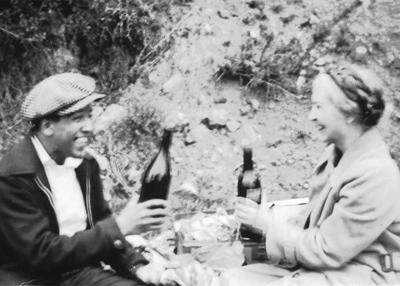
“WHAT HAPPENS TO A DREAM DEFERRED?” Langston Hughes asked, in his most famous and widely anthologized poem. “Does it dry up/ like a raisin in the sun?”
Hughes had his share of setbacks – political, psychological and economic – over the course of a protean career which included major contributions as a poet, playwright and newspaper columnist in his 65 years.
His own dreams were often deferred in the search for professional respect and financial security. But it’s little known that in crucial periods of his life, he found respite from societal pressures in the perhaps unlikely quarters of Carmel-by-the-Sea.
Hughes’ time in Carmel, part of a somewhat hidden chapter of local history, illuminates a time when African-American artists and whites – at least those with bohemian aspirations and progressive politics – were joined in social harmony and mutual support.
It was 1933, in the depths of the Great Depression.
After an ill-fated trip to the Soviet Union, China and Japan, Hughes took up an earlier offer from Noel Sullivan, the wealthy scion of a San Francisco family, to stay at Sullivan’s Carmel cottage, free of charge.
Hughes was “broke and without serious prospects” at the time and jumped at the chance, according to Arnold Rampersad, a Stanford professor and author of the definitive two-volume biographies of Hughes, I Too Sing America, 1902-1941 and I Dream A World, 1941-1967.
In Carmel, Hughes enjoyed economic freedom, the artistic community, and the fabled beauties of the area.
“It was like a Guggenheim fellowship,” Rampersad says. “His career was on an upswing, selling stories and poems to major publications, but he was not rolling in money. So it came as a respite.”
The cottage, called “Ennisfree” – named for a verse by the poet William Butler Yeats – was located on the corner of Thirteenth Street and Carmelo, and it came with free groceries, utilities and a cook. Hughes was accompanied by Sullivan’s German shepherd, Greta, named for the reclusive actress Greta Garbo, who often took shelter in Carmel.
His stay there put him in the midst of a larger social and artistic circle, including the likes of Sullivan; poet Robinson Jeffers and his wife Una; famed muckraker Lincoln Steffens, and his wife, radical journalist Ella Winter; and famed photographer Edward Weston, who shot Hughes’ portrait.
It couldn’t have been further from the hothouse political dramas of Manhattan, let alone Moscow, but served as badly needed restorative balm for the poet, until the passions of the day caught up with him on the West Coast as well.
Not all the locals were friendly.
“On Sept. 6, the Carmel Village Daily noted his arrival – or sounded an alarm: ‘Colored Poet Here,’” Rampersad writes.
While Hughes’ immediate social circle was progressive, the rest of the town was not, voting heavily for Herbert Hoover, despite Franklin Roosevelt’s sweep of the rest of California.
In what seems to foretell the current climate, 100 years later, Rampersad writes: “The next year, for the first time in Carmel history, no artist was elected to the village council. The ‘artists’ colony’ had become, in the words of a San Francisco newspaper, ‘just one more California mecca for prosperous retired people, who are always conservative.’”
The Carmel Pine Cone fiercely repudiated local radicals belonging to the John Reed Club, named for the revolutionary whose life was portrayed in the Academy Award-winning movie Reds. The newspaper even urged the Carmel library to turn down a donation of free books from the local chapter – chaired by Winter, the journalist – because “gifts of snakes and poisoned apples shall always be refused.”
HUGHES WAS BORN ON FEB. 1, 1902 in Joplin, Missouri. He was 31 when Sullivan bankrolled his writer’s retreat to Carmel.
It was critically important to the writer, as a matter of sheer survival. And it’s a testament to Hughes’ adaptive skills, shape-shifting to blend into black and white communities alike, that he was able to move 3,000 miles from Harlem to his new home, however temporary.
Hughes left Carmel, “not wishing to be tarred and feathered,” as he wrote a friend.
The country was in the depths of the Depression, including fierce battles between agribusiness and farm workers in California, with a bitter longshoreman’s strike in the offing. Black and brown people were most affected, a circumstance that drew Hughes’ ire, and his active sense of irony.
“Certainly Carmel was an odd home for a black poet,’’ Rampersad writes. Although Hughes easily adapted to the artists in his midst, and made friends among the scant members of the African-American community there, too, others were less friendly.
When the International Longshoremen’s Association led a statewide strike closing down ports for 90 days, it drew a predictable backlash from red-baiting outlets like the Sun and the Pine Cone.
The poet was not amused when the Carmel Village Council voted to buy tear gas to head off “insurrections,” and a “citizen’s force” with riot guns began practice drills on the local polo fields. Warned that a personal attack was imminent, Rampersad says, “[Hughes] finally had to leave, virtually for his life.’’
Hughes left Carmel, “not wishing to be tarred and feathered,” as he wrote a friend.
When the strike ended and tempers cooled, Hughes returned, only to be vilified for potential miscegenation, among other sins, by Sun editor E.F. Bunch, who wrote a hit piece that read, in part: “Langston Hughes has been a very ‘distinguished’ guest in Carmel – not that the town is proud of it… White girls have ridden down the street with him, have walked with him, smiling [into] his face. And the Women’s Home Companion and other magazines which should be standing for America, have spread his Communistic doctrines to the thousands and thousands of American homes. Russia would be a good place for Hughes.’’
BEFORE THE INEVITABLE BACKLASH, Carmel had been a place of respite for the poet, where he could get work done in an atmosphere where the artists, at least, were firmly on his side.
Visits to Tor House – a home and tower built out of granite on Carmel Point by the poet Robinson Jeffers – provided friendship and succor, and Hughes celebrated a birthday with Robinson and Una Jeffers in Big Sur.
Jeffers recommended Hughes for a Guggenheim Fellowship, which he received, in 1935. He also gave Hughes a poem to be used for a San Francisco auction to raise money for the Scottsboro Boys, nine black teenagers falsely accused of raping two white women on an Alabama train.
Hughes was reciprocally friendly, writing a Pine Cone piece about Jeffers’ adaptation of the Greek tragedy Clytemnestra at the Forest Theater.
While literary retreats don’t always yield results, for Hughes, it worked. Freed of economic constraints, by 1934 he had published The Ways of White Folks, his first book of short stories, touching on themes of race and injustice. Despite his sweeping societal concerns, Hughes dedicated the book to Sullivan, adding the sardonic epigraph: “The ways of white folks, I meansome white folks… ”
“Sullivan was a patron who was not patronizing,” Rampersad says, marking the difference between his generosity and that of Charlotte Mason, an earlier East Coast benefactor and relentless guilt tripper, who fell out with Hughes when she tried to control his artistic output.
By contrast, Sullivan left the poet alone to pursue his artistic muse.
AFTER SOJOURNS IN MEXICO, SPAIN, NEW YORK AND LOS ANGELES, the well-traveled author returned to Sullivan’s new Carmel Valley abode, Hollow Hills Farm (now home to the Carmel Valley Manor retirement community) six years later, in 1939.
Sullivan was at or near the epicenter of the Carmel cultural scene. A gifted basso-baritone, he was an early supporter of the Carmel Bach Festival and sang at 13 of their first events.
The grandson of the founder of Hibernia Bank, and the nephew of former San Francisco mayor James Phelan, he lived large, entertaining everyone from Paul Robeson and Marian Anderson – he was famously without racial prejudice and put them up at a time when black people were barred from staying at public hotels – to the actor-politician couple of Melvyn and Helen Gahagan Douglas and the composer Samuel Barber.
Langston enjoyed the festive atmosphere, although he did not always appreciate having to dress for dinner.
He also had a social life that was less highfalutin, mixing freely with the (admittedly limited) black community, including Sullivan’s servants and a friend who ran a Carmel car repair shop.
Rampersad acknowledges that Hollow Hills was a welcome retreat, but adds: “He never wanted to be cut off from black people, especially poor black people. He wanted to live a certain way with certain comforts, but he also wanted to keep his political edge. Living in Carmel, a dreamily beautiful part of the world, where he could go to the beach or take trips to Big Sur, allowed him to do that. He enjoyed it while he was there. And when he wanted to move on, he moved on.”
Sullivan’s support (and friendship) got Hughes through early struggles, and enabled him to fight – and write – on. After his pastoral retreat, he moved back to Harlem, ultimately a more natural landing point for this jazz-loving sophisticate, and found his fair share of fame, and even a bit of fortune. The elusive dream was no longer deferred.



(0) comments
Welcome to the discussion.
Log In
Keep it Clean. Please avoid obscene, vulgar, lewd, racist or sexually-oriented language.
PLEASE TURN OFF YOUR CAPS LOCK.
Don't Threaten. Threats of harming another person will not be tolerated.
Be Truthful. Don't knowingly lie about anyone or anything.
Be Nice. No racism, sexism or any sort of -ism that is degrading to another person.
Be Proactive. Use the 'Report' link on each comment to let us know of abusive posts.
Share with Us. We'd love to hear eyewitness accounts, the history behind an article.