

TAQUERIA ZARAPE COULDN’T KEEP UP. Costs were spiraling upward so quickly that staff members finally scribbled new menu prices on pieces of paper, taping them over the old. At more formal restaurants, new menus were printed and then printed again. And as 10s turn to 20s then to 30s, a troubling question is nagging the food service industry.
“What’s a middle-level restaurant?” Ken Donkersloot asks, pondering for a moment the phrase and its meaning, without pursuing a response.
In the wake of two chaotic years for the hospitality industry, the question has gone from rhetorical to ironic. An everyday plate of fish and chips often tops $30. Buffalo wings, once a handy place setter for small gatherings, run closer to $50 or more. That quick breakfast staple, avocado toast, now fits into the $15-$20 range.
While it may be too soon to sound the death knell on moderately-priced dining, there’s a gathering pall and Donkersloot – the owner of Coastal Roots Hospitality, which operates Tarpy’s Roadhouse, Rio Grill and Montrio – recognizes the signs. Quick service pricing has crept to the former realm of casual sit-down bistros with demanding kitchens. “You go to McDonald’s now and it’s a $15 meal,” Donkersloot points out.

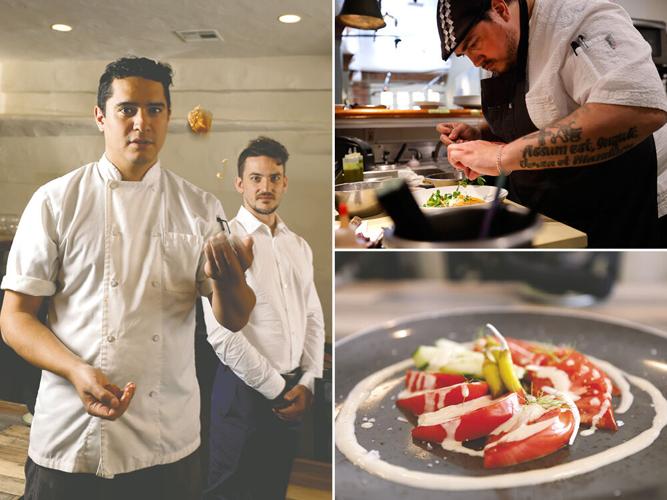
A colorful burrata salad at Montrio. Quality ingredients and presentation put the Monterey restaurant near the top of the midscale price spectrum.
CORONAVIRUS FLICKED A ROW OF DOMINOES that fell against other rows of dominoes, sending pieces tumbling in lines running all directions. According to Nation’s Restaurant News, some 90,000 establishments across the country shut down either temporarily or permanently. With surviving restaurants converting hastily to curbside takeout and then to reduced seating, the workforce scattered. It has returned in limited numbers. U.S. Bureau of Labor Statistics data shows jobs being added in California, but there remains a shortfall of 102,500 positions. Nationwide, some 800,000 staff left the industry.
Full-service restaurants – the sector that includes midscale and upscale restaurants – took the hardest hit. The U.S. Department of Agriculture reported that average total spending from March to May of 2020 at full-service establishments plummeted by 52 percent compared to the same span in 2019. The quick-service sector suffered a 15.4-percent drop.
Projections for the near future offer little comfort. The management consulting firm McKinsey & Company ran several different recovery scenarios and determined that mid and fine dining sales were unlikely to return to pre-Covid levels until sometime in 2024. And the USDA offers little hope when it comes to costs. Their March report has the price of goods climbing at a clip between 5.5 and 6.5 percent through the end of 2022. And this is coming off the largest price hike in a one-year span – February 2021 to February 2022 – since 1981.
Demand for goods plummeted amid shutdown orders, leaving artisanal farmers and ranchers dependent on restaurants with unsold fava beans, cheese meant to be consumed fresh ripening in cellars, shellfish passing their prime. They responded by selling off cattle, planting more relatable crops or closing outright.
The farm-to-table pipeline brought $12 billion to small producers in 2019, but it was left in peril. Compounding the calamity, Covid-19 swept through processing facilities, crimping the supply of meats in particular. The price of gasoline soared, dramatically increasing the cost of transporting even locally produced goods to kitchens. Within the pipeline are shippers, purveyors and others who need to profit, and so costs climb each step along the way. Before the pandemic, Chef Anthony Quintana – now at Promesa in Carmel – paid $4.50 a pound for mussels. Now he pays closer to $15 a pound. Rubber gloves jumped from $8 a box to $25.
It’s unprecedented. Wayne Brooks, chef at Shearwater Tavern in the Carmel Mission Inn, has suffered through minor price spikes during his 25 years in the kitchen. “It’s usually an item or two where prices go crazy – maybe an ice storm in Florida or a drought in the Midwest,” he explains. “I’ve never faced a situation where it’s every single price.”
Recounting the perilous odyssey from March of 2020 to the present in great detail is hardly necessary. Surviving restaurants often find profit margins whittled, even as owners shuffle menu items and step prices higher in response. The smallest steak on offer at Carmel’s Seventh & Dolores – a 10-ounce filet mignon – taps in at $70. The price for a coveted 36-day dry-aged ribeye can no longer be fixed, so the acronym MKT sits alongside its listing. Demand has rebounded much quicker than supply, and the supply chain remains crippled.
“It’s out of our control and that’s scary,” says Ted Balestreri, owner of The Sardine Factory in Monterey with Bert Cutino and an industry veteran who has been tossed around by the whims of economy, inflation and the other forces pressing on restaurants before.
In order to profit, restaurants must control costs. Owners must cover the cost of ingredients, of labor, rent, utilities, insurance, taxes, maintenance, marketing and more before achieving profitability. Pre-pandemic profit margins averaged in the 5 – to 10-percent range. As a general rule, the target for food cost is 30 percent of income. Labor is also around 30 percent. If they manage to keep rent and utilities below 20 percent the restaurant is in pretty good shape. In the chaos of pandemic and post-pandemic dining, those major costs spiked closer to 50 percent for some establishments.
To keep up, restaurants have stepped up menu prices once, twice, perhaps three or four times. And with each increase, the fear of cost gentrification rises. At some point, restaurants appealing to the middle range – the space between quick service and fine dining – may become too expensive for their preferred customers. And the bistros, the gastropubs, hip destinations, the casual sit-down establishments with a local, seasonal vibe that populate the space will disappear.
“We’re feeling the pinch in the middle,” Donkersloot says, asking – this time rhetorically – “Am I scared?”

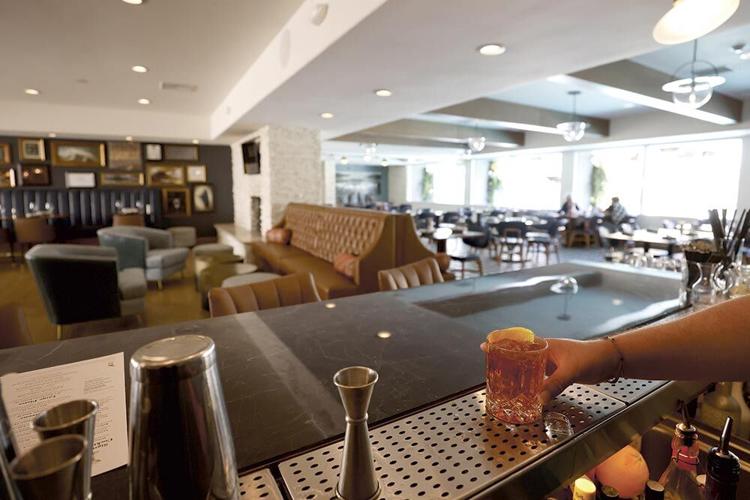
The dining room at Shearwater Tavern. “We want to be at the price point we’re at,” says chef Wayne Brooks.
DINING ESTABLISHMENTS ARE GENERALLY GATHERED INTO THREE BROAD CATEGORIES. Quick service includes fast food and fast-casual places – chains like McDonald’s, diners, taquerias, counter service spots and the like. Fine dining restaurants such as The Sardine Factory belong in the upscale category. The middle is a rather extensive territory, with prices ranging from Googie Grill to Villa Azteca and Saltwood Kitchen & Oysterette.
“We all come from a fine dining background, but we don’t want to cook fine dining food,” says Klaus Georis, who opened Maligne on Broadway in Seaside at the beginning of June after a lengthy Covid-related delay.
Other restaurants have opened recently in the middle sector, all facing the new reality. Georis believes that the cost of many goods – particularly those like sanitation products where demand is more predictable – are never going to fall back to pre-shutdown levels. In general, he says, “restaurants are going to get more expensive.”
The new normal is a phrase that was a constant in the national vocabulary as the realities of pandemic set in. Like so many apt descriptions it was overworked to the point where it became a despised cliche. Restaurateurs and chefs at midscale kitchens are currently in the process of adapting, crafting a new normal. The changes that are underway may not be immediately visible to restaurant guests, yet they will touch all aspects of dining.
Maligne is not a spacious restaurant. Yet Georis and his crew have created distinct areas that beckon with comfort – a dining area with soothing tones and compelling art, a cozy corner with a living room appeal, flames flickering from a wood-fired grill visible across the floor. Their goal is to become a neighborhood hub, a place where people can gather frequently. There is nothing revolutionary in appearance. The restaurant is, however, helping to define the emerging middle.
Rising costs and thinned-out profit margins are driving this transformation. The residue of Covid also left restaurants scrambling to fill staffing needs. Demand – and a growing call for justice in the workplace – forced wages higher. Many consider the longstanding practice of the below minimum wage scale inherently unfair and Georis agrees.
“Restaurants should pay fair wages, should offer health insurance,” Georis says. “The other side is: Are customers ready to pay $10 for bread and butter?” The solution, he adds, is in the answer to a tricky dilemma. “Without becoming an expensive restaurant, how do we allow our staff to have quality of life?”
At Maligne, diners pay a 20-percent service charge on every bill. The practice has been tried elsewhere with varying degrees of acceptance. But the flat charge provides a relatively fixed – accountants use the term semi-variable – amount to apply to staff salaries in order to pay an above-average wage across the board while holding menu prices steady. Georis believes service charges will be more common at lower – and middle-priced establishments, part of the new normal.
George Thompson, co-owner of Promesa in Carmel, agrees that pre-pandemic comfort levels are unlikely to return. Promesa opened this spring in Carmel with a concept suited to the times: tapas. Small plates and shared plates have been trending for many years, and the idea became more attractive as inflation began nibbling on bottom lines. Chef Philip Wojtowicz shifted in that direction in an effort to save Poppy Hall, a Pacific Grove favorite, when the restaurant was faced with an increase in rent last year. However, even with the menu adjustment, the restaurant was forced to shutter in May.
“A lot of supplies aren’t going back down,” Thompson says. “I see the middle pricing continuing to grow.” Yet he is also optimistic that cost gentrification will not subsume the moderate range: “We’re trying to stay in the upper middle, and I don’t think the middle is going away. There’s always something you can do.”
Despite Poppy Hall’s demise, the small or shared plate concept offers both real and perceived advantages. Not only are portion sizes pared down – a favor to a restaurant’s food cost – customers also realize value in the lower cost of a small plate compared to an entree portion, or might try sharing multiple dishes. Chefs are also containing expenses by narrowing menu offerings, focusing on best-selling dishes or best use of fewer ingredients.
“Menus are becoming more streamlined and efficient,” Balestreri notes. Even at the fine dining level, he sees more concise menus as the future: “Do what you do well and be consistent.”

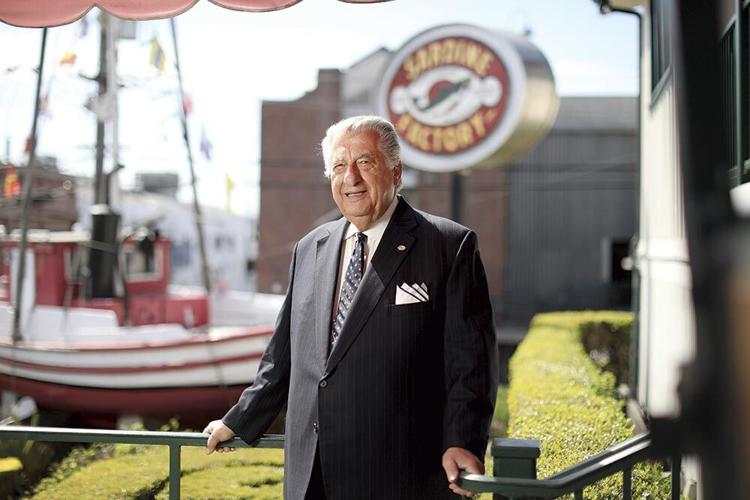
The Sardine Factory’s Ted Balestreri is a hospitality industry veteran who has served as president of the National Restaurant Association and has seen establishments adapt over the years. “Labor is going to be the biggest change,” he points out, adding that technology will fill the gaps. “It’s a great industry, but a very tough industry."
BALESTRERI OPENED THE SARDINE FACTORY IN 1968. He has served as president of the National Restaurant Association, the California Restaurant Association and many other hospitality organizations. You wouldn’t anticipate his comic side, but it’s there even as he speaks about the waning interest in old-school decorum. Coats and ties used to be the norm, he says, then adds: “Now if you’re breathing, we take you,” with a big laugh.
His observations on the future of restaurants carry the weight of authority. There will, he says, be more outdoor spaces and more mobile options – food trucks, ghost and pop-up kitchens. Convenience will become even more important to consumers, so restaurants will continue to add options such as delivery, take away and heat and serve packages.
“When people hosted dinner parties in the past, they cooked,” he points out. “A great host today assembles a meal.”
The most notable feature as the new middle takes shape, Balestreri predicts, will be a finessed use of technology, what hospitality industry consultants refer to as “digital layering” or “omnichannel.”
Before and during the pandemic, technology tended to face outward – online ordering or touch-screen point-of-sale systems. Reaching out through digital components increased during shelter-in-place as restaurants struggled to engage and retain customers. According to a recent Zagat survey, 59 percent of restaurant customers expect to order meal kits, alcohol or other “non-traditional” items for delivery.
The omnichannel approach concedes that guests want convenience and different experiences and restaurants must develop multiple revenue streams. The new middle will increasingly use digital technology to make ordering for delivery, pickup or even line jumping more efficient. The “technology stack” at any given restaurant may have contactless ordering and payment, geofencing – which defines an area within which notifications are sent to a potential customer’s mobile device – and guest engagement apps. The point is to gather information about guests.
“Where digital has become a key element of every restaurant is that data and personalization become far easier because you know more about your guest, you’re not guessing,” Zach Goldstein told Nation’s Restaurant News at a streamed event in April hosted by Thanx, a San Francisco-based guest engagement platform.
Goldstein, the company’s CEO, explained that price, location, service and quality are not the only components attracting guests: “Now it’s about how deeply you understand your guests through data and how you are using that to differentiate.”
Donkersloot and his team have improved on the digital capabilities of Montrio, Rio Grill and Tarpy’s Roadhouse. These enhancements allowed the restaurants to create features such as rewards for referrals and enhance a loyalty program with member benefits. Restaurants across the nation are adding or emphasizing such programs. In a study by the Massachusetts-based customer engagement firm Paytronix, data gleaned from the 10 percent of loyalty members who spent the most money at restaurants showed that core customers made up 7.8 percent of income in January of 2020, before Covid hit. That figure jumped to 9.4 percent in April.
The new normal, Donkersloot says, “is a changing philosophy of how we market. We think of our digital presence, being able to reach out.”
Data and digital engagement may become the most important features of the new middle, with more ways to order and experience a restaurant and perhaps less contact. But Balestreri, for one, is wary of too much front-of-the-house technology. The Sardine Factory was founded on fine dining etiquette, and that requires personal contact.
Still, he notes that some hotels are turning to robot room service. The Panera chain added coffee brewing robots, freeing up limited staff.
“It will all be computerized,” Balestreri adds. “Someday there will be one man pressing buttons and a perfect steak will come out. It will be a good steak, but it kills the romance.”
GO BACK A CENTURY OR SO and dining out meant either dressy white tablecloth finery, working-class diners or roadside greasy spoons. Quick-service restaurants followed the growing interstate highway network, giving rise to national chains. Casual and fast-casual sectors developed, and within these such categories as bistro and gastropub. Menus and fashion evolved along the way. Coat and tie elegance gave way to more inclusivity. The industry has endured.
Balestreri’s vision is a bit of a jest. But the new normal for middle-priced restaurants means higher prices, some streamlining and data-based engagement. Menus may be smaller – portions, too. And establishments may pass on the cost of labor to their guests through service charges. It all helps keep menu prices lower.
Maligne, Cella, Stokes Adobe, Mangia, Hay’s Place and other recently opened restaurants across the midscale spectrum are forging this change. And Georis sees all of this as a positive.
“It’s time for a rebirth of restaurants,” he says.


(0) comments
Welcome to the discussion.
Log In
Keep it Clean. Please avoid obscene, vulgar, lewd, racist or sexually-oriented language.
PLEASE TURN OFF YOUR CAPS LOCK.
Don't Threaten. Threats of harming another person will not be tolerated.
Be Truthful. Don't knowingly lie about anyone or anything.
Be Nice. No racism, sexism or any sort of -ism that is degrading to another person.
Be Proactive. Use the 'Report' link on each comment to let us know of abusive posts.
Share with Us. We'd love to hear eyewitness accounts, the history behind an article.