
STEVE BRUEMMER IS A RELUCTANT TRIATHLETE. The way he describes his “midlife crisis,” it sounds like barely a blip – a moment of exasperation with his career in IT, when yet another request for tech support came in on the Monterey Peninsula College campus on a Friday afternoon six years into the job, when he was 50.

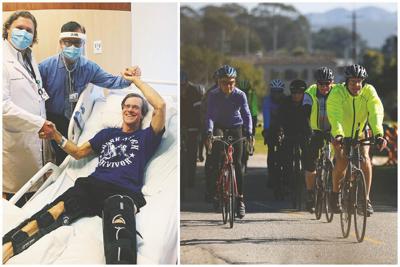
(left) Bruemmer with Natividad trauma surgeon Dr. Nicholas Rottler, left, and Acute Rehabilitation Center Director Dr. Anthony Galicia. (right) Steve Bruemmer re-learned how to ride a bike after suffering major injuries from a shark bite in 2022. He is now regularly riding 100 miles a week as he trains for a triathlon.
“I thought maybe I should quit my job and run a marathon, or ride a bicycle across the country,” he says. The notion lasted for just a few hours until Steve realized he had responsibilities, including two daughters and their private school tuitions: “I shouldn’t quit my job, that’s dumb.”
Midlife crisis, averted.
His wife, Brita Bruemmer, had already embraced “the triathlon lifestyle” and was registered for a race. Steve was already a bicyclist; he’d just have to learn to run and swim. He registered that night for a race.
Swimming was not easy for him, but he signed up for a class at MPC. When he first joined Brita for an ocean swim with a group called the Kelp Krawlers, who meet every Sunday at Lovers Point, it was a choppy “rock-and-roll day on the water.” Nauseated, he quickly turned around.
Ear plugs solved the seasickness problem, and the years went on. Bruemmer became known as Fast Steve, and regularly met up with the group. During the pandemic, when pools were closed, smaller groups started meeting for ocean swims almost daily.
So by 2022, when he was 62 and newly retired, Bruemmer was confident he’d find a group at Lovers Point to join him for a swim on a warm, sunny, still Wednesday morning. He was surprised to show up on June 22 and find himself alone. But conditions were perfect, so he pulled on his wetsuit, got in the water, and went for a swim.
BRUEMMER WAS NEARLY BACK TO THE BEACH in Lovers Point cove, cruising along freestyle, when all of a sudden he was jolted out of the water.
Adult white sharks hunt their prey by hurtling toward it from below, mouth open. It’s not uncommon for a shark and its meal to be hoisted fully up and out of the water.
In the mouth of a white shark, its jaws around his midsection, Steve was hoisted up and out of the water, then plunged back into it. He felt oddly calm as he came eye-to-eye underwater with a great white shark.
“Don’t bite me again,” Bruemmer telegraphed silently.
He reached out to try to punch the shark, a technique he’d heard about if, against the odds, you ever encounter a shark in the ocean. His fist couldn’t reach, but his outstretched hand could, so he pushed the shark’s lower jaw with his fingertips.
The animal disappeared, and Bruemmer quickly came to the surface. He doesn’t remember feeling pain, but he saw blood everywhere. He immediately started yelling for help.
An improbable and heroic rescue effort followed, as two stand-up paddle-boarders, Aimee Johns and Paul Bandy, were heading back toward the beach and heard the screaming. Surf instructor Heath Braddock was coaching a church youth group in the cove, and a parent with the group, visiting from Topeka, Kansas, saw the shark’s tail reenter the water, before he heard the yelling – he whispered to Braddock to go help, and Braddock paddled out on two surfboards stacked together. Collectively, Braddock, Johns and Bandy – who later received Carnegie Medal awards for their heroism – hoisted Bruemmer onto a board and got him back to shore. An ambulance was already waiting.
FIFTY-NINE MINUTES AFTER he was in the jaws of a shark, Bruemmer was at Natividad hospital in Salinas at 11:30am.
“We talk about the ‘golden hour’ in trauma, the first 60 minutes,” says Dr. Nicholas Rottler, a trauma surgeon at Natividad who treated Bruemmer. “If patients don’t receive care within that [time period], their chances of dying go up significantly.”
The page had already gone out while Bruemmer was en route to the hospital, which 10 years ago was designated as Monterey County’s trauma center. That means a team of specialists – trauma surgeons, an anesthesiologist, X-ray tech, the blood bank, etc. – is ready to spring into action. The majority of patients come in suffering from blunt force trauma in traffic collisions, not penetrative wounds. Most penetrative wounds come from violence like gunshots or stabbings. An animal bite patient in the trauma unit is extremely rare – but everything about Bruemmer’s case seemed rare.
“This was the unluckiest moment followed by all the luckiest moments in the world,” Rottler says.
That luck started with an ad hoc team of rescuers who quickly got Bruemmer to shore. And it continued as the trauma team cut off Bruemmer’s wetsuit and evaluated his injuries. It was clear that his midsection had been squarely in the shark’s mouth – tooth marks cut across his abdomen and thighs, and also his arm. But remarkably, no major arteries were severed.
“It was, ‘oh my god, I can see his iliac artery,’” Rottler recalls. “But it is not bleeding.” The artery, located in the pelvis, was exposed but not sliced open – a matter of millimeters that would have been the difference between life and death.
Bruemmer received 28 units of blood transfusions, equivalent to about 9.8 liters; the entire body holds 6 liters.
“I never expected to see something like this,” Rottler says.
At first, he says the medical team was not sure that Bruemmer would survive. Once he stabilized after the immediate trauma, it was not clear that he would regain mobility. Asked two-and-a-half years later if he thought this patient would be walking, bike riding and swimming again – and now training for another triathlon – Rottler says, “At the time, I don’t think I was thinking about that too much, I was a little bit more worried about him surviving the day. It’s incredibly impressive.”
BRUEMMER IS NOW TRAINING FOR A TRIATHLON, just like the old days. He swims regularly at MPC, back with the group that made swimming fun for him in the first place. (He says he’ll never get back into the ocean; it is just too traumatic.) He’s going on three 30-mile bike rides a week, plus some around-town bike commuting; he adds a few miles to avoid big hills, but otherwise is happy to have that wind-in-his-hair feeling again.
“I realized: I can do the swim leg, I can do the bike leg. The thing I can’t do is the run or walk, so I will focus on walking, and getting stronger at that,” Bruemmer says. “I thought what a neat thing it would be to get back to the thing I used to do, just to be able to finish one.”
He and a friend are looking for a suitable course with a lake swim (no ocean) and a course that is not too hilly. (That means the Wildflower Triathlon, returning this May to Lake San Antonio in South Monterey County, is out – too steep.) An Olympic-distance triathlon includes a 1.5-kilometer swim (nearly a mile), a 25-mile bike ride and a 10K (6.2 miles) on foot – a distance that might take a typical runner 50-60 minutes. Bruemmer is worried about timing out while walking it, and realizes he might be disqualified for using his hiking poles, but that doesn’t matter to him. Instead, his training goal is motivating him to improve his walking, and to go further and faster. (His current maximum distance is about three miles, so he has a ways to go.)
“If my toe catches, I will fall – I can’t recover,” he says. “I have to concentrate on lifting my right leg up so I don’t trip.”
He’s nearly two years out from a surgery at Stanford, where branches of a working nerve that is used to activate the muscles of the inner thigh was moved into his quadriceps, on the front of the thigh. Progress has been slow, but there are signs that it is working; he’s able to move his right foot slightly by activating his quad. (Think about sitting in a chair and kicking your leg up, a motion that remains impossible for him.)
The nerve crossover creates a little confusion; trying to pull his knees together gets his right foot to kick a bit forward. “My brain is still figuring it out,” he says.
What his brain has long since figured out is how to make movement fun. “Brita will get up at 5am and go run by herself in the dark and the rain,” he says. “I can’t do it – willpower is not enough for me.
“What does work for me is outdoor group exercise. The group is critically important, the camaraderie. Oh, and by the way, they have a start time so you can’t just say, ‘I’m going to ride my bike sometime today.’ It makes all the difference in the world for motivation.” (It doesn’t hurt that group bike rides, swims or runs are usually followed by snacks or a beer, some kind of social experience.)
“I always thought running was so boring. But swimming in a pool?” Bruemmer says with an edge of sarcasm. “It’s the people – that’s what made it work.”
Perhaps it’s no surprise that Bruemmer also gives credit to other people when he reflects on his survival and continued recovery. There are of course the people involved in his immediate rescue, who paddled into bloody water to save a stranger. There are the paramedics, and the team at Natividad. But Bruemmer also credits the anonymous people – blood donors, taxpayers, everyone who enables the system to work.
“My biggest takeaway,” he says, “is gratitude.”




(0) comments
Welcome to the discussion.
Log In
Keep it Clean. Please avoid obscene, vulgar, lewd, racist or sexually-oriented language.
PLEASE TURN OFF YOUR CAPS LOCK.
Don't Threaten. Threats of harming another person will not be tolerated.
Be Truthful. Don't knowingly lie about anyone or anything.
Be Nice. No racism, sexism or any sort of -ism that is degrading to another person.
Be Proactive. Use the 'Report' link on each comment to let us know of abusive posts.
Share with Us. We'd love to hear eyewitness accounts, the history behind an article.