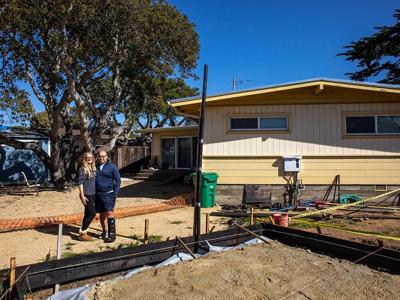
Jon Wizard and Jessica Hare had a plan and it sounded like a good one: They would hire a contractor, get some plans drawn up and convert their circa-1950s garage into an ADU – Accessory Dwelling Unit – which the Seaside couple would then rent out to someone who needed it.
Not just any someone, mind you. Wizard, a Seaside City Councilmember whose day job is as a housing element coordinator with San Francisco-based YIMBY Law, and Hare, a registered nurse, had in mind someone who really needed housing, but might have trouble finding it in the Monterey Peninsula’s pricey rental market.
“In my mind the right person is not some bachelor from the Navy who has the BAH,” Wizard says, referring to the Basic Allowance for Housing, which some believe helps contribute to high rents and low rental inventory on the Monterey Peninsula.
“Our goal is to rent it out to someone who has the need for a two-bedroom apartment,” Wizard says. “A single parent with kids, or a couple of students. We don’t really know who the person is, but we want to do it all legally and properly and because we think it’s a good thing to do.”
It is a good thing to do, and the couple is still doing it, but what was to have been a garage conversion instead became a tear-down and new construction, after a city of Seaside building inspector took a look at the existing garage and said something to the effect of, “Not a chance in hell.”
The 70-plus-year-old foundation on the garage wouldn’t have supported it, and building codes are stricter now than they were then. So tear it down they did and now the ADU construction is in process, with a new foundation poured and plumbing roughed in, awaiting an inspection.
Building an ADU “is so much more complicated than you can even imagine,” Wizard says. His advice to people interested in building one? “Have patience, ask questions and be persistent with your local permitting agency.”
ADUS AREN’T NECESSARILY GOING TO GET CALIFORNIA OUT OF ITS WIDESPREAD AND ENTRENCHED HOUSING CRISIS, where too many people are competing for not enough space, new construction moves at a glacial pace and affordable housing construction usually doesn’t move at all. But they stand to make a dent in that crisis.
California legalized ADUs for all cities in 2017 – meaning cities and counties couldn’t actively prohibit them, although it also didn’t mean jurisdictions had to make it easy. The easy (or easier, anyway) part came in 2019, when the state legislature passed new bills aimed at making the process easier; Gov. Gavin Newsom signed all three into law.
SB 13, from Sen. Bob Wieckowski, D-Fremont, tackled the issue of high permit fees and prohibits jurisdictions from requiring the replacement of parking spots if a garage, carport or covered parking is demolished to build an ADU. AB 881, by Assemblymember Richard Bloom, D-Santa Monica, removed owner-occupancy requirements from ADUs. And maybe the most important of the three, AB 68, from Assemblymember Phil Ting, D-San Francisco, requires jurisdictions to approve one ADU and one junior ADU (or JADU, a unit no more than 500 square feet) per lot.
In comments to the press in 2019, Ting said the legislation was necessary because cities had been erecting barriers making it difficult to build ADUs, either through high permitting fees or by slow-rolling applications through the permitting process.
Craig Riddell, a former Pacific Grove planning commissioner and owner of Monterey Bay Design Group, which works with Hare Construction and local architects and designers on custom home design, has started to eat, sleep and breathe the ADU process, and is in the midst of writing a book on them. With a working title of Maximizing Your Largest Investment, the theme is how to turn a home into a revenue stream via ADUs and JADUs.
He echoes Ting’s sentiments, about the early initial roadblocks that jurisdictions put up when it came to permitting ADUs.
“We had the initial response from some districts where they were in denial, maybe, but now a lot of them are embracing it,” Riddell says. He goes through a list of cities – Seaside has its pre-approved plan program, Pacific Grove is on board and “very strong and positive.” Carmel, he says, “has a lot of issues,” Monterey is fine but has no water, and Marina is also positive. The county is another animal, because there are more zoning issues and septic systems can be a limiting factor, he says.
Throughout the state, the number of ADU permits issued has increased exponentially since 2017, when 5,000 permits were issued. In 2019, almost 15,000 ADU permits were issued. And, Riddell notes in a sample chapter from his book, a study from Freddie Mac (or Federal Home Loan Mortgage Corporation) found 1.4 million properties in the U.S. with ADUs, with the fastest growing areas in high-cost states in the South and West.
“It’s clear the state is for ADUs, and cities have resisted for a long time,” Riddell says. But, he adds, post-WWII, housing was built for “nuclear families, with two parents, 2.5 kids and a dog and it was fine.”
Now, though, 62 percent of homes have fewer than three people living in them. And fewer people living in larger homes means they’re paying for more housing than they may want or need.
“We’re in this situation where we’ve created a housing problem for a lot of reasons,” he says. “One of the concerns with ADUs is that it’s intensifying a property’s use, but in reality, I’m not sure we are. Some people call it hidden density. ADUs are interlaced into a neighborhood, they’re built by homeowners and can become a lifesaver for that homeowner.”
How is it a lifesaver? It can house an adult child moving back home from college. It can house an elderly or infirm parent and avoid the need for a more expensive care facility. Or it can serve as a rental that provides an income stream and enables a homeowner to stay in their own homes as they age.
Building them isn’t cheap, though. Construction is construction, and the soft cost of lumber has risen 170 percent during the pandemic, as some places have stopped cutting and processing lumber and a beetle infestation in Canada has taken out a number of trees. Meanwhile, speculators are buying lumber on the supposition it will be worth more in the future.
“In general, if the area standard on per-square-foot cost for construction is $550 a square foot, that’s what an ADU is going to cost you,” Riddell says. “You have all the parts – plumbing, bathroom, foundation, utilities. You have all of that. It’s one of the reasons garage conversions and JADUs look good right now.”
RIDDELL RECOMMENDS THREE THINGS FOR PEOPLE CONSIDERING BUILDING AN ADU, whether it’s an ADU that comes from a garage conversion, one that’s carved out of space in an existing home or from building a free-standing unit in a backyard.
First, figure out the purpose of the unit: Will you use it as space for family, as a rental unit or some other use, such as a home office or art studio? Second: Figure out your budget – your real budget, not your fantasy, pie-in-the-sky budget. Third: Make sure your designer and your general contractor communicate effectively, and start that communication early in the process.
“If you don’t throw in a budget conversation, if that conversation never gets started, there’s no use in going through a whole design process,” Riddell says. “Figuring out a rough budget and making sure you have a general contractor lined up is helpful, and working with a designer and general contractor together is a good idea.”
Wizard also points out financing can be a problem, in that there’s no good mechanism for financing ADUs.
“You can’t go to a bank and get a mortgage for an ADU. You have to get a home equity line or a consumer loan from 8 to 15 percent, and that’s not a great financial strategy,” he says. “The consumer financial market has not met the moment of creating funding mechanisms.”
Both former Gov. Jerry Brown in 2018 and Newsom in 2019 and 2020 vetoed an ADU financing bill to create a funding mechanism for consumers to borrow against. Still, Wizard says, Seaside has seen a lot of ADU activity, allocating 5 acre-feet of water for people who want to build one, but didn’t have existing water credits. So far, 1.5 acre-feet have been used and the city has issued 36 ADU permits, with 19 of those finaled.
“People want to build these because it’s an income stream, they’re critical to aging in place and for younger families buying a home, it’s a way to build wealth and provide stable housing.
“It’s a good use of the built environment,” Wizard adds, “and it concentrates human uses on already disturbed land and doesn’t contribute to sprawl.”
Hanif Panni is one member of a younger family looking to do just that – build wealth and provide stable housing. An artist and DJ whose wife works in conservation communications, both have aging parents who live elsewhere, and they wanted to have a place for grandparents to stay. They availed themselves of one of Seaside’s pre-approved plans, and received their construction permit earlier this month.
“We thought the water issue was going to make it impossible, but we started looking into it and found it was attainable,” Panni says. “Seaside’s package looked nice and they’re sexy plans. They’re very future-thinking, forward-thinking. Where the [building] hardships will come is yet to be seen.”


(0) comments
Welcome to the discussion.
Log In
Keep it Clean. Please avoid obscene, vulgar, lewd, racist or sexually-oriented language.
PLEASE TURN OFF YOUR CAPS LOCK.
Don't Threaten. Threats of harming another person will not be tolerated.
Be Truthful. Don't knowingly lie about anyone or anything.
Be Nice. No racism, sexism or any sort of -ism that is degrading to another person.
Be Proactive. Use the 'Report' link on each comment to let us know of abusive posts.
Share with Us. We'd love to hear eyewitness accounts, the history behind an article.