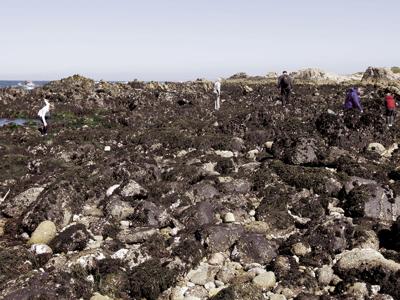

There it is, right in front of our noses, a most dramatic collision of natural forces, drenched with life and death. Yet it draws essentially zero attention from those of us closest to it.
That just doesn’t do justice to the California coast’s intertidal zone – the prime context for summer tidepooling adventures – at least according to some of the foremost naturalists on land and sea.
One of them is legendary thinker and sociobiologist E.O. Wilson. When he wrote of humans exploring the forest, he felt they often missed the real show: In the urge to spot megafauna like bears and deer, they missed the microfauna all around them – the bugs, bacteria, fungi and countless other species teeming under a rock or at the base of a tree.
Jim Covel gets that. He’s the director of interpretation at Monterey Bay Aquarium, and he describes “exactly the same thing” happening along the rocky shores of Monterey Bay.
“There are just so many fascinating animals that get overlooked,” he says. “You can crawl on hands and knees over just 12 feet and never get bored.”
Our eyes, he adds, tend to look at the tidepool sculpins darting around or the big colorful sea star, instead of the endless creatures tucked tightly underneath rocks, especially at low tide.
“They blend in so well,” Covel says. And the fact they do blend in is what helps keep them safe from predators: “So many animals’ success is tied to going unnoticed,” he says.
But the real wow that so many miss hails as much from a lack of imagination as attention to detail: We struggle to envision, let alone appreciate, what it’s like when the sea swells several feet higher and the environment changes drastically.
“It’s a whole different life, and it happens twice a day,” he says. “These animals are so rugged and fragile at the same time, living for years and years, taking this battering of heat and crashing waves.”
Covel marvels at the staying power of the giant green anemones (“Some are well over 100 years old!”) and the tenacity of hermit crabs (“Theirs is a constant tug of war, always battling for better housing”). But he also warns against disturbing them with the poke of a finger or stray foot, pointing out best practices for the health of humans and intertidal types. Here are Covel’s quick tips for an exploratory day of tidepooling:
~ Know your ocean.
Check tide levels (he likes the app Tide Track because it shows more than highs and lows). Go when it’s low. And don’t turn your back on the sea.
~ Go bare.
Step on bare rock where there’s likely nothing living there. There’s probably something living under that seaweed or algae, and it prefers not to be stepped on. Plus, it’s slippery to boot.
~ Look closely.
Get low and really peer into the pools and under the rocks. As Covel says, “You have to get on that level.”
~ Stay hands free.
Even displacing a rock to look underneath has big potential consequences for small animals: When the tide comes in, it could be sent rolling around, wreaking havoc on creatures and their homes.





(0) comments
Welcome to the discussion.
Log In
Keep it Clean. Please avoid obscene, vulgar, lewd, racist or sexually-oriented language.
PLEASE TURN OFF YOUR CAPS LOCK.
Don't Threaten. Threats of harming another person will not be tolerated.
Be Truthful. Don't knowingly lie about anyone or anything.
Be Nice. No racism, sexism or any sort of -ism that is degrading to another person.
Be Proactive. Use the 'Report' link on each comment to let us know of abusive posts.
Share with Us. We'd love to hear eyewitness accounts, the history behind an article.