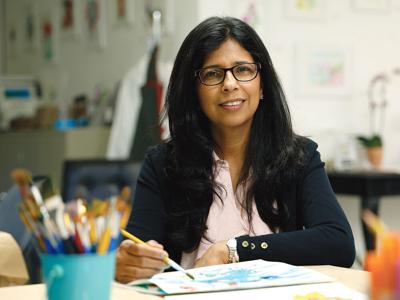
SOMETIMES, ALL IT TAKES is a little help for one person to transform lives. This artist used her own pain of exclusion as an immigrant to build a community for those Americans who are often the least visible in our society: people with disabilities.
Born in the small town of Punjab in northern India, Ritika Kumar was part of a big business-oriented family where women didn’t work.
Despite the conservative environment around her, she was allowed to pursue art, which she did for a while in Mumbai. She chose her own husband and early on in the marriage, he got a job in the United States, a country they heard so much about. She was 26 when they arrived in Dallas, Texas and the plan was to stay a few years and then return home. It was immediately clear to her that the U.S. offered women more rights, but the independence – living as a nuclear family as opposed to a big clan full of close-living cousins “so that you never have to set a play day or arrange for a sleepover,” Kumar, now a mother of a 16-year-old son, says – comes with a cost: a person has to do everything by themselves.
The young couple moved to California in 2009 and Kumar was blown away – and still is – by the beauty of the state. But while in Texas, she had a large Indian community around her, whereas here, she was forced to make new friends. She noted that she experienced exclusion in Texas: “Some people are clear about how they feel about you,” she says. “You know, this whole ‘immigrants steal jobs’ rhetoric, despite that I barely worked, not having a work authorization.”
A speaker of three languages (Punjabi, Hindi and English), Kumar suddenly found that she had problems communicating and making friends. It was hard to understand why she was not accepted because she always thought she was such a wonderful person, she says with laughter.
The plan was to establish herself as an artist in the new country, but soon Kumar, now living in Pacific Grove, started to volunteer at her son’s school, loved it and ended up teaching art to children in various local schools and institutions.
At one of them, she was asked to work with people with disabilities and the experience was a breakthrough in her life.
“To see how someone grows because of you is magic,” she says.
Still, the ratio of one teacher for 40 students was far from ideal. That’s the reason she eventually started her own nonprofit, Art Abilities, a space in Pacific Grove where she and other art teachers work with people with physical and mental challenges in small groups – one art teacher per three students.
“Actually, the real reason was Paul,” she says, referring to her autistic student Paul Landman.
Landman was the first student she felt she helped through art classes. Seeing him thriving and now even selling his art made her believe in herself, and Landman’s family played a crucial role in convincing Kumar she could start her own nonprofit.
The technique of work she uses is called adaptive art and Kumar saw it at work at the Creativity Explored nonprofit in San Francisco. That was exactly what she wanted to do, she realized.
“I experienced inclusion for the first time,” she says candidly. “My students don’t care about the color of my skin or my accent. You know how they say the language of the universe is feeling? I’m a very emotional person and this work is a perfect fit for me.”
Despite hiring other art teachers to help her with the workload and moving to a bigger space, Kumar says she works and thinks about Art Abilities day and night.
“It brings me more joy to sell my students’ art than my own,” she says, when asked about her own artistic pursuits.

(0) comments
Welcome to the discussion.
Log In
Keep it Clean. Please avoid obscene, vulgar, lewd, racist or sexually-oriented language.
PLEASE TURN OFF YOUR CAPS LOCK.
Don't Threaten. Threats of harming another person will not be tolerated.
Be Truthful. Don't knowingly lie about anyone or anything.
Be Nice. No racism, sexism or any sort of -ism that is degrading to another person.
Be Proactive. Use the 'Report' link on each comment to let us know of abusive posts.
Share with Us. We'd love to hear eyewitness accounts, the history behind an article.