
“ARE YOU A DOG PERSON OR A CAT PERSON?”
This is a standard question when asked which pet binary people fall into.
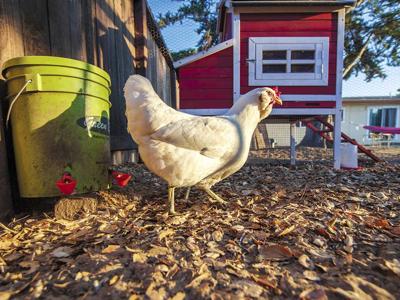
“I’m a chicken person.” My answer catches people with a reaction of surprise – chickens as pets? People are accustomed to chickens as livestock – they lay eggs, or are “grown” and “harvested” as food. But like any cat-doting or dog-loving parent I reply, “I’m obsessed! Want to see photos?!” and I pull out my phone before they can give an answer. There’s also a chicken tattoo on my wrist, but that’s a different story.
Laying hens offer an important part to the circle of life that is a backyard farm – the chickens lay eggs; eggshells and other vegetable scraps are composted in the yard; compost is used in the garden beds to help grow vegetables and the chickens scrounge through the yard for bugs and aerate the soil as they dig. There’s something relaxing and Old World about sitting in the garden on a sunny day while my hens wander through the yard, clucking as they go.
Besides, chickens, similar to dogs and cats, have an array of personalities. My speckled Sussex named Pretzel – a large bird, weighing around eight pounds – absolutely hates being touched and will run away clucking anytime a person comes close. She lays eggs equivalent to a grocery store jumbo brown.
On the other hand, Waffles loves sitting on my lap and nuzzles into my shirt. She’s a Silkie bantam – a category of smaller birds, weighing around three pounds – and lays eggs in keeping with her size. They’re about the size of a golf ball. Also in my flock is Yogurt, a very needy lavender Sussex, who, similar to Pretzel, is a fluffy English breed that resembles a pile of feathers with a beak and feet.
Chris Olow agrees that chickens can be more than livestock. He and his wife have co-owned Hacienda Hay & Feed in Carmel Valley for 20 years.
“They follow you around the yard and they have different personalities,” he says. And there is the egg-making benefit to boot: “They give you a present every day.”
Aside from hay and horse supplies, Olow says 80 percent of his chicken-related sales are for backyard chicken farmers. He sells about 2,500 chicks a year. Most urban chicken farmers are small-scale, with four or fewer birds.
The city of Seaside allows no more than four adult animals (including dogs, cats and hens) per household. Pacific Grove and Del Rey Oaks (where there’s a five-bird max) require permits for chickens. Monterey allows fowl as long as they’re enclosed. In Salinas, all “livestock” – chickens included – is prohibited, but city officials are considering a chicken ordinance to join in the backyard bird trend.



(0) comments
Welcome to the discussion.
Log In
Keep it Clean. Please avoid obscene, vulgar, lewd, racist or sexually-oriented language.
PLEASE TURN OFF YOUR CAPS LOCK.
Don't Threaten. Threats of harming another person will not be tolerated.
Be Truthful. Don't knowingly lie about anyone or anything.
Be Nice. No racism, sexism or any sort of -ism that is degrading to another person.
Be Proactive. Use the 'Report' link on each comment to let us know of abusive posts.
Share with Us. We'd love to hear eyewitness accounts, the history behind an article.